Stained glass church windows: meaning, history, and care
Stained glass church windows: meaning, history, and care
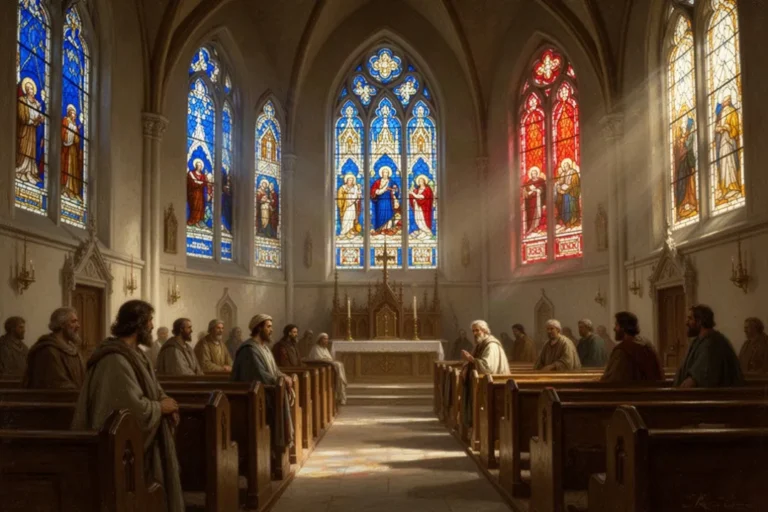
Stained glass church windows combine colored glass, leading, and architectural design to tell sacred stories, honor individuals, and shape the atmosphere of worship. Their images may portray biblical scenes, saints, symbols, local history, or patterns chosen mainly for beauty and light.
To understand a church window, look at three things together: the subject shown, the symbols surrounding it, and the way daylight changes its appearance. A window can function as religious teaching, a memorial, a record of community life, and an important piece of architectural history at the same time.
Stained glass became especially valuable in churches because it brings colored light into a space designed for prayer and gathering. Instead of treating windows as plain openings, builders and artists used them to give the interior a distinct visual language. Sunlight passing through ruby, cobalt, amber, and green glass can make the room feel different from one hour to the next.
Many windows also served a teaching purpose. In periods when many worshipers could not read, a sequence of images could communicate stories from the Bible and the lives of important Christian figures. A scene such as the Annunciation, the Nativity, the Crucifixion, or Pentecost could be recognized through visual details even when no words were present.
Church windows can also preserve memory. A memorial inscription may identify a person, family, pastor, Sunday school class, military group, or congregation that helped fund the work. The window therefore connects private remembrance with the public life of the church.
Look beyond the central figure: borders, flowers, animals, tools, heraldic symbols, and small inscriptions often reveal why a window was commissioned and who paid for it.
What the colors and symbols in church windows mean
Color symbolism varies by denomination, period, artist, and region, so no single meaning applies to every window. Still, certain associations appear often enough to provide a useful starting point. The surrounding composition matters just as much as the color itself.
Blue is frequently associated with heaven, faith, purity, or the Virgin Mary, although its use may also be artistic or regional.
Red can suggest love, sacrifice, martyrdom, fire, or the work of the Holy Spirit.
White and clear glass may represent purity, light, glory, or simply provide contrast and brightness.
Green is often linked with life, renewal, creation, and hope.
Purple may refer to royalty, penitence, preparation, or solemnity.
Gold and yellow commonly create associations with divine light, holiness, celebration, or heavenly radiance.
Symbols can make the subject more specific. A dove may refer to the Holy Spirit, while a lamb can represent Christ or sacrifice. A vine may evoke spiritual life and connection, and a crown may indicate royalty, martyrdom, or victory. A lily is often connected with purity, while a cross identifies Christian faith in one of its most recognizable forms.
Some symbols refer to a particular person. Saint Peter may be shown with keys, Saint Paul with a sword, and Saint Catherine with a wheel. These attributes are not universal rules, but they can help you identify a figure when the window includes no caption.
Common subjects shown in stained glass church windows
Designers often choose subjects that fit the church’s theological tradition, dedication, history, or physical setting. A church named for a saint may feature that saint prominently. A parish with a strong missionary history may display scenes of service, travel, or community outreach.
Biblical scenes and Christian festivals
Windows frequently illustrate stories from both the Old and New Testaments. Well-known scenes are particularly effective because viewers can recognize them through a small number of visual clues. Noah’s Ark, Moses with the tablets, David with a harp, the Good Shepherd, and the empty tomb are examples of subjects that may appear in different artistic styles.
Liturgical seasons also influence commissions. Advent and Christmas windows may show prophecy, the Nativity, angels, or the journey of the Magi. Lent and Easter themes often include the Passion, the Crucifixion, burial, Resurrection, or symbols such as a crown of thorns.
Christ, Mary, saints, and angels
Images of Christ may emphasize different aspects of Christian belief. He may appear as teacher, shepherd, ruler, infant, crucified Savior, or risen Lord. Mary may be portrayed in scenes from the life of Jesus or through titles and symbols associated with her in a particular tradition.
Saints and angels can indicate the church’s dedication or express a congregation’s values. An image of Saint Francis may point toward care for creation and service to the poor, while an angel holding a trumpet may refer to resurrection or divine proclamation. These interpretations should be checked against inscriptions and local records rather than assumed from appearance alone.
Geometric, floral, and abstract designs
Not every church window tells a narrative. Geometric patterns can fill a large architectural opening, create visual rhythm, and harmonize with stone or wood details. Floral designs may represent growth, seasonal worship, local plants, or general beauty without referring to one specific passage.
Abstract windows became especially common in some modern churches. Their colors, lines, and shapes may communicate movement, peace, joy, or contemplation without depicting recognizable figures. The absence of a literal scene does not mean the window lacks religious purpose.
Traditional stained glass begins with a design drawing called a cartoon or full-size working pattern. The artist plans the composition, decides where each piece of glass will go, and marks the locations of the leading that will support the finished window.
The design is then divided into individual shapes. The artist selects glass for color, transparency, texture, and surface effect. Some pieces are cut from colored glass made with metallic additives, while others may be painted or treated to add facial features, folds in clothing, lettering, shading, or architectural details.
In the traditional leaded-glass method, the pieces are fitted into channels in strips of lead called cames. The joints are soldered so the network holds together, and cement or glazing compound may be worked beneath the lead to weatherproof and stabilize the panel. A reinforcing bar or frame can provide additional support, especially for a large window.
Another method uses copper foil. In that process, each piece is wrapped with thin copper foil before being assembled and soldered. Copper-foil construction is useful for detailed objects and smaller panels, while leaded glass is strongly associated with architectural windows and broad structural compositions.
Modern studios may also use insulated glass units, laminated layers, protective glazing, or structural systems that were not available to medieval and nineteenth-century makers. These techniques can improve safety and energy performance, but they must be selected carefully so the historic appearance and ventilation needs of an older window are not harmed.
How to read a stained glass church window
Begin with the overall design rather than trying to identify every detail immediately. Ask what your eye notices first: a human figure, a strong color, a cross, a central medallion, or a bright opening. The focal point usually reflects the main subject, while the border and corners provide supporting information.
Next, examine the composition. Is the window organized vertically, like a series of figures stacked above one another? Does it use circular medallions, panels, arches, or a symmetrical pattern? A sequence of scenes may be read from left to right, bottom to top, or according to a path suggested by the figures and gestures.
Look for inscriptions along the bottom edge or in a banner. Names and dates can identify a donor or memorial subject, but an inscription may also refer to a biblical passage, church anniversary, organization, or dedication. If the lettering is difficult to read, take a photograph from a respectful distance and enlarge it later rather than standing directly against the glass.
Identify the main subject by observing figures, gestures, objects, and clothing.
Check the border and corners for symbolic plants, animals, tools, shields, or initials.
Read any inscription and record names, dates, and unusual spellings accurately.
Compare nearby windows to see whether they form a series or share an artist and donor.
Ask the church or local historical group for records before drawing firm conclusions.
Keep in mind that a window can contain both intentional symbolism and decorative choices. An artist may select a color because it expresses an idea, balances the composition, or remains visible in a dim interior. Good interpretation leaves room for all three possibilities.
Historical periods and styles to recognize
The stained glass visible in American churches comes from many periods. Older windows may have been imported from Europe, made by domestic studios, or installed in buildings that were later expanded. Style alone cannot establish an exact date, but it can suggest questions for further research.
Medieval-inspired windows
Many nineteenth-century churches adopted designs inspired by medieval architecture and art. These windows often feature strong outlines, richly colored glass, narrative panels, quatrefoils, tracery, and figures arranged beneath canopies. The style may be associated with Gothic Revival buildings, though similar motifs can appear elsewhere.
Medieval glass itself is usually found in historic European churches, museums, or carefully preserved fragments. It may have irregular textures, small pieces, and surface variation caused by the materials and methods of its time. A modern window that imitates this appearance is not necessarily medieval.
Victorian and academic studio work
Victorian windows may combine realistic faces and clothing with elaborate borders, painted details, and strong architectural framing. Some were produced by large studios using designs created by specialist artists and assembled by teams of craftspeople. The studio name may appear discreetly in a corner or on a plaque, but many windows have no visible maker’s mark.
Academic or ecclesiastical styles often emphasize carefully modeled figures and clear storytelling. Their designs may reflect European traditions while incorporating local donors, American landscapes, or denominational preferences.
Arts and Crafts windows
Arts and Crafts designers generally valued visible craftsmanship, natural motifs, and the relationship between art and architecture. Their windows may use stylized flowers, trees, birds, vines, or simplified figures. The design can feel less crowded than a highly pictorial Victorian window, with texture and lead lines contributing strongly to the effect.
Modern and abstract church glass
Twentieth- and twenty-first-century windows may use simplified forms, unexpected color combinations, faceted glass, or nonfigurative compositions. Some respond directly to modern architecture, with broad areas of color designed to be seen from a distance. Others commemorate social events, local identity, or a congregation’s changing understanding of worship.
Do not date a window by appearance alone. Repairs, replacement glass, protective coverings, and later restorations can make an older window look newer—or make a modern window appear historic.
Where stained glass church windows are usually located
Windows are placed according to architecture, lighting, worship practices, and the story the congregation wants to tell. The large window behind an altar or chancel often receives special attention because it serves as a visual focal point. It may show Christ, a cross, a patron saint, or a design connected with the church’s dedication.
Side aisles may contain a sequence of smaller windows. These can represent the life of Jesus, the seasons of the church year, saints, donors, or local organizations. Clerestory windows, positioned high in the walls, may use repeated geometric or floral patterns because they are viewed from farther away.
Rose windows and other circular designs are especially associated with Gothic and Gothic Revival architecture. Their radial divisions create an organized pattern that works with the building’s structure. Smaller windows near entrances, chapels, baptisteries, and choir areas may have specialized subjects connected with those spaces.
Practical tips for viewing and photographing church windows
Churches are active places of worship, so viewing should fit the building’s schedule and customs. Contact the congregation before visiting if you want time to study or photograph the windows. Some sanctuaries have limited hours, restricted photography, or services and ceremonies that take priority.
Visit at different times of day if possible; sunlight direction changes color and contrast.
Ask permission before using a tripod, flash, or specialized equipment.
Turn off flash unless church staff specifically approve it; flash can disturb worship and rarely improves a backlit window.
Photograph the full window first, then capture details such as inscriptions and maker’s marks.
Record the church name, location, window position, and date of your visit.
Use a respectful distance and avoid touching frames, walls, or protective glazing.
Compare the window with exterior light conditions before judging its colors.
For a clearer photograph, keep the camera parallel to the window when possible. A bright sky behind the glass can make the colors look pale, while a cloudy day may reveal texture and painted details more evenly. Editing should correct exposure and perspective rather than change the original colors.
Common mistakes when identifying or caring for stained glass
Curiosity is helpful, but careless handling can damage fragile glass and historic frames. Stained glass may look solid from across a room while containing cracked pieces, loose lead, failed cement, or previous repairs that are difficult to see.
Do not clean the glass yourself with household sprays, paper towels, or abrasive materials.
Do not assume every colored pane is original. Replacement pieces may match the design without matching the age.
Do not scrape paint or putty from the frame. Historic finishes and seals can be lost easily.
Do not remove a panel for inspection without a trained conservator or experienced stained-glass professional.
Do not rely on one visual clue to identify an artist, saint, or date.
Do not install interior or exterior protective glazing casually. Poorly designed systems can trap moisture and accelerate deterioration.
One of the most common interpretive mistakes is treating a symbol as if it has one fixed meaning everywhere. A lily might be a religious reference, a family emblem, a decorative flower, or all three. Reliable identification combines visual analysis with church minutes, dedication records, donor histories, newspaper reports, architectural surveys, and conservation documents.
How churches preserve historic stained glass
Preservation starts with documentation. A church should photograph each window, note its location and dimensions, record visible damage, and gather any information about its maker, donor, installation date, and previous repairs. A basic inventory can prevent confusion when several windows share similar patterns.
A qualified stained-glass conservator or specialist contractor can then assess the window. The assessment may look for cracked or missing glass, bowed panels, weakened lead, corrosion, failing cement, damaged stone or wood openings, water infiltration, and inadequate external protection. The condition of the surrounding building matters as much as the glass itself.
Conservation usually aims to retain as much original material as possible. Small repairs may involve stabilizing a loose section or replacing a limited number of broken pieces. More extensive work may require careful removal, cleaning under controlled conditions, releading, selective glass replacement, and reinstallation with appropriate support.
Protective glazing can shield historic windows from weather, vandalism, and temperature changes. However, it needs a properly designed ventilation system so moisture does not become trapped between the original window and the protective layer. An energy upgrade that ignores airflow can create a long-term conservation problem.
Churches should obtain multiple professional opinions for major projects and ask for clear information about proposed methods, replacement glass, documentation, insurance, scaffolding, and warranties. A low bid may not represent the lowest long-term cost if it uses inappropriate materials or removes original fabric unnecessarily.
How congregations can fund window repairs
Stained glass projects often require substantial planning because the windows are part of a larger building envelope. Congregations may combine designated gifts, memorial funds, capital campaigns, grants, foundation support, and community fundraising. Historic status can affect eligibility, but not every historic church qualifies for the same programs.
A clear public explanation helps supporters understand the need. Photographs of damage, a condition report, a project schedule, and a description of conservation methods are more useful than a general appeal to “restore the windows.” Donors may also appreciate information about the window’s subject, history, artist, and connection to local families.
Before accepting a memorial gift or commissioning a new window, the church should create written expectations. These may cover the donor’s name, placement, subject, maintenance responsibilities, ownership, future building changes, and the process for approving the design. Good records protect both the congregation and the artwork.
Choosing a new stained glass window for a church
A new commission should begin with the building rather than a picture chosen from a catalog. The artist needs to understand the window’s size, orientation, viewing distance, structural opening, interior lighting, exterior exposure, and relationship to nearby windows. A design that works in a small chapel may become visually weak in a tall sanctuary.
The congregation should also discuss the purpose of the window. It might commemorate a person, mark a building anniversary, express a theological theme, honor a community partnership, or provide a quiet abstract focus for prayer. A specific purpose makes it easier to evaluate sketches and avoid overcrowded symbolism.
Ask prospective artists for examples of comparable architectural work, not only small decorative panels. Their proposal should explain the design concept, glass types, support system, schedule, budget, maintenance requirements, and approach to future repairs. The contract should state who owns the design, who approves changes, and how the finished window will be documented.
Accessibility matters as well. Important inscriptions should not be placed where they are impossible for most visitors to see, and the design should be legible from the intended viewing distance. A beautiful window succeeds when it belongs to the architecture and remains meaningful to the people who use the space.
How to research the history of a church window
Start with the church’s own records. Vestry minutes, board minutes, dedication programs, anniversary books, newsletters, donor lists, and memorial registers may reveal when a window was ordered and why. Older records may be held by a denominational archive, local historical society, or public library.
Search for inscriptions carefully and preserve exact wording. A person’s full name can lead to obituaries, family papers, cemetery records, or local newspaper coverage. Studio names may connect the window to other buildings in the region, but an apparent signature should be photographed and checked against reliable records.
Architectural surveys can provide information about the building and its construction phases. If the window does not match the rest of the church, it may have been installed during a renovation, transferred from another building, or replaced after damage. Oral histories can add valuable context, but they should be compared with written documentation when possible.
A window’s history is often preserved not only in the glass, but also in the records of the people who gathered beneath it.
When sharing research online or in a church program, separate confirmed facts from interpretation. You can write that a window “is documented as a memorial to” someone when records support that claim, while describing an uncertain symbolic reading as a possibility. That distinction keeps the story accurate without making it less engaging.
Why stained glass still matters in churches
Stained glass remains useful because it works on several levels at once. It can direct attention, soften daylight, mark a sacred place, and give a congregation a visible connection to its past. Figurative windows can teach and remember, while abstract designs can support quiet reflection without prescribing a single interpretation.
Each window also changes with weather, season, and time of day. The same blue panel may look cool and subdued on an overcast morning, then glow intensely when sunlight reaches it in the afternoon. That changing quality is part of the medium’s character and one reason photographs cannot fully replace seeing the window in its architectural setting.
Whether you are visiting a historic sanctuary, researching a family memorial, planning repairs, or selecting a new commission, the most useful approach combines careful observation with documented history. Treat the glass as artwork, architecture, religious expression, and community record at the same time.
Frequently asked questions
Are all stained glass church windows religious?
Many are designed around biblical stories, saints, Christian symbols, or themes connected with worship. Others use abstract, floral, geometric, or memorial designs without a specific religious scene. Even a nonfigurative window may have been commissioned to express faith, mark a church anniversary, honor a donor, or create a contemplative atmosphere. Its purpose is best understood through church records and local context.
How can I tell how old a church window is?
Start with inscriptions, dedication plaques, church minutes, anniversary publications, and architectural records. Style can suggest a period, but it cannot prove a date because later windows often imitate older designs, and historic windows may contain replacement glass. A stained-glass conservator or architectural historian can examine construction methods, lead, glass, paint, and installation details more reliably.
What should I do if a church window is cracked or leaking?
Keep people away from any loose or falling material and notify church leaders promptly. Do not tape, clean, remove, or patch the window yourself. The building owner should arrange an assessment by a qualified stained-glass conservator or experienced specialist, while also checking the surrounding masonry, wood, roof, and drainage for the source of the problem.
Can stained glass windows improve a church’s energy efficiency?
Historic stained glass itself usually provides little insulation, so a carefully designed protective glazing system may reduce drafts and shield the original panel. The system must allow appropriate ventilation and prevent condensation from becoming trapped. Churches should obtain a professional assessment before adding storm panels or replacing original windows, since poorly planned upgrades can cause moisture damage and alter the building’s appearance.











Leave a Reply