Have you seen the word pietà in a museum label, church guide, or art-history book and wondered what it means? In its simplest sense, a pietà is an image of the Virgin Mary holding the dead body of Jesus after the Crucifixion. The word comes from the Italian for pity, compassion, or tenderness, but the image carries several emotions at once: grief, love, reverence, and hope.
The subject is not described in detail in the Bible. Instead, it developed from Christian meditation on the moments between Jesus’ death and burial. Artists used Mary’s sorrow to help viewers contemplate Christ’s sacrifice and the human cost of violence. The best-known example is Michelangelo’s Vatican Pietà, a marble sculpture in St. Peter’s Basilica, but the subject appears in many styles, countries, and materials.
In Italian, pietà refers to pity, compassion, or devoted feeling. In art history, the word usually identifies a specific devotional subject: Mary mourning over Christ’s body, often while supporting him across her lap. In English, the term is commonly pronounced “pee-eh-TAH,” although pronunciation can vary depending on whether a speaker is using Italian or an English art-history convention.
A pietà does not show the Crucifixion itself. Christ has already been taken down from the cross, yet he has not necessarily been placed in the tomb. This suspended moment gives the image its distinctive emotional power. The viewer is invited to pause with Mary rather than watch the violence that caused her grief.
The subject also creates a visual connection between the beginning and end of Jesus’ earthly life. Mary often appears youthful in pietà images, even though she would be older than her adult son. That choice is not simply an attempt at realistic portraiture. It can suggest her timeless purity, the enduring nature of maternal love, or the way sacred art places spiritual meaning above ordinary chronology.
Quick definition: A pietà is a Christian image of the Virgin Mary grieving over and supporting the dead Christ, usually after his descent from the cross and before his burial.
How the pietà subject developed in medieval Europe
The pietà became especially important in European Christian art during the late Middle Ages. Its development is often associated with the Vesperbild, a German devotional image showing Mary with Christ’s body on her lap. Early examples could be stark and physically forceful, emphasizing the weight of the dead body, the wounds of the Passion, and Mary’s intense sorrow.
The Vesperbild was connected with evening devotion, particularly meditation on Christ’s death. The name derives from vespers, an evening prayer service, though not every image called a pietà had the same function or exact design. As the subject spread, artists adapted it to local traditions, materials, and ideas about religious feeling.
Medieval viewers were often encouraged to imagine themselves present at sacred events. A pietà made that meditation personal. Rather than presenting Christ at a distance as a triumphant ruler, it placed the viewer before a vulnerable human body and a mother’s grief. The image could support prayer, repentance, compassion, and reflection on resurrection.
Artists gradually produced many different compositions. Mary might hold Christ across her lap, kneel beside him, or support only his upper body. Angels, saints, donors, or the instruments of the Passion could appear around them. Some works are quiet and restrained; others emphasize dramatic gestures, twisted bodies, blood, and visible wounds.
What a pietà represents to Christian viewers
A pietà can be read on several levels at once. At the most immediate level, it shows maternal mourning. Mary’s sorrow makes the death of Jesus emotionally accessible, especially for viewers who have experienced bereavement or cared for someone in pain.
At the theological level, the dead Christ remains the central figure. His body recalls the Crucifixion, while his placement in Mary’s arms points toward the burial and, for Christians, the promise of resurrection. The image therefore holds death and hope together without removing the reality of grief.
The subject can also encourage an understanding of Mary as a participant in Christ’s suffering. Christian traditions describe her as present near the cross, and later devotional art gives visual form to her compassion. This does not mean that every pietà makes the same theological claim. Meaning depends on the period, denomination, patron, setting, and details chosen by the artist.
Physical closeness is another important feature. Mary touches Christ, supports his head, or steadies his torso. These gestures communicate care after catastrophe. The image is not only about a dead body; it is about the relationship between two people and the tenderness that remains when words and action can no longer change the outcome.
How to tell a pietà from related Christian scenes
Several artworks show Mary or other followers mourning Christ, so it helps to distinguish the subjects. A pietà normally centers on Mary and the dead Christ in a relatively compact arrangement. The exact pose may change, but the mother-and-son relationship remains the visual focus.
Descent from the Cross: Christ is being removed from the cross. Figures may include Joseph of Arimathea, Nicodemus, Mary Magdalene, John, and other followers.
Lamentation: A larger group mourns Christ after his death. Mary may be present, but angels, disciples, and women often surround the body.
Entombment: The figures carry or place Christ’s body in the tomb. The scene emphasizes the burial rather than a private moment of maternal grief.
Mater Dolorosa: This means “sorrowful mother” and usually depicts Mary alone in grief, without Christ’s body in her arms.
Man of Sorrows: Christ is shown alone, often displaying his wounds, rather than being supported by Mary.
These categories are useful guides rather than rigid rules. An artist may combine elements from different devotional traditions. Museum labels can also use broader terms, especially when a damaged or unusual work does not fit one standard composition.
Why Michelangelo’s Pietà is so famous
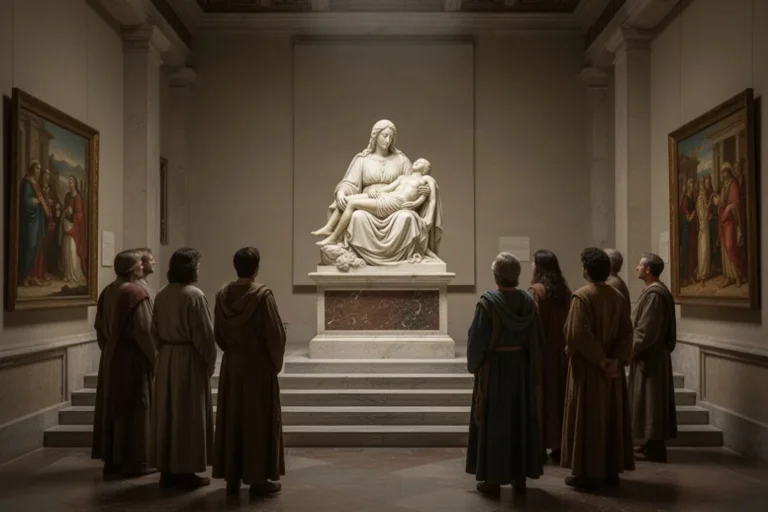
Michelangelo’s Pietà is the most widely recognized work associated with the subject. He carved it in Rome between 1498 and 1500 for the French cardinal Jean de Billheres. The sculpture was made from marble and is now displayed in St. Peter’s Basilica in Vatican City, behind protective glass.
Michelangelo shows Mary seated and holding Christ’s body across her lap. Christ’s torso bends gently, while one arm falls downward and his hand remains open. Mary’s left hand extends outward in a restrained gesture that can suggest sorrow, acceptance, or an appeal to the viewer. The composition is carefully balanced, even though it represents the weight and disorder of death.
The sculpture’s polish and anatomical detail are central to its effect. Christ’s body appears physically convincing, yet the surface has a quiet smoothness that gives the marble a luminous quality. Mary’s broad drapery creates a stable base, making it possible for the adult Christ to rest across her lap without the group appearing unstable.
Michelangelo also made Mary appear unusually youthful. Many viewers notice that she seems close in age to Christ rather than old enough to be his mother. The choice can be interpreted as an expression of her purity or as a way to present her as eternally beautiful. It also helps the sculpture avoid the visual distraction of advanced age and keeps attention on the emotional and spiritual relationship between mother and son.
Unlike some earlier pietà images, Michelangelo’s sculpture does not focus on graphic wounds or uncontrolled anguish. The sorrow is measured, dignified, and inward. Mary looks down at Christ, but her face does not become a theatrical display of despair. That restraint has helped the work communicate across different audiences and centuries.
Details to notice in Michelangelo’s Vatican Pietà
The sculpture rewards slow looking. Its apparent simplicity depends on many carefully controlled choices. Start with the overall shape: Mary and Christ form a broad triangular composition, with Mary’s head near the apex and the folds of her clothing spreading toward the base.
Then examine the difference between their bodies. Christ is fully adult and physically heavy, while Mary’s proportions and expansive clothing make her seem larger. This is partly a practical solution to the problem of supporting an adult figure on a seated woman’s lap. It also creates a visual hierarchy in which Mary becomes a sheltering space for Christ.
Look at Christ’s right hand and arm. The relaxed hand and exposed palm reinforce the fact that he is dead. The marks of the Passion are present but not exaggerated, allowing the sculpture to communicate vulnerability through posture rather than gore.
Mary’s face is another important detail. Her expression is sorrowful but controlled, and her downward gaze keeps the relationship intimate. She does not look directly at the viewer. Instead, her attention remains with Christ, while the viewer becomes an observer of a private act of mourning.
Michelangelo signed the work across the sash on Mary’s chest. The inscription identifies him as the artist, and the sculpture is generally regarded as his only signed work. The signature is unusual partly because Renaissance artists did not always sign major works in such a prominent way. It may also reflect the importance of the commission and the young sculptor’s desire to establish his authorship.
Other important versions of the pietà
The Vatican sculpture is famous, but it does not define every possible pietà. Comparing other works reveals how flexible the subject can be and how different artists respond to the same emotional structure.
Michelangelo returned to the theme more than once. The Florentine Pietà, also called the Bandini Pietà, is a later and more complex group in which several figures support Christ. It has a rougher, more troubled appearance than the polished Vatican work. The sculpture is associated with the Museo dell’Opera del Duomo in Florence.
Michelangelo’s Rondanini Pietà, now in Milan’s Castello Sforzesco, is radically different again. The figures are elongated, narrow, and unfinished in places. Mary appears to merge with or support Christ in a way that reduces the separation between the two bodies. The unfinished surface makes the work feel searching and physically unresolved rather than classically complete.
Across Europe, artists created pietàs in wood, stone, terracotta, painted panels, and other materials. Northern European examples often preserve the intense physicality of medieval devotion, while Italian Renaissance works may emphasize balance, ideal beauty, and controlled anatomy. Later artists used the subject to explore theatrical grief, social violence, war, and private loss.
Modern and contemporary artists have also reinterpreted the composition. Some replace the traditional figures with ordinary people, victims of conflict, or abstract forms. Others retain the recognizable mother-and-child arrangement while questioning how images of suffering are viewed. In each case, the basic structure remains powerful because it joins personal mourning with a larger meditation on death.
How to look at a pietà in a museum or church
You do not need specialized training to understand a pietà. Begin by identifying the figures and their physical relationship. Ask whether Mary supports Christ, whether he is shown as clearly dead, and whether other figures change the scene from a private lament into a larger narrative.
Next, consider the artist’s treatment of emotion. Is Mary looking at Christ, looking toward heaven, or facing the viewer? Does Christ appear heavy, rigid, relaxed, or almost weightless? These choices tell you whether the work emphasizes grief, theological hope, bodily suffering, tenderness, or a combination of them.
Material and scale also matter. A small wooden sculpture may have been intended for close personal devotion, while a monumental marble group could shape the experience of a chapel or public church interior. Surface details such as paint, gilding, tool marks, and polished areas can reveal how viewers originally encountered the work.
Finally, inspect the setting. A pietà in a side chapel may invite quiet prayer, while one in a museum is usually approached as a historical object and work of art. Neither setting eliminates the other meaning. The same sculpture can be artistically significant, devotional, historically important, and emotionally affecting at the same time.
Practical tips and common mistakes when discussing a pietà
Clear terminology helps when you are writing about a work, studying for an art-history class, or interpreting a museum label. The following points prevent several common misunderstandings.
Use the accent: Write pietà when possible. The accent distinguishes the Italian term and signals the final stressed syllable.
Do not call every grieving scene a pietà: Check whether Mary is supporting the dead Christ. A crowded scene may be a Lamentation instead.
Do not assume the scene is directly narrated in the Bible: The specific image of Mary holding Christ after the Crucifixion developed through later Christian devotion and artistic tradition.
Separate subject from artist: “The Pietà” often means Michelangelo’s Vatican sculpture, but “a pietà” can refer to many artworks with the same subject.
Look beyond sadness: Include compassion, physical tenderness, sacrifice, burial, and hope when interpreting the image.
Be careful with Mary’s age: Her youthful appearance in some works is usually an intentional symbolic or compositional choice, not a realistic portrait.
Describe what you can see before making claims: Mention pose, gesture, wounds, clothing, scale, and material before assigning a precise theological meaning.
One frequent mistake is treating Michelangelo’s version as the original or standard form. The subject had already existed in European devotional art for centuries. His sculpture is exceptionally influential, but it represents one Renaissance solution to a much older religious and artistic question.
Viewing tip: Compare the handling of Christ’s weight and Mary’s gesture. Those two details often reveal whether an artist wants the scene to feel intimate, dramatic, physically painful, or spiritually serene.
Why the pietà continues to resonate
The enduring power of the pietà comes from its ability to hold different experiences together. It is a Christian image rooted in the Passion, yet its central relationship is immediately human: someone is grieving over a person who can no longer respond. The scene gives physical form to the care that remains after death.
Its silence also matters. Unlike scenes filled with shouting, crowds, or action, a pietà often shows what happens after the decisive event. The violence has ended, but its consequences cannot be undone. That pause gives viewers room to think about responsibility, loss, compassion, and the treatment of vulnerable bodies.
For believers, the image may support prayer and reflection on Christ’s death and resurrection. For other viewers, it can be approached through art, history, psychology, or human experience. Its meaning does not depend on one emotional response. A person may see theological hope, maternal grief, formal beauty, political symbolism, or all of these at once.
When you encounter the word pietà, the most useful starting point is therefore both precise and broad: it identifies the image of Mary mourning and supporting the dead Christ, while opening onto a long tradition of thinking about compassion, suffering, and love after loss.
Frequently asked questions
Is a pietà the same as a Lamentation?
No. A pietà usually focuses on Mary supporting or mourning over the dead Christ, often in a relatively compact composition. A Lamentation generally includes a larger group of mourners, such as disciples, angels, or holy women. The terms can overlap in casual descriptions, but the number of figures and the central relationship help distinguish them.
Where is Michelangelo’s Pietà located?
Michelangelo’s most famous Pietà is in St. Peter’s Basilica in Vatican City. It is displayed behind protective glass in a chapel near the entrance area. The sculpture was created in Rome around the turn of the sixteenth century and remains one of the best-known works of Renaissance sculpture.
Why does Mary look young in many pietà artworks?
Artists often made Mary youthful to express spiritual purity, timelessness, or ideal beauty. A younger appearance also creates a more unified and harmonious composition with Christ. The choice is symbolic and artistic rather than an attempt to show her probable age realistically at the time of Jesus’ death.
Are all pietàs sculptures?
No. Pietàs appear as sculptures, paintings, drawings, prints, reliefs, and devotional objects. Artists have used marble, wood, terracotta, metal, and other materials. The defining feature is the subject—the Virgin Mary grieving over or supporting the dead Christ—not the medium or a particular artistic style.








Leave a Reply