Censers are containers designed to burn incense, most often in religious worship, where rising fragrance can represent prayer, reverence, purification, and offering.
The word can describe several forms of incense burner, from a small bowl used at home to a swinging metal vessel used during a church service. Their appearance and handling vary by tradition, but the basic purpose remains the same: to hold burning charcoal or another heat source while fragrant material smolders above it.
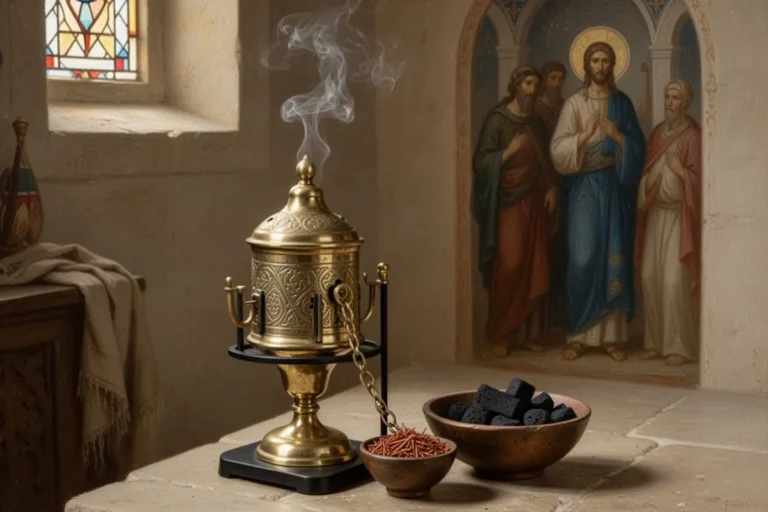
A censer is a heat-resistant vessel that allows incense to burn or smolder safely. Traditional versions usually have a bowl, a lid or open top, and openings that let smoke escape. Some are placed on a stand, while others are carried by a handle or suspended from chains.
The incense itself may be made from resins, woods, herbs, flowers, spices, or blended fragrances. Many traditional varieties use resin granules such as frankincense or myrrh, which are placed on hot charcoal. Other products are made as sticks, cones, or compressed blocks and may require a different type of burner.
When charcoal is used, the censer needs a layer of heat-resistant material, such as sand or a purpose-made ash bed, beneath it. This protects the vessel and helps distribute heat. A censer should always sit on a stable, nonflammable surface, even when its exterior does not feel especially hot.
Safety first: Burning incense creates heat, ash, and smoke. Keep a lit censer away from curtains, paper, children, pets, and unventilated rooms, and never leave it unattended.
Why censers are used in religious worship
Incense has a long history in religious practice because scent affects both the physical setting and the worshiper’s attention. Fragrance can mark a sacred action, distinguish a ceremonial space, and encourage a slower, more deliberate form of prayer.
In many traditions, rising smoke symbolizes prayer ascending toward God. The image is especially associated with Psalm 141:2 and Revelation 8:3–4, where incense is connected with prayer. These passages are often understood symbolically rather than as instructions that every worship service must include a censer.
Incense may also express honor, holiness, purification, or offering. In a formal service, a minister may incense an altar, sacred book, congregation, or other objects. The gesture does not mean that the material object is divine. Instead, it can show respect for what the object represents within that community’s worship.
Some communities use incense at nearly every solemn service; others reserve it for particular feast days, funerals, processions, or times of prayer. Many Protestant churches do not use censers at all, while some Anglican and Lutheran congregations do. Practice depends on denomination, local custom, and the character of the service.
Censers in the Bible and ancient worship
Biblical references to incense burners appear in several settings, including Israelite worship and accounts of religious conflict. The English word censer can represent different original terms and objects, so a modern metal thurible should not automatically be treated as identical to every ancient vessel mentioned in a translation.
In the Hebrew Bible, incense was part of the worship system associated with the tabernacle and later the Temple. Exodus 30 describes a dedicated altar for burning incense, along with rules concerning its preparation and use. The account emphasizes that sacred incense was not simply an everyday household fragrance; it had a particular ritual purpose.
Numbers 16 describes censers in the story of Korah’s rebellion. The vessels become part of the dispute over legitimate priestly authority, and the passage presents ritual objects within a larger teaching about worship and obedience. The censers in that account are not merely decorative accessories.
The New Testament also uses incense imagery. In Luke 1, Zechariah serves in the Temple during a time when people are praying outside. Revelation 8 presents incense together with the prayers of the saints. These scenes help explain why later Christian worshippers may see a censer as a visual reminder of prayer, even though Christian groups interpret and practice incense differently.
How Catholic, Orthodox, and Anglican traditions use censers
In Roman Catholic worship, the most familiar censer is the thurible, a metal container suspended from chains. A priest, deacon, or trained server may use it during Mass, processions, funerals, the Liturgy of the Hours, or other solemn celebrations. The exact moments of use are governed by liturgical practice rather than personal preference.
The thurible may be used to incense the altar, the bread and wine, the Gospel book, the cross, ministers, and the congregation. Each action has a ceremonial meaning, and the pattern of swings can be prescribed by local rubrics. The incense is generally placed on live charcoal by the person presiding or by an assisting minister.
Eastern Orthodox and Eastern Catholic churches commonly use a censer called a katzion or katsioni, often translated simply as a censer or thurible. It usually has chains and may include small bells. Incense is used extensively during the Divine Liturgy, Vespers, Matins, processions, and other services, with the priest or deacon censing the altar, icons, clergy, congregation, and sometimes the entire church.
In Orthodox practice, censing is often understood as an act of blessing and honor as well as a representation of prayer. The use of incense can also help mark the church as a consecrated space. Customs differ among jurisdictions and parishes, so a visitor should follow the local congregation’s guidance rather than assume that every church handles a censer in the same way.
Anglican worship may use censers in churches with a more ceremonial tradition. A thurifer may carry or swing the censer during the procession, Gospel reading, Eucharist, or departure. Other Anglican congregations may use incense rarely or not at all, reflecting the broad range of worship styles within the Anglican Communion.
What different types of censers look like
Censers are designed for different settings, fuel types, and methods of use. A vessel that works well for a church procession may be unsuitable for a small apartment, while a decorative household burner may not tolerate the heat of charcoal.
Thuribles: Suspended metal censers with chains, handles, and often a fitted lid. They are commonly used in Catholic, Orthodox, Anglican, and other liturgical settings.
Open bowls: Simple vessels made from ceramic, stone, brass, or another heat-resistant material. They are often used with incense sticks, cones, or charcoal.
Covered tabletop censers: Small burners with lids or perforated tops that contain some ash and reduce the spread of loose embers.
Hanging censers: Vessels suspended from a bracket or chain, sometimes used as part of a home shrine or ceremonial arrangement.
Portable travel censers: Compact burners intended for personal prayer or small spaces. They should still have adequate ventilation and heat protection.
Electric incense devices: Appliances that warm incense without a glowing charcoal tablet. They may be useful where smoke or open flame is restricted, although they do not reproduce every traditional practice.
Materials affect both appearance and performance. Brass and bronze are common in ceremonial censers because they are durable and visually suited to formal worship. Ceramic and stone can work well for stationary use, but they may crack from thermal shock if heated too quickly or placed on a cold surface.
Some censers are highly ornate, with engraved patterns, religious symbols, enamel, or precious-metal finishes. Decoration can communicate the importance of the object, but it does not guarantee safe construction. Check the vessel’s heat resistance, stability, ventilation, and chain strength before using it.
How a traditional charcoal censer is used
Traditional loose incense is often burned on quick-lighting or natural charcoal. Quick-lighting charcoal ignites more easily, while natural charcoal may have less added ignition material but requires an external heat source. Follow the manufacturer’s directions and use tongs rather than holding charcoal in your fingers.
Prepare the location. Choose a stable, nonflammable surface in a well-ventilated area. Remove nearby paper, fabric, oils, and other combustible items.
Protect the bowl. Place sand, ash, or another recommended heat buffer in the bottom of the censer. This helps protect the vessel and makes disposal easier.
Light the charcoal carefully. Hold it with metal tongs over a heat-safe area until it begins to glow and develop a layer of ash.
Place the charcoal in the censer. Set it on the prepared bed and wait until it is hot enough for incense. Do not cover a newly lit tablet in a way that prevents proper airflow.
Add a small amount of incense. Put a few resin grains or a modest pinch on the charcoal. Too much material can create excessive smoke or extinguish the coal.
Monitor the burner. Move the censer only by its handle or chains if it is designed for carrying. Check that sparks and ash remain contained.
Extinguish and cool it fully. Let the charcoal burn out in a safe place, or follow the product’s instructions for extinguishing it. Ash and metal may remain hot long after the visible glow disappears.
A thurible used in worship requires additional training. The person carrying it must learn how to hold the chains, control the swing, add incense without spilling embers, and move around people safely. Ceremonial technique should be learned from the relevant church rather than improvised during a service.
What incense to use in a censer
The right incense depends on the burner and the experience you want. Resin incense is traditionally placed on charcoal and produces a rich, variable fragrance. Frankincense, myrrh, benzoin, copal, and mixed church incense are common examples, although formulas vary greatly between suppliers and traditions.
Incense sticks and cones usually contain combustible material throughout the product. They are placed in a holder that catches ash and supports the burning end. Do not place them directly on hot charcoal unless the product specifically calls for that method.
Loose herbs and wood chips can be used in some burners, but their moisture content, oil content, and burning temperature differ. A decorative vessel may become dangerously hot or crack if it is used with a fuel it was not designed to handle.
Use less than you think: A small amount of incense is usually enough to scent a room. Adding more will not necessarily create a better fragrance and may produce irritating smoke or an unpleasantly heavy odor.
People with asthma, fragrance sensitivity, migraines, or respiratory conditions may react to incense smoke. Open windows when appropriate, avoid burning it around anyone who reports symptoms, and consider a non-burning alternative such as an electric warmer or simply using the unlit resin as part of a devotional display.
Practical tips and common mistakes when using censers
A censer is simple in principle, but small mistakes can lead to burns, stains, smoke damage, or a broken vessel. These habits make use safer and more consistent:
Do not place a hot censer on wood, plastic, glass, or an unprotected countertop. Use a trivet or heat-resistant tile even if the burner has a flat base.
Do not fill the bowl with incense. Loose material should be added gradually so you can control the smoke and fragrance.
Do not swing a censer unless it was made for suspension. An open bowl or tabletop burner can spill burning charcoal when moved.
Do not leave a burner near a draft. Moving air can scatter ash, spread smoke, or destabilize a flame.
Do not seal a burning charcoal censer in an airtight container. Charcoal consumes oxygen and can produce carbon monoxide.
Do not touch the bowl immediately after use. Test nothing with bare fingers until it has had ample time to cool.
Do not use a damaged chain or cracked vessel. Replace unsafe parts before the next use, particularly with a suspended thurible.
Do not assume a decorative censer is food-safe or flame-safe. Some pieces are intended only for display and may contain finishes that release unpleasant fumes when heated.
Do not burn incense where a smoke detector, sprinkler, or building rule makes it unsuitable. Choose a permitted location or a smokeless alternative.
When carrying a thurible, keep your movements controlled and make sure people have enough space. The hot metal can injure someone even when no flame is visible. A church should also provide instruction for servers and establish a clear procedure for disposing of charcoal and ash.
How to clean and care for a censer
Allow the censer to cool completely before cleaning it. Hot ash can remain active beneath the surface, and adding water too quickly to a very hot metal or ceramic vessel may cause cracking, warping, or a burst of steam.
Once cool, remove loose ash with a small brush or scoop. If the censer has a removable ash bed, empty it into a metal container intended for cooled ash. Avoid putting charcoal remnants directly into a trash can unless you are certain they are fully extinguished.
Metal censers can usually be wiped with a soft, dry cloth after each use. For heavier residue, use a cleaner appropriate for the specific metal and finish. Abrasive pads may remove plating, engraving, patina, or protective coatings.
Resin can harden on the bowl and grate. Gentle warming may soften it, but never heat a censer unattended or use a solvent near a flame. Follow care instructions from the maker, especially for silver-plated, enamelled, painted, or antique pieces.
Inspect chains, rings, handles, hinges, and lids regularly. A small weak link can cause a thurible to fall while hot. Store the censer in a dry place where it will not be knocked over, and keep incense in a sealed container away from heat and moisture.
How to choose a censer for home use or worship
Start with the type of incense you intend to burn. If you use sticks or cones, choose a stable holder that catches ash. If you use resin on charcoal, select a deeper, heat-resistant burner with room for sand or ash and enough ventilation for the charcoal to remain lit.
Consider the size of the room and how often you will use it. A small burner may be sufficient for personal prayer, but a very small bowl can become hot quickly and may provide little protection from embers. A larger censer can hold more heat, so it also requires a stronger, safer base.
For formal worship, appearance matters alongside function. Look for secure chains, balanced construction, a well-fitting lid, and a comfortable handle. A ceremonial censer should be easy to control and maintain, not merely attractive in photographs or on a display shelf.
Is the vessel made for the specific fuel you plan to use?
Does it have enough ventilation without allowing embers to escape?
Can it be placed securely on a heat-resistant surface?
Are replacement chains, grates, or handles available?
Will the amount of smoke be suitable for the intended room?
Does the finish tolerate heat, or is the piece decorative only?
What censers represent beyond their physical use
A censer can make an invisible idea visible. Fragrance spreads through a room, and smoke rises beyond the immediate reach of the burner. For worshippers, that movement may evoke prayer, presence, blessing, sacrifice, and the connection between earthly worship and heaven.
The object can also mark a transition. Incense may accompany a procession, the reading of a sacred text, the preparation of an altar, or the blessing of a congregation. In these settings, the censer helps structure attention and signals that an action carries ceremonial significance.
Its meaning is not identical in every community. Some people regard incense as an essential part of traditional worship; others see it as optional, distracting, or unsuitable for their faith practice. Understanding the local tradition matters more than assigning one universal definition to every censer.
Used thoughtfully, a censer joins material craft, fragrance, movement, and prayer. Its value comes not only from the vessel’s design but from the purpose for which a community or individual uses it.
When a censer is not the right choice
Incense may be inappropriate in hospitals, classrooms, offices, small rooms, and buildings with strict fire policies. Even a modest amount can trigger an alarm or affect someone with a respiratory condition. A religious or personal practice should not create avoidable risk for other people.
Alternatives include an unlit censer as a visual symbol, scented oil used in accordance with the setting’s rules, an electric incense warmer, or a period of silent prayer without fragrance. In communal worship, the most suitable option should reflect both the tradition’s intentions and the congregation’s health and safety needs.
When smoke, flame, and fragrance are appropriate, use the censer with restraint. A well-maintained vessel, a small amount of suitable incense, adequate ventilation, and careful supervision preserve the meaning of the practice while reducing preventable hazards.
Frequently asked questions
Is a thurible the same thing as a censer?
A thurible is one specific type of censer. It is usually a metal vessel suspended from chains and designed to be carried or swung during worship. “Censer” is the broader term and can include tabletop bowls, hanging burners, and other incense containers that are not made for movement.
Can any censer burn charcoal?
No. Charcoal reaches a high temperature, so the vessel must be heat-resistant and designed with suitable ventilation. Some decorative burners are intended only for incense sticks or display. Check the manufacturer’s instructions and use sand or ash as a heat buffer when appropriate.
How long does incense remain hot after it stops smoking?
A charcoal tablet can remain hot after visible smoke decreases or disappears. Let it cool completely in the censer or another approved metal container before disposal. Do not rely on appearance alone, and never place warm ash in a trash can with paper or other flammable material.
Why does incense smoke make me feel uncomfortable?
Incense smoke contains airborne particles and fragrance compounds that can irritate the eyes, throat, or lungs. People with asthma, allergies, migraines, or fragrance sensitivity may be especially affected. Stop burning it, move to fresh air, and use a non-burning alternative if symptoms continue or return.



Leave a Reply