Mephibosheth was Jonathan’s son and Saul’s grandson, whom King David protected and welcomed because of his covenant with Jonathan. His story appears mainly in 2 Samuel and combines political danger, physical disability, loyalty, mistaken judgment, and unexpected kindness.
Mephibosheth’s life changed dramatically after the deaths of his father Jonathan and grandfather Saul. As a member of Saul’s family, he could have been treated as a rival to David’s throne. Instead, David searched for him, returned Saul’s land, provided for him, and gave him a permanent place at the royal table.
The account also becomes more complicated during Absalom’s rebellion. A servant named Ziba accused Mephibosheth of hoping to reclaim the kingdom, but Mephibosheth later denied that accusation. David divided the disputed property between them, leaving a story that invites careful reading rather than simple assumptions about every character.
Mephibosheth was the son of Jonathan, Saul’s eldest son and David’s close friend. He was therefore also the grandson of King Saul, Israel’s first king. His family connection gave him royal status by birth, but it also placed him in a vulnerable position after David became king.
Jonathan had recognized David’s future importance even though David’s rise threatened Jonathan’s own prospects. The two men made a covenant marked by loyalty and concern for each other’s families. Jonathan asked David to show steadfast kindness to his descendants, and David later acted on that promise when he became established as king.
Mephibosheth’s original name appears in some biblical passages as Merib-baal. The form “Mephibosheth” is the name most familiar to English readers from the account in 2 Samuel. Biblical names can appear in different forms because of changes in language, copying traditions, or the way later writers referred to names associated with Israel’s older history.
He was born into a family that had once held the throne, but he did not inherit Saul’s crown. David’s kingship had replaced Saul’s dynasty, and Saul’s remaining descendants could have been viewed as political threats. In that setting, Mephibosheth’s survival was not something to take for granted.
His position was made more difficult by a childhood injury. The Bible says that he became disabled in both feet when he was five years old. The injury happened when his nurse fled after news arrived that Saul and Jonathan had died in battle, and she dropped him while carrying him away.
The central relationship: Mephibosheth’s story is not primarily about his disability or his royal ancestry. It is about David remembering Jonathan’s covenant and extending protection to Jonathan’s son.
The biblical account does not describe the medical details of Mephibosheth’s condition, and modern labels should not be imposed on the text. It simply records that the injury left him unable to walk normally and that his disability shaped the practical circumstances of his life.
Why David searched for Mephibosheth
After David had become firmly established as king, he asked whether anyone remained from Saul’s family to whom he could show “the kindness of God” for Jonathan’s sake. The question shows that David was not searching for a rival to eliminate. He was looking for a descendant to whom he could honor an old promise.
A former servant of Saul named Ziba was brought to David. Ziba knew about one surviving son of Jonathan and identified him as Mephibosheth, who was living in Lo-debar at the house of Machir son of Ammiel. Lo-debar was outside the royal center and is often understood as a place of relative obscurity, though the text does not explain Mephibosheth’s daily life there in detail.
David sent for him. Being summoned by the king could have caused fear, especially for a man from Saul’s household. Mephibosheth came and bowed before David, addressing him with the respect due to a king.
David immediately told him not to be afraid. He explained that he intended to show him kindness because of Jonathan, and he promised to restore to him all the land that had belonged to Saul. David also assigned Ziba and Ziba’s household to cultivate the land and provide its produce for Mephibosheth.
This arrangement gave Mephibosheth more than a safe place at court. It restored economic security and publicly acknowledged his family’s former status. He would receive the benefit of Saul’s property even though he would not become king.
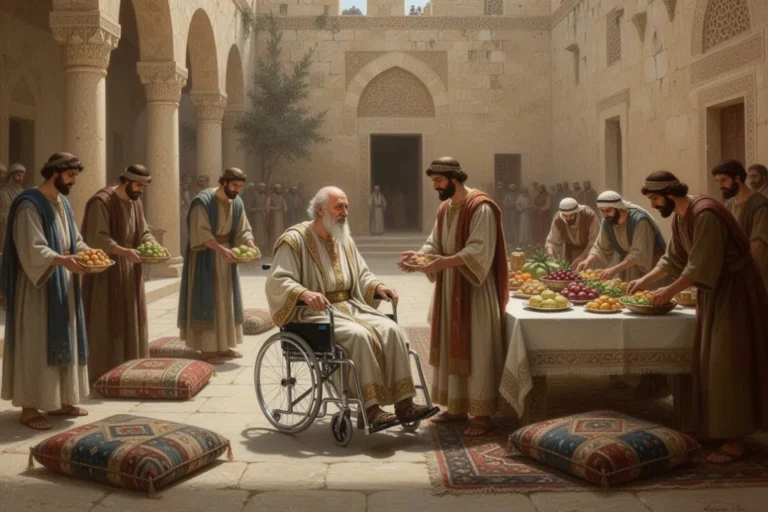
David also gave Mephibosheth a place to eat regularly at the king’s table. The table represented more than a meal. In an ancient royal setting, eating continually at the king’s table expressed acceptance, protection, and close association with the royal household.
Mephibosheth responded with humility, asking why David would show kindness to someone he described as a “dead dog.” That expression communicated his sense of smallness and unworthiness in the presence of the king. He did not present himself as a claimant demanding his grandfather’s throne.
David then summoned Ziba and gave him instructions concerning Saul’s land. Ziba had fifteen sons and twenty servants, and the arrangement placed them in charge of working the property for Mephibosheth’s benefit. Mephibosheth himself would continue to eat at David’s table.
Mephibosheth received protection from the king who might otherwise have been considered his political enemy.
Saul’s land was restored as a practical provision for Jonathan’s son.
Ziba’s household worked the property and brought its produce to Mephibosheth.
Mephibosheth ate at David’s table as a continuing member of the royal household.
The chapter ends by repeating that Mephibosheth lived in Jerusalem and ate at David’s table, even though he was disabled in both feet. The repetition places the emphasis on his accepted place in the king’s household rather than on his limitation.
What Mephibosheth’s place at David’s table means
David’s treatment of Mephibosheth demonstrates the reach of covenant loyalty. David did not help him because Mephibosheth had earned political influence or performed a service for the kingdom. He helped him because of a promise made to Jonathan.
The kindness was also costly. David gave away property connected with Saul’s family and committed royal resources to Mephibosheth’s ongoing care. The story presents this as a deliberate act of faithfulness, not as a momentary gesture of generosity.
Mephibosheth’s position at the table also reverses the expectations created by his background. Saul’s grandson could have lived in fear, hidden among ordinary families, or been removed as a threat. Instead, he was treated as someone with a recognized place in the king’s household.
That does not mean Mephibosheth became equal to David in authority. He remained a subject of the king, and the property was administered by others. The image is one of belonging under protection, not independent power.
The detail about his disabled feet appears several times in the story. It identifies him, explains some of his dependence on others, and reminds readers that royal status did not erase his physical vulnerability. At the same time, the repeated reference does not prevent him from receiving honor, property, food, or a voice in the royal court.
Readers should be careful not to turn the narrative into a claim that disability is a spiritual defect or a punishment. The text does not say that Mephibosheth’s injury resulted from personal sin. His disability is part of his circumstances, while David’s response shows that physical limitation does not remove a person’s dignity or right to humane treatment.
“Do not fear, for I will surely show you kindness.”
This is a brief paraphrase of David’s reassurance to Mephibosheth in 2 Samuel 9. The wording varies by Bible translation, but the meaning is consistent: David addresses fear before he describes the benefits he intends to give.
The account also presents a model of remembering promises across generations. Jonathan was dead when David acted, and Mephibosheth had done nothing to create the original friendship. Yet David regarded his commitment to Jonathan as still binding.
For Christian readers, Mephibosheth’s welcome is sometimes used as an illustration of grace: someone in a vulnerable position is brought near because of another person’s covenant faithfulness. That can be a meaningful application, but it should remain an application rather than a claim that the passage directly explains Christian salvation.
What happened when David fled from Absalom
Mephibosheth appears again during the rebellion of Absalom, David’s son. Absalom seized control of Jerusalem, and David fled the city with his supporters. The political crisis placed Mephibosheth’s loyalty under suspicion because he belonged to Saul’s former royal family.
At that time, Ziba went out to meet David with donkeys, bread, raisins, summer fruit, and wine. When David asked where Mephibosheth was, Ziba said that Mephibosheth had remained in Jerusalem because he believed the people of Israel would restore Saul’s kingdom to him.
David accepted Ziba’s report and gave him all that belonged to Mephibosheth. The decision was made quickly, during a dangerous flight, without a recorded hearing from Mephibosheth himself. That detail matters because the story later provides a different account of what happened.
After Absalom’s rebellion had ended, David returned toward Jerusalem. Mephibosheth came to meet him. The text says that he had not cared for his feet, trimmed his beard, or washed his clothes from the day David left until the day David returned.
Those signs of mourning or distress suggest that Mephibosheth had not been celebrating David’s removal. His neglected appearance supports his claim that he had shared in David’s suffering rather than waiting eagerly for a change of dynasty.
When David asked why he had not gone with him, Mephibosheth explained that he had wanted to have his donkey saddled so he could travel with the king. He said that Ziba had betrayed him by slandering him to David. Mephibosheth also acknowledged that David had the right to decide what should happen because David was like an angel of God.
Mephibosheth’s statement includes a complication: he says he was unable to go because of his disability, while also saying that he had ordered a donkey prepared. The passage does not explain every logistical detail. His disability may have required assistance, and Ziba may have prevented or abandoned him. The text leaves some questions unresolved.
Mephibosheth then declared that David had already shown him kindness by bringing him into the king’s household, so he did not consider himself entitled to demand more. He rejected the idea that he should receive the entire estate if David was safely home.
David responded by ordering the land divided between Mephibosheth and Ziba. This ruling differs from the absolute transfer David had announced during the crisis. It may reflect David’s uncertainty, his desire to settle the matter quickly, or a practical attempt to prevent further conflict.
Mephibosheth’s final recorded response is striking. He told David that Ziba could take everything because the king had returned safely. His words focus on David’s restoration rather than on recovering property.
Read the dispute carefully: The Bible records Ziba’s accusation and Mephibosheth’s denial, but it does not provide an independent verdict explaining exactly who told the truth. Avoid treating David’s division of the land as proof that every part of either man’s account was confirmed.
How to understand the dispute between Mephibosheth and Ziba
The conflict in 2 Samuel 16 and 19 raises questions about evidence, power, and rushed judgment. Ziba approached David first and supplied immediate material help during a crisis. Mephibosheth later appeared with visible signs of grief and gave his own explanation.
Both men had reasons to influence David. Ziba administered Saul’s property and stood to benefit if Mephibosheth lost it. Mephibosheth faced the danger of being associated with a rival dynasty and needed to explain why he had not joined David’s flight.
David’s first decision shows how quickly a ruler can act when information is incomplete. He transferred the land to Ziba after hearing only one side. When Mephibosheth later spoke, David did not fully restore the original arrangement; instead, he ordered a division.
The passage does not tell readers whether David believed Mephibosheth, believed Ziba, or simply wanted to end the dispute. His response may seem unsatisfying, but that lack of resolution is part of the narrative. Not every biblical account provides a final explanation of motives or a complete legal judgment.
Mephibosheth’s response can be read in more than one way. It may show loyalty to David, humility, grief, or resignation to the loss of his property. Some readers see it as strong evidence that he cared more about David’s safety than material gain. Others remain cautious because a brief statement cannot reveal every motive.
His words also echo the humility seen in chapter 9. Mephibosheth does not demand privilege, even though David had promised him the land. He recognizes the king’s authority and treats David’s safe return as the most important outcome.
At the same time, humility should not be confused with the absence of injustice. Mephibosheth had been accused without a full opportunity to respond, and the resulting decision cost him property. The story can therefore encourage compassion for people whose circumstances make it difficult to defend themselves quickly or publicly.
The account offers several practical observations:
First reports can be incomplete. A persuasive accusation is not the same as established truth.
Power affects whose voice is heard. Mephibosheth’s disability and distance from David may have made him dependent on others.
Visible behavior can provide important context. His unwashed clothes, untrimmed beard, and neglected feet communicated prolonged mourning.
A peaceful settlement is not always a complete restoration. David ended the dispute without clearly explaining the facts.
Loyalty may be expressed without financial demands. Mephibosheth valued David’s return even when his own property remained at issue.
These observations should not be turned into accusations against every servant, ruler, or person with a disability. The passage describes specific people in a specific political crisis. Its value lies in showing how complicated relationships and decisions can become when fear, power, loyalty, and self-interest meet.
Where Mephibosheth appears in the Bible
The fullest account is in 2 Samuel 9, which describes David’s search for Jonathan’s surviving son, the restoration of Saul’s land, and Mephibosheth’s place at the king’s table. This chapter is the clearest source for understanding David’s covenant loyalty toward him.
2 Samuel 4:4 explains how Mephibosheth became disabled in both feet. It places the injury in the period after Saul and Jonathan died and records his age at the time. This detail prepares readers for the later account of David’s kindness.
2 Samuel 16:1-4 records Ziba’s meeting with David during Absalom’s rebellion. Ziba supplies provisions and claims that Mephibosheth is hoping to regain Saul’s kingdom. David then gives Ziba control of Mephibosheth’s property.
2 Samuel 19:24-30 presents Mephibosheth’s return to David after the rebellion. His appearance, explanation, and response to the division of the land provide the other side of the dispute.
Mephibosheth is also mentioned in 2 Samuel 21:7, where David protects him because of the oath between David and Jonathan. This reference appears in a difficult narrative about Saul’s descendants and a famine. The verse reinforces the continuing force of David’s promise to Jonathan, even in a later national crisis.
Some readers confuse this Mephibosheth with another man of the same or a similar name. In 2 Samuel 21, a different Mephibosheth is identified as one of Saul’s sons by Rizpah. Context distinguishes him from Jonathan’s son in 2 Samuel 9 and 19.
Keeping the passages separate prevents confusion. Jonathan’s son is the man welcomed at David’s table, while the other reference belongs to a different branch of Saul’s family.
What Mephibosheth’s story teaches about kindness and loyalty
Mephibosheth’s story shows that kindness can cross former political divisions. David did not erase the history between Saul’s house and his own, but he refused to let that history cancel his promise to Jonathan.
It also shows the difference between a person’s identity and the conditions surrounding that person. Mephibosheth was described through his family line, his injury, his location, and his dependence on servants. Yet none of those descriptions prevented him from being treated as a person worthy of honor and protection.
The table at David’s palace provides a lasting image of inclusion. Mephibosheth did not need to hide his disability to receive a place there, and David’s generosity did not depend on pretending that the injury did not exist. The story holds together vulnerability and dignity.
David’s actions also show that promises require follow-through. A commitment made to Jonathan became a concrete arrangement involving land, food, safety, and ongoing care. Good intentions became meaningful because they changed Mephibosheth’s circumstances.
The later dispute adds a necessary warning. Even a ruler who acts generously can make a poor decision when relying on untested information. David’s treatment of Mephibosheth in chapter 9 was compassionate, but his response to Ziba in chapter 16 appears hasty. The same story therefore presents both admirable generosity and imperfect judgment.
For readers facing a similar situation, the account encourages several responses:
Remember promises responsibly. Loyalty is shown through dependable actions, not only affectionate words.
Protect people who may lack power. A person’s dependence on others can make false accusations especially damaging.
Seek more than one account. Decisions affecting property, reputation, or safety deserve careful listening.
Do not define people by disability. Physical limitations describe part of a person’s circumstances, not the whole of that person’s worth.
Value restoration over rivalry. Mephibosheth’s place in the story is not built on defeating another person or reclaiming a throne.
The Bible does not present Mephibosheth as a warrior, king, or public reformer. His significance comes through a quieter story: a vulnerable man is remembered, brought near, provided for, and later caught in a dispute that the text does not completely resolve.
That quietness is part of the story’s strength. Mephibosheth’s life demonstrates how one person’s faithfulness can preserve another person’s future, while the later conflict reminds readers that kindness and justice must be accompanied by careful judgment.
Frequently asked questions
Was Mephibosheth the son of Saul or Jonathan?
Mephibosheth was Jonathan’s son and Saul’s grandson. The Bible also mentions another man named Mephibosheth among Saul’s descendants, which can cause confusion. The Mephibosheth who ate at David’s table was Jonathan’s son, described in 2 Samuel 4, 9, 16, and 19.
Why was Mephibosheth disabled?
Mephibosheth became disabled in both feet when he was five years old. His nurse dropped him while fleeing after news that Saul and Jonathan had died in battle. The biblical account gives this explanation but does not describe the medical details of his condition.
Did David restore all of Mephibosheth’s property?
David initially promised to restore Saul’s land to Mephibosheth and assigned Ziba’s household to work it. During Absalom’s rebellion, David gave the property to Ziba after hearing an accusation. When Mephibosheth later denied it, David ordered the land divided, so the final outcome was not a complete restoration.
What does Mephibosheth’s story symbolize?
Many readers see his welcome at David’s table as a picture of covenant kindness, protection, and belonging despite vulnerability. That application can be helpful, but the passage itself focuses on David’s promise to Jonathan, Mephibosheth’s royal family connection, and the complicated dispute with Ziba.









Leave a Reply