Agag was the king of the Amalekites whom Saul spared against God’s command, leading Samuel to execute him. His story appears mainly in 1 Samuel 15, although the name also occurs in Numbers 24 and later becomes associated with Haman in the book of Esther.
Agag was the ruler of Amalek, a people who had opposed Israel during its journey from Egypt toward the promised land. The Bible presents him as a defeated enemy king, not as an ordinary soldier or a minor local official. His position made his survival especially significant after Israel’s victory.
King Saul captured Agag during a military campaign. Saul’s army destroyed much of Amalek’s population and livestock, but Saul kept Agag alive and preserved the best animals. The biblical narrative treats these choices as disobedience, even though Saul had carried out much of the campaign successfully.
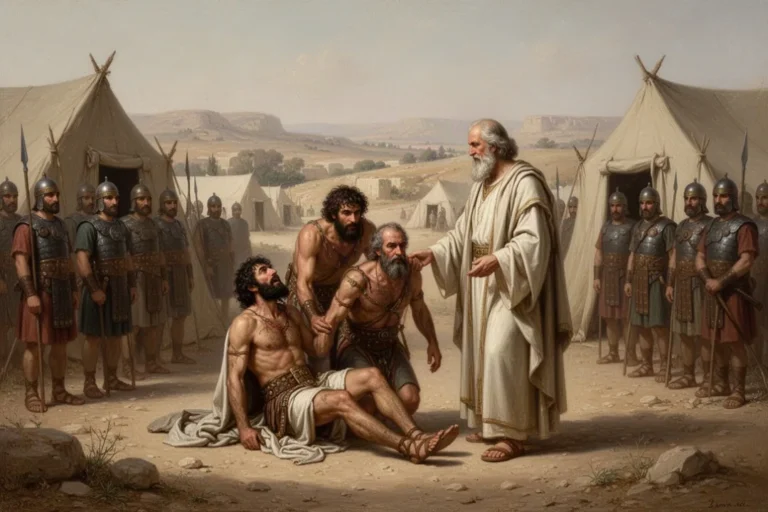
Samuel, the prophet who had anointed Saul, confronted the king. Saul defended himself by saying that the people had spared the finest animals for sacrifice, but Samuel rejected that reasoning. The central issue was not whether the animals could be used for worship; it was that Saul had replaced God’s command with his own judgment.
The central fact: Saul’s failure was not simply that he made a military mistake. He preserved what God had placed under judgment and then tried to present that decision as religiously useful.
Where Agag appears in the Bible
The name Agag appears in more than one biblical setting, and the references should not all be treated as though they describe the same moment. The clearest account is in 1 Samuel 15, but Numbers 24 uses the name in a prophecy that may refer to an Amalekite king or to a royal title.
Numbers 24:7 and 24:20: Balaam speaks of Amalek’s future defeat and mentions Agag in a prophetic setting.
1 Samuel 15: Saul captures Agag, refuses to kill him immediately, and Samuel later executes him.
Esther 3:1: Haman is called an Agagite, which has traditionally been connected with Agag and the Amalekites.
The two passages that directly describe Agag as a person are separated by a long period of Israel’s history. Numbers belongs to the wilderness period, while 1 Samuel describes events during Saul’s reign. For that reason, readers should allow for the possibility that Agag was a royal name or title, similar to how other ancient rulers are identified by recurring throne names.
The Bible does not provide enough information to establish every detail about Agag’s family, birthplace, or political history. Claims that go beyond the biblical text should be identified as later interpretation rather than presented as certain fact.
How the story of Agag unfolds in 1 Samuel 15
The account can be followed in a clear sequence. Each step adds to the Bible’s explanation of Saul’s rejection as king.
God’s judgment is announced. Samuel tells Saul to attack Amalek because of its earlier hostility toward Israel. The command concerns the people, their possessions, and their animals.
Saul defeats Amalek. Saul gathers Israel’s forces and wins the battle. The military result is substantial, but the narrative immediately focuses on what Saul did not obey.
Agag is spared. Saul captures the Amalekite king alive. The king’s survival becomes the clearest example of Saul withholding what had been commanded.
The best animals are kept. Saul and the people spare valuable sheep, cattle, and other animals. Saul later claims these were preserved for sacrifice.
Samuel confronts Saul. Saul greets Samuel as though he has completed the Lord’s command. Samuel responds by pointing to the sounds of the animals, exposing the gap between Saul’s claim and his actions.
Saul admits partial wrongdoing. He eventually acknowledges that he feared the people and listened to them. His explanation reveals that public pressure and political leadership were involved in his decision.
Samuel explains the priority of obedience. Samuel teaches that listening to God matters more than offering a sacrifice that depends on disobedience.
Samuel executes Agag. After Saul’s failure is formally declared, Samuel puts Agag to death. The passage says Samuel did what Saul had refused to do.
This sequence shows why the story is not mainly about Agag’s personality. The biblical emphasis falls on Saul’s responsibility as king. Saul had received a specific command, won the battle, and then altered the terms of victory. His partial obedience could not be treated as full obedience.
Why Saul was commanded to attack Amalek
The background appears much earlier in the Bible. During Israel’s wilderness journey, the Amalekites attacked the Israelites when they were vulnerable. Exodus 17 describes the conflict and records a divine promise that the memory of Amalek would eventually be removed. The issue appears again in Deuteronomy 25:17-19, which recalls Amalek’s attack on the weak and stragglers.
These passages explain why the campaign in 1 Samuel 15 is presented as a delayed act of judgment rather than an ordinary territorial war. The biblical story connects Amalek’s destruction with its earlier violence against Israel. It also stresses that Israel was not being told to act on private revenge.
That setting is difficult for modern readers, especially because the command involves the complete destruction of a people and their possessions. A responsible reading should not soften the severity of the passage or turn it into a general permission for later violence. It belongs to a particular narrative of divine judgment in Israel’s history, under prophetic instruction, and it does not authorize individuals or modern governments to claim the same mandate.
Reading the passage responsibly: The command against Amalek is a specific biblical judgment tied to a particular time and covenant setting. It should not be used to justify hatred, ethnic violence, or attacks against any present-day group.
What Samuel’s confrontation with Saul means
Samuel’s rebuke focuses on the difference between obedience and religious appearance. Saul did not describe his actions as rebellion. He said the animals were saved for sacrifice, which made his decision sound devout. Yet the narrative shows that worship cannot repair a deliberate refusal to follow God’s instruction.
Saul also tries to shift responsibility. At different points, he blames the people, says he obeyed the Lord, and asks Samuel to honor him publicly before the elders. These reactions show a leader concerned not only with the original command but also with how his failure will affect his reputation.
The famous principle in this scene is that obedience is better than sacrifice. Rather than reproducing a translation-specific verse, the idea can be stated this way: ritual offerings do not compensate for refusing to listen. Worship has no integrity when it is used to excuse deliberate disobedience.
Samuel’s statement also explains why Saul’s victory did not preserve his kingship. Saul had not merely made a private error. As Israel’s king, he acted as though he could revise a prophetic command and then define success by his own standards.
Why Agag’s survival mattered so much
Agag represented more than one captured enemy. As king of Amalek, he embodied the nation’s leadership and continuing identity. By keeping him alive, Saul left the defeated kingdom with a living symbol of its former power and a potential source of political danger.
The text does not describe Agag as repentant, converted, or harmless. When Samuel brings him forward, Agag speaks in a way that suggests he expected to survive. The passage does not give enough detail to reconstruct his exact attitude, but his confidence contrasts with Saul’s later shame and fear.
Agag’s survival also exposed the difference between visible achievement and complete faithfulness. Saul could point to a major military victory. He could say that animals had been reserved for worship. Yet the preserved king and livestock showed that the command had not been carried out as given.
Samuel’s execution of Agag closes the immediate crisis, but it does not undo Saul’s failure. The king’s disobedience has already revealed a deeper problem: Saul wants the authority and honor of kingship while retaining the freedom to decide which divine instructions are convenient.
Was Agag a personal name or a title?
The Bible does not settle the question directly. In 1 Samuel 15, Agag is introduced as a particular king captured by Saul. In Numbers 24, Balaam’s prophecy mentions Agag in a way that may point to a ruler of Amalek, but the passage does not provide a full biography or explain whether it refers to the same individual.
Some interpreters understand Agag as a dynastic title, meaning that more than one Amalekite ruler could have been called Agag. This view helps explain why the name appears in settings that may belong to different periods. Other readers take the references as pointing to a representative or especially notable Amalekite king.
Neither interpretation should be stated as proven beyond doubt. The safest wording is that Agag is the name of the Amalekite king in 1 Samuel 15, while the use in Numbers may reflect a royal title or a later prophetic reference to Amalek’s ruler.
In Esther 3:1, Haman is called an Agagite. Because Agag was an Amalekite king, Jewish and Christian interpreters have often connected Haman with Amalek and understood him as part of the continuing conflict between Amalek and Israel.
The book of Esther itself does not give a genealogy that says Haman was Agag’s direct biological descendant. It simply uses the designation Agagite. That label may identify Haman by ancestry, place of origin, political tradition, or literary association. The text leaves the exact connection unexplained.
The literary parallel is still significant. Agag was an enemy king spared by Saul, while Haman was a powerful official who planned the destruction of the Jewish people. In the Esther narrative, Haman’s hostility toward the Jews recalls the older Amalekite opposition, and the designation invites readers to see a connection between the two enemies.
Later Jewish interpretation develops this connection more fully. Rabbinic writings often treat Haman as descended from Agag, and many Christian commentators have followed the same broad reading. That tradition helps explain why the name Agag carries symbolic weight in Esther, but it should be distinguished from what the biblical text explicitly states.
What the Agag story teaches about leadership
The account offers a serious portrait of leadership under accountability. Saul had authority, military success, and public support, but those strengths did not excuse his refusal to follow the instruction he had received. The story evaluates him by faithfulness under pressure, not merely by results.
Several leadership failures appear in the narrative:
Selective obedience: Saul carried out part of the command and treated that partial success as sufficient.
Fear of people: He admitted that he listened to the people, showing how public pressure shaped his decision.
Excuse-making: He described disobedience as preparation for worship instead of acknowledging it immediately.
Concern for reputation: Saul wanted Samuel to honor him before the elders even after the judgment had been announced.
Failure to accept responsibility: His explanations shifted between the people’s actions and his own claimed obedience.
These patterns are recognizable beyond the ancient setting. A person may complete a large assignment while ignoring the central requirement. A leader may preserve an attractive result while violating the principle that was supposed to govern the work. The biblical lesson is that outward success cannot redefine faithfulness.
What Agag’s death reveals about judgment
Samuel’s execution of Agag is one of the harshest moments in the narrative. The passage presents it as the completion of a judgment Saul had failed to carry out. Samuel, not Saul, becomes the person who acts decisively at the end of the episode.
The scene should not be read as approval of uncontrolled anger. Samuel is acting within the narrative as a prophet carrying out a specific divine judgment. The text does not invite readers to imitate the act in ordinary disputes or to treat personal enemies as equivalent to Amalek.
Agag’s death also demonstrates that delayed obedience is not the same as obedience. Saul’s decision to spare him was not made acceptable merely because Samuel later corrected it. The king had already shown that he would not submit his power to God’s command.
At the same time, the story should be read alongside the Bible’s wider teaching about justice, mercy, and the limits placed on human vengeance. It is not a simple template for political action. Its immediate purpose is to explain Saul’s rejection and the seriousness of his failure as Israel’s king.
How the Agag passage fits Saul’s larger story
Saul’s conflict with Agag is a turning point, not an isolated incident. Earlier in 1 Samuel, Saul had shown promise but also impatience and uncertainty about his role. By chapter 15, the pattern has become clear: he wants divine approval, yet he also wants to preserve control over decisions that belong to God.
After Samuel declares that Saul has been rejected as king, the relationship between the two men changes permanently. Samuel grieves for Saul, but he does not reverse the judgment. The chapter then moves toward David’s anointing, showing that Saul’s political decline is connected to his spiritual failure.
That transition helps explain why Agag receives so much attention in a relatively short episode. The story is not preserved only to record the fate of one Amalekite ruler. It is used to reveal why Saul cannot continue as Israel’s ideal king.
Saul’s loss of the kingdom is not caused by a lack of courage in battle. He has demonstrated courage and military ability. His downfall comes from refusing to remain accountable when obedience conflicts with public opinion, personal judgment, and the desire to retain honor.
Common misunderstandings about Agag
Several assumptions about Agag go beyond what Scripture says. Keeping the details separate makes the passage easier to understand and prevents later traditions from being confused with the biblical account.
Agag was not the king of Israel. He was identified as the king of Amalek, an enemy of Israel.
Agag was not killed by Saul. Saul captured him alive; Samuel later executed him.
Agag is not clearly identified as Haman’s direct ancestor. Esther calls Haman an Agagite, but it does not provide a full family tree.
Agag does not appear throughout the Old Testament. The name is concentrated in Numbers, 1 Samuel, and the Agagite designation in Esther.
The story is not mainly about animal sacrifice. The animals reveal Saul’s disobedience, but the deeper issue is his refusal to carry out the command.
The Amalekite judgment is not a general command for modern violence. It belongs to a specific biblical setting and must not be applied as a license against contemporary peoples.
How to study Agag in the Bible carefully
A careful study begins with the immediate passage rather than with later legends. Read 1 Samuel 15 as a complete scene, paying attention to what God commands, what Saul does, how Saul explains himself, and how Samuel responds.
Read the background: Examine Exodus 17 and Deuteronomy 25 to understand why Amalek appears in Israel’s history as an enemy under judgment.
Read the prophecy: Consider Numbers 24 and ask whether Agag functions as a personal name, a royal title, or a representative ruler.
Track responsibility: Notice that Saul blames the people but also admits that he listened to them and preserved Agag himself.
Separate explicit claims from tradition: Mark what the text says about Haman and what later Jewish or Christian interpretation adds.
Consider the literary purpose: Ask how Agag’s survival exposes Saul’s character and contributes to the transition toward David.
Apply the lesson carefully: Draw conclusions about obedience, leadership, and accountability without transferring an ancient judgment command to modern conflicts.
Agag matters in the Bible because his story reveals the cost of partial obedience. He is the captured king whom Saul spared, the figure Samuel executed when Saul would not obey, and the name later associated with Haman’s hostility toward the Jews. The account ultimately directs attention away from Agag’s personal biography and toward the kind of king Saul proved to be.
For readers studying the passage today, the most reliable conclusion is both clear and limited: Agag was an Amalekite king defeated by Saul in 1 Samuel 15. His story illustrates the seriousness of disobedience, the danger of religious excuses, and the responsibility carried by leaders who act under divine authority.
Frequently asked questions
Was Agag a Philistine king?
No. Agag was identified as the king of the Amalekites, not the Philistines. Amalek and Philistia were distinct peoples who appear separately in the Old Testament. Saul’s campaign against Agag occurred in the context of Israel’s conflict with Amalek, whose earlier attack on Israel is recalled in Exodus 17 and Deuteronomy 25.
Did Saul personally kill Agag?
No. Saul captured Agag alive after defeating the Amalekites. When Samuel confronted Saul and found that the king had been spared, Samuel carried out the execution. This detail is central to the story because it demonstrates that Saul did not fully obey the command he had received.
Is Haman definitely descended from Agag?
The Bible does not provide a direct genealogy connecting Haman to Agag. Esther calls Haman an Agagite, which creates a strong literary and traditional association with Amalek. Later Jewish interpretation commonly understands Haman as Agag’s descendant, but that specific family connection is not explicitly explained in Esther.
Why does the Bible mention Agag in Numbers before Saul’s reign?
Numbers 24 refers to Agag in Balaam’s prophecy about Amalek. The name may identify a particular ruler, represent Amalek’s future king, or function as a royal title used by Amalekite rulers. Because the passage gives limited historical detail, readers should avoid insisting on one interpretation as certain.











Leave a Reply