Korah in the Bible: rebellion, judgment, and legacy
Korah in the Bible: rebellion, judgment, and legacy
Have you ever wondered why a person who belonged to Israel’s priestly tribe would challenge Moses and Aaron? Korah in the Bible is remembered chiefly for leading a serious rebellion during Israel’s wilderness journey. His story appears in Numbers 16, where his demand for religious authority brings judgment on him and his followers.
Yet Korah’s story does not end with rebellion. The Bible later names the sons of Korah among Israel’s worshipers, musicians, and gatekeepers. That detail creates an important distinction: Korah was judged for his own actions, but his descendants were not treated as permanently guilty because of their ancestor.
Korah was a Levite, the son of Izhar, who was the son of Kohath, the son of Levi. This family connection placed him within the clan responsible for particular duties connected with the tabernacle. Moses and Aaron were also from the tribe of Levi, so Korah was not an outsider attacking Israel’s leadership from a distance.
Numbers 16 identifies Korah alongside Dathan and Abiram, who were from the tribe of Reuben. The account also mentions 250 other community leaders. Together, these men confronted Moses and Aaron and questioned why the brothers had elevated themselves above the rest of the assembly.
Korah’s position gave him a legitimate connection to Israel’s worship system, but it did not give him the authority to claim the priesthood. The Levites had assigned responsibilities, while the priestly role belonged specifically to Aaron and his sons. The dispute therefore involved more than personality or administrative control; it concerned God-appointed roles within the covenant community.
Important distinction: Korah was a Levite, but not every Levite was a priest. His family had sacred responsibilities, yet the priestly ministry was assigned to Aaron’s line.
What Korah and his allies challenged
Korah’s complaint begins with language about the holiness of the entire congregation. He and his supporters argued that all the Israelites were holy and that the Lord was among them. Their question was essentially this: why, then, should Moses and Aaron place themselves above the assembly?
That claim contained a truth mixed with rebellion. Israel was indeed called to be a holy people, and God’s presence was among them. But Korah used that truth to reject the specific responsibilities God had assigned to Moses and Aaron. Shared dignity did not mean identical authority.
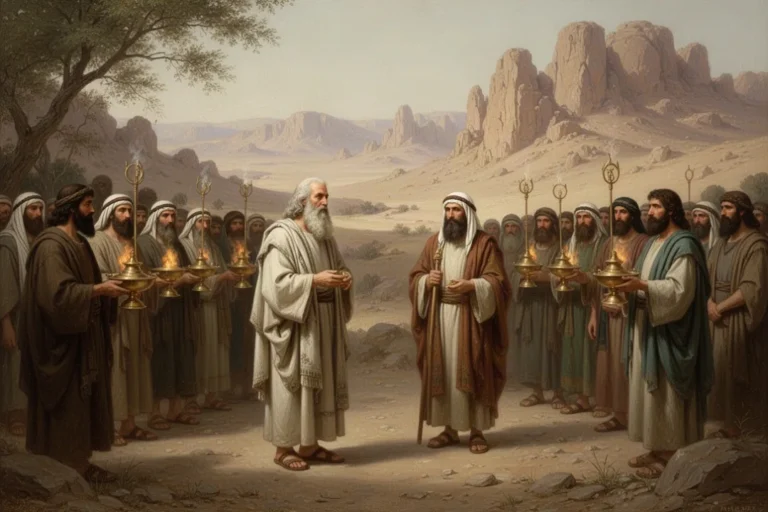
Moses responded by falling facedown, apparently recognizing the seriousness of the situation. He proposed a test involving censers, the containers used for burning incense. Korah and the 250 leaders were to appear before the Lord with Aaron, each carrying a censer and incense.
The test would show whom God had chosen for priestly service. Moses also challenged Korah directly, reminding him that the Levites had already received an honored ministry. They had been brought near to serve at the tabernacle, so the desire to take the priesthood as well was not a request for a minor adjustment. It was an attempt to seize a role God had not given them.
Why the rebellion was especially serious
Korah’s rebellion was serious because it challenged both Moses’ leadership and Aaron’s priesthood. In the biblical narrative, these offices were not self-appointed positions. Moses had been commissioned to lead Israel, and Aaron’s family had been chosen for priestly service.
The rebellion also arose in a difficult period. Numbers records repeated complaints, fear, and resistance among the Israelites after their departure from Egypt. The people had recently heard the negative report from the spies and learned that the wilderness generation would not enter Canaan. Against that background, Korah’s challenge added another major crisis to an already unstable community.
Dathan and Abiram intensified the conflict. They refused to come when Moses summoned them and accused him of bringing Israel out of a land flowing with milk and honey only to make himself ruler over the people. Their words reversed the biblical description of Egypt and portrayed the promised land as an unreachable hope.
These accusations reveal a pattern that often appears in the story: grievance becomes accusation, accusation becomes resistance, and resistance becomes an attempt to replace God’s appointed order. The issue was not simply that these men wanted greater respect. They rejected the leadership structure through which God was directing the nation.
How God judged Korah’s rebellion in Numbers 16
Numbers 16 describes several connected judgments. Moses announced that if the rebels died in an ordinary way, people might conclude that the Lord had not sent him. But if the ground opened and swallowed the men and their households, that would demonstrate that they had treated the Lord with contempt.
The ground opened beneath Korah’s group and the households associated with the rebellion. They went down alive into the earth, and the ground closed over them. The text presents this event as a direct divine judgment rather than a natural accident.
The 250 men who offered incense faced a different judgment. Fire came out from the Lord and consumed them. Their bronze censers were then hammered into a covering for the altar as a lasting reminder to Israel that unauthorized people must not approach the priestly ministry.
The judgment did not end the people’s anger. On the following day, the congregation accused Moses and Aaron of killing the Lord’s people. This accusation led to a plague among the people. Aaron took incense and stood between the dead and the living, making atonement and stopping the plague.
The sequence shows the seriousness of unauthorized worship, but it also highlights Aaron’s priestly role. The same office challenged by Korah became the means through which Aaron interceded for the people. The account presents priesthood as a responsibility of service and mediation, not merely a position of honor.
What the budding staff confirmed about Aaron
Numbers 17 follows the rebellion with another sign. Each tribal leader placed a staff before the Lord, while Aaron’s name was written on the staff representing the tribe of Levi. The next day, Aaron’s staff had sprouted, blossomed, and produced almonds.
This miracle confirmed the choice of Aaron’s family for priestly service. It addressed the continuing question of who had authority to approach the sanctuary in the priestly role. The budding staff became a visible sign that God, not political pressure, established the priesthood.
The people responded with fear, recognizing the danger of coming near the tabernacle improperly. Numbers 18 then describes the responsibilities of the priests and Levites in greater detail. The placement of these chapters matters: the rebellion, judgment, sign, and instructions together clarify the boundaries of sacred service.
Did Korah’s sons die with him?
One of the most significant details appears in Numbers 26:11, which says that the sons of Korah did not die. This brief statement prevents readers from assuming that every member of Korah’s extended family shared his judgment.
The text does not explain every circumstance of their survival. It does, however, make the central point clear: Korah’s guilt was not automatically transferred to his sons. The Bible treats the rebellion as a personal and communal act involving specific participants, while also recognizing that his descendants could live differently.
This detail helps explain later references to the sons of Korah. They appear in the worship life of Israel and are connected with several psalms. Their later service does not erase Korah’s rebellion, but it demonstrates that a family’s future is not fixed by an ancestor’s failure.
Read Numbers 26:11 with Numbers 16: The judgment on Korah does not mean every descendant was destroyed. The Bible deliberately records that his sons survived.
What the sons of Korah did in Israel’s worship
The phrase “sons of Korah” appears in the headings of a group of psalms. These include Psalms 42, 44–49, 84, 85, 87, and 88. Psalm headings are ancient identifications connected with the composition, performance, or association of the psalms, and they connect Korah’s descendants with Israel’s worship tradition.
Their psalms express longing for God, confidence in divine protection, reflection on suffering, and praise for Jerusalem and the sanctuary. Psalm 42, for example, portrays an intense desire for God’s presence. Psalm 84 celebrates the beauty and blessedness of dwelling near the sanctuary. Psalm 46 emphasizes God as a refuge in trouble.
These themes create a striking contrast with Korah’s attempt to grasp authority. His descendants are remembered not for claiming the priesthood but for helping lead the community in humble worship. Their work directed attention toward God rather than toward their family’s past or status.
First Chronicles also names Korahite families among those serving at the tabernacle and later in the temple. They are associated with responsibilities such as guarding the entrances and caring for the duties connected with worship. A gatekeeper’s work might appear less prominent than a priest’s, but it was a trusted and necessary assignment.
The biblical record therefore presents a meaningful reversal. Korah sought a role God had not assigned him, while his descendants faithfully carried out roles that were assigned to them. Their example shows that faithful service does not require the highest public position.
How the Bible uses Korah as a warning
The New Testament refers to Korah in Jude 11, alongside Cain and Balaam. Jude uses these Old Testament figures as examples of destructive spiritual behavior. Korah represents rebellion against legitimate God-given authority and the pursuit of a self-serving religious position.
Jude’s reference assumes that readers know the story from Numbers. Korah is not mentioned as a random historical figure; he becomes a symbol of a particular kind of corruption. The warning concerns people who enter the community, distort its values, and use religious claims to advance themselves.
The reference in Jude does not mean every question about leadership is sinful. Scripture contains examples of people raising legitimate concerns, confronting wrongdoing, and asking leaders to account for their actions. Korah’s case is different because his challenge involved ambition disguised as a claim to equality and rejection of a role God had established.
His story should therefore be applied carefully. It warns against pride and unauthorized self-promotion, not against every disagreement with a religious leader. Leaders can be wrong, abusive, or accountable to the community and to God. The biblical lesson is not “never question authority”; it is “do not use spiritual language to justify rebellion, envy, or an unearned claim to power.”
Other people named Korah in the Bible
The name Korah does not refer to only one person in every biblical passage. The best-known Korah is the Levite in Numbers 16, but the Old Testament also uses the name in genealogical lists connected with Edom.
Genesis 36:16 names Korah among the chiefs of Edom and identifies him as a descendant of Esau through Eliphaz. First Chronicles 1:35 also includes Korah in a genealogy related to Esau. This person belongs to a different family and historical setting from the Levite who rebelled against Moses.
That distinction matters when reading Bible references. A name may occur more than once, and genealogical lists often preserve people who are not central to the main narrative. You should check the tribal connection and surrounding context before assuming that every reference points to the same individual.
Numbers 16: Korah the Levite who led a rebellion against Moses and Aaron.
Numbers 26:11: a statement that Korah’s sons did not die in the judgment.
Psalms: the sons of Korah are associated with several worship songs.
1 Chronicles: Korahite descendants serve in tabernacle and temple duties.
Genesis 36 and 1 Chronicles 1: another Korah appears among the descendants or chiefs of Edom.
Common mistakes when interpreting Korah’s story
Korah’s account is memorable, but several common reading mistakes can blur its meaning. Keeping the narrative details together helps prevent conclusions that the text does not support.
Assuming Korah was a priest. He was a Levite with tabernacle responsibilities, but the priestly office was assigned to Aaron and his sons.
Blaming every descendant. Numbers 26:11 specifically records that Korah’s sons did not die, and later passages show them serving God.
Reducing the dispute to jealousy alone. Personal ambition was involved, but the conflict also concerned the distinction between Levite service and Aaronic priesthood.
Applying the story to every disagreement. Korah’s rebellion should not be used to silence honest questions, legitimate accountability, or opposition to wrongdoing.
Confusing the two biblical Korahs. The Levite in Numbers and the Edomite figure in Genesis belong to different genealogical contexts.
Ignoring the aftermath. The budding staff, the plague, the priestly instructions, and the later service of Korah’s descendants all contribute to the story’s meaning.
Practical ways to study Korah in the Bible
A careful study works best when you read the central passage alongside the chapters that explain its consequences. Numbers 16 gives the rebellion and judgment, while Numbers 17–18 addresses confirmation and priestly duties. Numbers 26 then supplies the crucial genealogy that preserves the survival of Korah’s sons.
Use the following approach when examining the account:
Read Numbers 16 slowly. Identify each group involved: Korah, Dathan and Abiram, the 250 leaders, Moses, Aaron, and the wider congregation.
Compare the complaints. Korah’s challenge focuses on holiness and authority, while Dathan and Abiram accuse Moses of failing to deliver the people.
Follow the signs. The censers, the earth opening, the fire, the incense that stops the plague, and the budding staff each answer a different part of the conflict.
Read Numbers 26:9–11. This passage places the rebellion within the later generation and clarifies what happened to Korah’s sons.
Read several psalms associated with the sons of Korah. Notice how their worship emphasizes dependence on God, longing for his presence, and confidence rather than self-exaltation.
Check the genealogy before drawing conclusions. Genesis 36 and 1 Chronicles 1 show that another Korah belonged to the Edomite line.
What Korah’s story teaches about leadership and service
Korah’s story presents leadership as a calling with responsibilities, not simply a reward to be claimed. Moses and Aaron were not praised because they were naturally superior to everyone else. Their authority was tied to a particular divine assignment, and they were still accountable for how they carried it.
The narrative also distinguishes holy identity from personal entitlement. The entire congregation could belong to a holy people without every person holding the same office. In practical terms, a community may value every member while assigning different responsibilities according to calling, training, and trust.
Korah’s descendants provide the other side of the lesson. They did not need to escape their family history by pretending it never happened. Instead, their recorded service shows a different response: they fulfilled their responsibilities within the worshiping community.
The result is a balanced biblical picture. Pride can turn a valid truth into a weapon, and authority can be abused if it is treated as personal ownership. Healthy service requires both humility about one’s role and courage to fulfill it faithfully.
Why Korah remains a significant biblical figure
Korah remains significant because his story brings together rebellion, worship, judgment, family identity, and service. He was close to Israel’s sacred life, yet proximity to holy things did not protect him from pride. His position made his challenge more serious, not less.
At the same time, the later history of the Korahites keeps the story from becoming a simple account of permanent family disgrace. The sons of Korah became associated with songs that have helped generations of worshipers express grief, hope, reverence, and trust in God.
Read as a whole, the biblical record offers two complementary warnings. Do not seize a role God has not given you, and do not assume that someone else’s failure determines your own faithfulness. Korah is remembered for rebellion, while his descendants are remembered for service and worship.
Frequently asked questions
Was Korah related to Moses and Aaron?
Yes. Korah was a Levite from the Kohathite clan, while Moses and Aaron were also descendants of Levi. Korah was the son of Izhar, and Izhar was a brother of Amram, the father of Moses and Aaron. Their shared ancestry helps explain why Korah had access to Israel’s sacred responsibilities and why his challenge was an internal dispute within the tribe of Levi.
What happened to the 250 men who followed Korah?
Numbers 16 says the 250 leaders who offered incense were consumed by fire from the Lord. Their bronze censers were later made into a covering for the altar. This object served as a continuing warning that the priestly role was not open to anyone who decided to claim it.
Are the sons of Korah the same people who wrote the Psalms?
The psalm headings associate several psalms with the sons of Korah, but they do not explain precisely whether every descendant personally composed a particular psalm. The phrase identifies a Korahite worship tradition or group connected with these songs. Their descendants served as musicians and worship leaders in Israel’s sanctuary and temple life.
Did Korah’s rebellion happen because Israel was about to enter the Promised Land?
The rebellion occurred after the crisis involving the spies and the announcement that the wilderness generation would not enter Canaan. Numbers does not state that disappointment alone caused Korah’s challenge. The account focuses on a dispute over leadership, priestly authority, status, and the legitimacy of Moses and Aaron’s roles.







Leave a Reply