There are several men named James in the New Testament, so the name does not refer to one person in every passage. The most prominent are James the son of Zebedee, one of Jesus’ twelve apostles; James the son of Alphaeus, another apostle; and James, the brother of Jesus, who became a leading figure in the Jerusalem church.
The person traditionally understood to have written the Letter of James is James the brother of Jesus. He was not initially presented as one of Jesus’ disciples, but after Jesus’ resurrection he became a respected leader, known for his wisdom, prayer, concern for the poor, and insistence that genuine faith should shape everyday conduct.
The New Testament mentions more than one James, and separating them prevents several common misunderstandings. “James” is the English form of the Greek name Iakōbos, related to the Hebrew name Jacob. The same name appears in the Gospels and Acts in connection with different families and ministries.
James son of Zebedee: an apostle, the brother of John, and one of Jesus’ closest three disciples.
James son of Alphaeus: an apostle often called James the Less or James the younger.
James the brother of Jesus: a leader of the Jerusalem church and the traditional author of the Letter of James.
James connected with Judas: Luke and Acts refer to an apostle named Judas as the son of James in many English translations, though this James receives little additional information.
The New Testament does not give a complete biography of each man. Some identifications remain debated, especially when early Christian tradition connects two descriptions that the biblical text does not explicitly combine. The safest approach is to distinguish people by the details the Bible does provide: their family connections, their place among the apostles, and their role in the early church.
Helpful distinction: When someone asks about “James in the Bible,” they may mean one of the apostles, James the brother of Jesus, or the writer of the New Testament letter. The surrounding passage determines which James is intended.
James son of Zebedee was an apostle and martyr
James son of Zebedee was a fisherman from Galilee and the brother of John. Jesus called both brothers while they were working with their father, Zebedee, and the two left their boat and followed him, according to Matthew 4:21–22 and Mark 1:19–20.
Jesus gave James and John the nickname Boanerges, meaning “Sons of Thunder,” in Mark 3:17. The name may reflect their forceful personalities. In Luke 9:51–56, the brothers wanted judgment on a Samaritan village that had not welcomed Jesus, showing that their zeal sometimes needed correction.
James belonged to Jesus’ inner circle of three apostles, along with Peter and John. These three witnessed the raising of Jairus’s daughter in Mark 5:37–43, Jesus’ transfiguration in Matthew 17:1–8, and his intense prayer in Gethsemane in Matthew 26:36–46. Their presence at these events suggests a particularly close relationship with Jesus, although it did not make them flawless or guarantee them positions of earthly prestige.
James and John once asked for places of honor beside Jesus when he came into his kingdom, as recorded in Mark 10:35–45. Jesus redirected their ambition toward suffering, service, and sacrifice. The passage teaches that leadership among Jesus’ followers is not defined by rank or control but by willingness to serve others.
James son of Zebedee is also significant because he was the first apostle whose death is recorded in the New Testament. Acts 12:1–2 says that King Herod Agrippa I had James killed with the sword. The account is brief, but it places James among the earliest Christian leaders to suffer a violent death for his association with Jesus.
James son of Alphaeus is a lesser-known apostle
James son of Alphaeus appears in the lists of the twelve apostles in Matthew 10:2–4, Mark 3:16–19, Luke 6:13–16, and Acts 1:13. The biblical record identifies him clearly as an apostle but gives almost no narrative about his activities.
He is commonly called James the Less or James the younger, based on the wording in Mark 15:40. The description may distinguish him from James son of Zebedee by age, stature, or prominence, but the text does not explain precisely what “less” means. It should not automatically be treated as a judgment about his importance or spiritual maturity.
James son of Alphaeus is not identified in the biblical text as the brother of Jesus or as the author of the Letter of James. Later traditions sometimes connect figures whose identities are not clearly joined in Scripture, but those traditions should be kept separate from what the New Testament directly states.
His limited appearance is a useful reminder that faithful service is not measured by visibility. Some apostles are described through major events, while others are named mainly in lists. The Bible preserves both kinds of testimony without suggesting that a quiet role is an unimportant one.
James the brother of Jesus became a Jerusalem church leader
James the brother of Jesus appears gradually in the New Testament story. During Jesus’ earthly ministry, Jesus’ brothers are described as not believing in him in John 7:3–5. After the resurrection, however, James received a personal appearance from Jesus, according to 1 Corinthians 15:7. This encounter appears to have been decisive in his movement from skepticism to committed leadership.
Paul refers to him as “the Lord’s brother” in Galatians 1:19. That phrase identifies James as a close family member of Jesus, although Christian traditions differ over the precise meaning of “brother.” Some understand James as a younger biological brother; others identify him as a stepbrother or a close relative. The biblical text clearly presents him as part of Jesus’ family and as an important leader after Jesus’ resurrection.
James became especially prominent in the church at Jerusalem. When Peter escaped from Herod’s prison in Acts 12, he told the believers to report what had happened to James and the other Christians. This detail shows that James already held a position of recognized authority by that point.
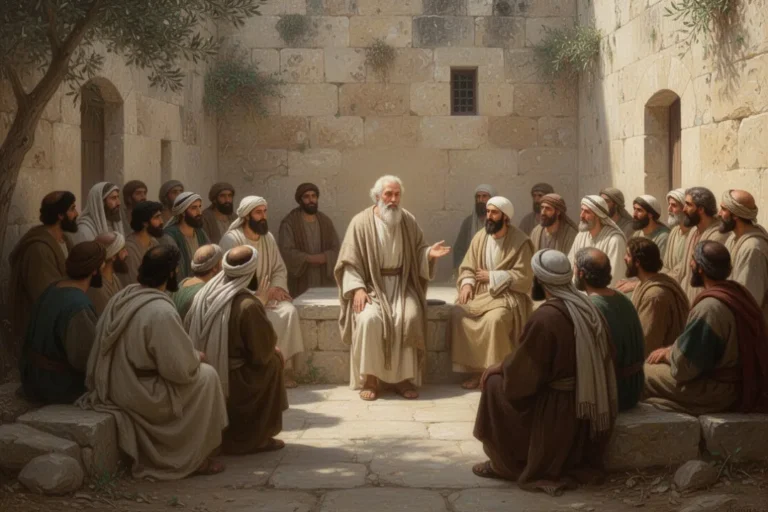
James also played a central role in the meeting described in Acts 15. The early church had to decide whether Gentile believers needed to follow all the distinctive requirements associated with Jewish life. After hearing testimony from Peter, Paul, and Barnabas, James offered a judgment and helped communicate a practical decision to Gentile congregations.
His speech in Acts 15 draws on Israel’s Scriptures and emphasizes that God was welcoming people from the nations. James then recommended that Gentile believers avoid practices that would create serious offense or compromise their fellowship with Jewish believers. His approach combined biblical conviction, pastoral wisdom, and concern for unity.
Paul later names James, Cephas, and John as “pillars” of the Jerusalem church in Galatians 2:9. That description confirms his influence among the earliest Christian leaders. James was not merely a private relative of Jesus; he was a recognized teacher and decision-maker in the first generation of the church.
Why James is traditionally connected with the Letter of James
The letter begins by identifying its writer simply as James, a servant of God and of the Lord Jesus Christ. It does not call him an apostle, the son of Zebedee, or the brother of Jesus. Even so, early Christian tradition commonly associated the letter with James the brother of Jesus because he was a prominent leader who was known by the single name James.
The letter’s practical tone also fits the portrait of James in Acts 15. It emphasizes conduct, wise speech, care for people in need, impartial treatment, and disciplined prayer. The writer does not present Christian faith as an abstract set of ideas. Instead, he asks whether a person’s beliefs are visible in choices, relationships, words, and treatment of the vulnerable.
Some scholars have questioned whether James the brother of Jesus personally wrote the letter, pointing to its polished Greek, its literary form, and questions about how widely written Greek was used in Galilee. Others understand the letter as coming from James through a secretary, a later collection of his teaching, or a text written in his name by a faithful follower.
The biblical letter itself does not settle every question about composition. What it does make clear is the authority of its message for the communities addressed: it is written to believers among “the twelve tribes in the dispersion,” a phrase that evokes Israel’s scattered people and may also describe Christians living outside their original communities.
What the Letter of James teaches about faith and conduct
The Letter of James addresses believers facing hardship, social inequality, temptation, conflict, and economic pressure. Its teaching is direct, but it is not simplistic. James does not claim that suffering is always easy or that poverty automatically makes someone morally superior. He asks believers to respond to difficult circumstances with steadfastness, wisdom, humility, and dependence on God.
Trials can produce steadfast character
James 1:2–4 tells readers to regard trials as an occasion for joy because testing can produce endurance and spiritual maturity. This does not mean pain itself is good or that Christians must pretend to enjoy injustice, illness, grief, or persecution. The point is that hardship can become a setting in which trust is tested and developed.
James also tells believers who lack wisdom to ask God for it in James 1:5–8. Wisdom here means more than information. It is the practical ability to respond to pressure in a way that honors God, and James presents God as generous toward those who ask in faith.
Temptation begins with disordered desire
James 1:13–18 rejects the idea that God tempts people to do evil. The writer traces temptation through a person’s own desires: desire can entice, grow, and eventually lead to destructive action. This teaching places responsibility neither on God nor on circumstances alone.
James balances this warning with a strong affirmation of God’s goodness. Every genuinely good gift comes from above, and God is described as the unchanging source of light and life. The contrast is clear: evil is not God’s gift, while new life and moral renewal come from God.
Hearing God’s word must lead to action
James 1:19–27 compares a hearer who does not act with someone who looks at a face in a mirror and immediately forgets what was seen. The image challenges religious self-deception. Listening to teaching, attending worship, or knowing biblical language is not the same as allowing God’s word to reshape behavior.
James identifies practical signs of sincere religion: controlling one’s speech, caring for orphans and widows in distress, and remaining morally uncorrupted by the surrounding world. These examples are not a complete definition of Christian discipleship, but they show that worship cannot be separated from mercy and personal integrity.
God’s people must reject favoritism
James 2:1–13 confronts a congregation that gives a wealthy visitor a prestigious place while treating a poor person with disrespect. The problem is not merely bad manners. Favoritism reveals a value system that judges people by wealth and status rather than by the dignity God gives them.
James calls believers to fulfill the royal law of loving their neighbor. He also reminds them that judgment and mercy belong together. Mercy does not ignore wrongdoing; it refuses to treat social position as a measure of human worth.
Faith is shown by obedient action
James 2:14–26 is the passage most often discussed in relation to faith and works. James asks what good it is to express concern for a person who lacks clothing and food without providing practical help. His argument is that faith that never acts is dead because it has no visible life.
James refers to Abraham offering Isaac and Rahab protecting the messengers in Joshua 2. These examples show faith expressing itself through costly obedience. James is not teaching that people purchase salvation through good deeds. Rather, he challenges a claim to faith that produces no change in conduct.
Paul’s letters often use “works” when discussing attempts to establish righteousness through observance of the law, while James addresses empty profession and inactive belief. Read in their own contexts, the two writers challenge different errors. Paul rejects earning acceptance before God; James rejects calling something faith when it never becomes active love.
The tongue can damage an entire community
James 3:1–12 gives sustained attention to speech. The writer compares the tongue to a bit guiding a horse and a small rudder steering a ship. The comparisons emphasize how something physically small can direct something much larger.
James warns that speech can bless God and curse people made in God’s likeness. The issue includes insults, gossip, boasting, lies, slander, and reckless teaching. Teachers receive special warning because words can shape the beliefs and behavior of many people.
The letter does not suggest that perfect speech is easy. It says that controlling the tongue is a sign of mature character and that a spring should not produce both fresh and bitter water. Christian speech should therefore be truthful, restrained, constructive, and consistent with respect for other people.
Godly wisdom produces peace rather than rivalry
James 3:13–18 contrasts two kinds of wisdom. One is marked by envy, selfish ambition, disorder, and harmful practice. The other is pure, peaceable, gentle, open to reason, full of mercy, and rich in good results.
This distinction helps you test wisdom by its fruit rather than by confidence or cleverness. A person may sound intelligent while promoting resentment and division. James says authentic wisdom is visible in humility, peace-making, mercy, and consistent goodness.
Conflict grows when desires control people
James 4:1–10 traces quarrels to desires that compete within people. The passage does not deny that communities can face real external problems, but it insists that conflict is often intensified by envy, pride, and the demand to have one’s own way.
James calls readers to submit to God, resist evil, draw near to God, cleanse their hands, and humble themselves. His language is communal and personal at the same time. Reconciliation requires more than changing public behavior; it requires bringing hidden motives into the light.
Wealth must be handled with justice and humility
James speaks sharply to wealthy people who store up possessions, exploit workers, and live in luxury while others suffer. In James 5:1–6, the problem is not simply owning property or having resources. The warning concerns hoarded wealth, unpaid labor, self-indulgence, and injustice.
The letter also encourages poor and suffering believers to wait patiently for the Lord’s justice. That patience is not passive approval of oppression. It is confidence that exploitation is seen and that human power will not have the final word.
Prayer, confession, and restoration belong together
James 5:13–20 gives practical instructions for different circumstances: people who suffer should pray, those who are cheerful should sing praise, and those who are sick should seek the elders of the church for prayer. The passage presents prayer as a normal part of community care rather than a private performance.
James also connects confession and prayer with healing and restoration. His example of Elijah shows that effective prayer does not depend on superhuman status; Elijah is described as a person with ordinary human weaknesses. The section ends by praising those who help someone turn away from destructive error, making restoration a shared responsibility.
Practical ways to read the passages about James accurately
The name James appears in enough settings that a few reading habits can prevent confusion. Pay attention to the family relationship, the location, and whether the passage is naming an apostle or describing a church leader.
Check the full name or description. “Son of Zebedee” and “son of Alphaeus” identify apostles, while “the Lord’s brother” points to James in Jesus’ family.
Read the surrounding verses. A name in an apostle list may refer to a different person than the James who speaks at the Jerusalem council.
Do not assume every James wrote the letter. The Letter of James does not identify its author with a family title or apostolic designation.
Separate Scripture from later tradition. Later Christian writings can preserve valuable historical memory, but they should not be presented as direct biblical statements.
Read James’s teaching in context. His emphasis on works addresses empty profession and practical neglect, not the idea that people earn God’s acceptance by accumulating good deeds.
Notice the letter’s community focus. James addresses speech, favoritism, conflict, wealth, prayer, and care for suffering people—not only private morality.
Common mistake: James 2 does not set James against Paul. James challenges inactive belief, while Paul often challenges reliance on “works of the law” as a basis for being made right with God. Both writers connect genuine faith with a changed life.
What James’s life and teaching mean for Christians today
James’s story combines family tension, conversion, leadership, and practical discipleship. He was connected to Jesus by family, yet that connection did not automatically make him a believer during Jesus’ ministry. His later leadership shows that recognition of Jesus’ resurrection, not family status alone, shaped his place in the church.
His example also shows that Christian maturity is practical. The concerns repeated throughout the letter are ordinary but demanding: how you speak when angry, how you treat people with less money, whether you help someone in need, how you respond to conflict, and whether your prayers are joined to compassion.
James also offers a corrective to two opposite errors. One error treats religious belief as sufficient even when a person remains harsh, dishonest, or indifferent to suffering. The other reduces Christianity to outward activity without humility, mercy, or dependence on God. James holds together trust in God and obedient love.
For personal study, read the letter in short sections and ask concrete questions. What desire is driving this conflict? Who is being ignored? What does the passage require you to do with your speech, money, time, or attention? Such questions fit James’s purpose better than treating the letter as a collection of isolated sayings.
The different men named James also show how the New Testament preserves a varied picture of discipleship. One James followed Jesus closely and died early; another was named among the apostles without a recorded public ministry; and James the brother of Jesus became a central teacher in Jerusalem. Their stories point to different forms of faithful service, all within the same early Christian movement.
Frequently asked questions
Was James the brother of Jesus one of the twelve apostles?
The Bible does not list James the brother of Jesus among the twelve apostles. The twelve included James son of Zebedee and James son of Alphaeus. James the brother of Jesus became a major leader in Jerusalem after Jesus’ resurrection, and Paul identifies him as “the Lord’s brother” in Galatians 1:19.
Did James the brother of Jesus write the Letter of James?
The letter names its author only as James, without identifying his family or apostolic credentials. Early Christian tradition commonly attributes it to James the brother of Jesus, and many readers accept that view. Some modern scholars question the precise process of composition, so the attribution should be described as traditional rather than stated explicitly by the letter itself.
What is James the Less known for?
James the Less, usually identified as James son of Alphaeus, was one of the twelve apostles. The New Testament gives no extended story about his ministry, travels, or death. “Less” may distinguish him from James son of Zebedee by age, size, or prominence, but Scripture does not explain the label in enough detail to be certain.
Why does James emphasize works so strongly?
James addresses people who claim to have faith but do not help those in need or change their conduct. His emphasis is that real faith becomes visible through mercy and obedience. He is not teaching that charitable actions buy salvation. Instead, he argues that a faith with no practical expression is empty and cannot be separated from genuine trust in God.








Leave a Reply