What is the Mosaic Law? Meaning, purpose, and relevance
What is the Mosaic Law? Meaning, purpose, and relevance
The Mosaic Law is the covenantal body of commandments God gave Israel through Moses, not just the Ten Commandments.
It appears mainly in the first five books of the Bible, known in Judaism as the Torah and in Christianity as the Pentateuch. The law shaped Israel’s worship, courts, family life, economy, treatment of vulnerable people, and relationship with God.
When people ask what the Mosaic Law means today, they are often asking a second question: Are all of these commands still binding? The answer differs among Jewish traditions and Christian denominations. Understanding the law first requires seeing what it was, whom it addressed, and how it functioned within Israel’s covenant.
The Mosaic Law is not a single short code. It is a broad collection of commands, regulations, case laws, rituals, warnings, promises, and covenant instructions found throughout Exodus, Leviticus, Numbers, and Deuteronomy, with its foundation connected to the wider story of Genesis.
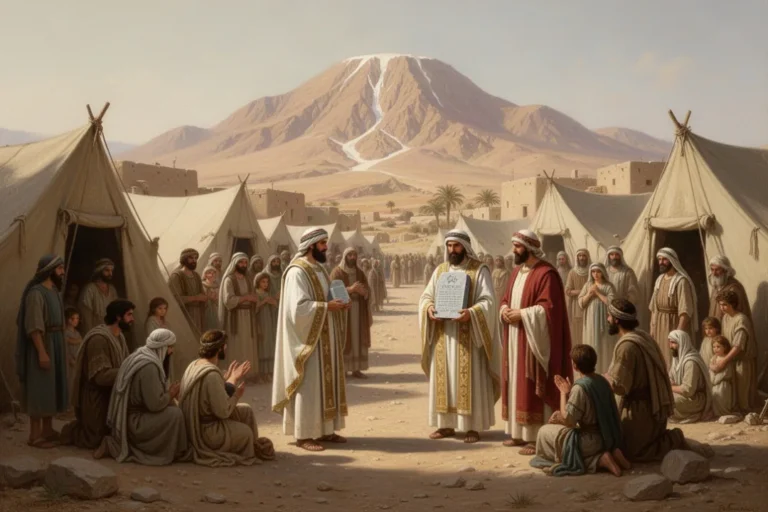
“Mosaic” means that the law is associated with Moses, the leader through whom God gave Israel these instructions. The Bible presents Moses as receiving and teaching the covenant at Mount Sinai, also called Horeb, after the Israelites were brought out of Egypt.
The Torah is broader than the word “law” may suggest in English. It includes stories about creation, the patriarchs, the exodus, Israel’s wilderness years, and Moses’ final speeches. Within that larger account, the Mosaic Law refers especially to the commandments and covenant requirements given to Israel.
A traditional Jewish enumeration identifies 613 commandments in the Torah. That number is a later way of organizing the commands, and different discussions may group or explain some instructions differently. The central point is that the Mosaic Law contains far more than the Ten Commandments.
How Israel received the law through the covenant
The law is presented as part of a covenant relationship between God and Israel. In Exodus, God first acts to rescue Israel from slavery in Egypt; the covenant instructions then define how this redeemed people should live as a distinctive community.
This order matters. The commandments are not presented merely as a ladder by which enslaved people could earn freedom. They are given to a people who have already been delivered, and they establish the responsibilities of belonging to that covenant.
Exodus 19–24 describes the covenant at Sinai. It includes God’s declaration that Israel is to be a treasured people, the giving of fundamental commandments, additional laws for community life, and a formal covenant ceremony. Deuteronomy later restates and applies the law for the generation preparing to enter the land.
Central idea: The Mosaic Law is best understood as the constitution of Israel’s covenant life: it joined worship, ethics, public justice, national identity, and everyday behavior.
The covenant also included blessings and consequences. Obedience was associated with life, stability, and flourishing in the land, while persistent rebellion brought judgment and could result in exile. These statements describe Israel’s national covenant and should not be reduced to a promise that every obedient individual will always experience wealth or freedom from suffering.
What subjects the Mosaic Law addresses
The law covers nearly every area of life in ancient Israel. Its commands cannot be separated neatly into modern categories, because worship, family, economics, public order, and personal conduct were all connected within the covenant community.
Worship, sacrifice, and the priesthood
Many instructions regulate the tabernacle, priests, sacrifices, offerings, and holy days. The sacrificial system included offerings connected with worship, thanksgiving, purification, restitution, and atonement. Priests served in the sanctuary, while the high priest had a distinctive role in the annual Day of Atonement described in Leviticus 16.
These rituals taught that approaching a holy God was not casual and that wrongdoing damaged the community’s relationship with God. They also created shared practices through which Israel confessed sin, expressed gratitude, marked sacred time, and maintained the sanctuary.
Leviticus contains rules concerning clean and unclean animals, bodily conditions, skin diseases, childbirth, and contact with death. Ritual uncleanness was not always the same as moral guilt. A person could become ritually unclean through an ordinary bodily process and then follow the required procedure for restoration.
These instructions helped Israel distinguish holy from ordinary, sacred space from common space, and covenant identity from surrounding cultures. Some purity rules also had practical effects for camp or community life, but their biblical purpose is primarily religious and symbolic rather than a modern medical code.
Festivals, Sabbath, and sacred time
The Mosaic Law sets apart the Sabbath and several annual festivals. Passover remembered Israel’s deliverance from Egypt, while the Feast of Unleavened Bread, the Feast of Weeks, the Feast of Booths, and other appointed times connected worship with harvest, history, and God’s provision.
Sabbath observance applied not only to individual Israelites but also to households, servants, resident foreigners, and even working animals within the community. The weekly rest command placed limits on labor and gave the whole society a recurring period of worship and relief.
Justice, property, and economic responsibility
The law contains rules about honest weights, theft, repayment, property boundaries, loans, wages, courts, and testimony. It repeatedly warns judges against partiality and commands the community to protect people who were vulnerable, including widows, orphans, immigrants, and the poor.
Israelite farmers were instructed to leave portions of crops for the poor and the foreigner to gather. Other provisions addressed debt, land, servants, and periodic rest for agricultural land. The system was designed to restrain exploitation and preserve the ability of families to remain part of the covenant community.
Family, sexuality, and community holiness
Some laws govern marriage, sexual behavior, childbirth, family duties, and offenses that threatened household stability. These commands are placed within the wider call for holiness, a concept that includes separation for God as well as integrity in relationships.
The law also addresses interpersonal conduct directly. Leviticus 19 connects worship with honest business, fair judgment, care for the poor, refusal to spread slander, and love for one’s neighbor. Its ethical vision is therefore much broader than ritual observance alone.
How the Ten Commandments relate to the Mosaic Law
The Ten Commandments, recorded in Exodus 20 and repeated in Deuteronomy 5, form a central summary of covenant obligations. They address exclusive worship of God, rejection of idols, reverence for God’s name, Sabbath, parental honor, murder, adultery, theft, false testimony, and coveting.
They are not the entire Mosaic Law. The commandments that follow explain how Israel’s covenant principles apply to worship, courts, property, injury, servitude, festivals, and many other circumstances.
A useful comparison is that the Ten Commandments provide a highly recognizable foundation, while the wider Mosaic Law supplies institutional and practical applications. Treating the Ten Commandments as the whole law leaves out much of the Torah’s teaching about sacrifice, priesthood, social responsibility, and national life.
Why God gave Israel the Mosaic Law
The law served several connected purposes. It identified Israel as a people belonging to God, taught the community how to worship, restrained injustice, and provided a framework for life in the land promised to the ancestors.
It also exposed the seriousness of sin. Commands about testimony, theft, violence, sexual wrongdoing, and false worship showed that faithfulness involved public behavior, not only private belief. The law’s sacrifices and purification rituals likewise communicated that sin and uncleanness affected the community’s access to holy space.
Another purpose was instruction. The Hebrew concept behind Torah carries the sense of teaching or direction, not only punishment-backed regulation. Parents were expected to teach the commands to their children, and the community was to remember its history through festivals, signs, recitation, and repeated practice.
The law also limited the power of the strong. Rules about leaving produce for the poor, paying workers, protecting resident foreigners, and avoiding dishonest measurements presented economic conduct as a matter of covenant faithfulness. Israel’s treatment of vulnerable people was repeatedly tied to its own memory of having been oppressed in Egypt.
The law’s commands join love for God with justice, mercy, honesty, and responsibility toward other people.
How Jewish tradition understands the Mosaic Law
In Judaism, the Torah is foundational to the Jewish relationship with God and to Jewish identity. The commandments are often called mitzvot, a term that can mean commandments or religious obligations. Jewish practice has developed through centuries of interpretation, debate, communal custom, and legal reasoning.
Jewish communities do not all interpret or practice the commandments in exactly the same way. Orthodox, Conservative, Reform, and other Jewish movements differ over the authority and application of traditional Jewish law, while individual practice also varies.
Some biblical commandments depend on the Temple in Jerusalem, the priesthood, or residence in the land of Israel, so they cannot be practiced in their original form today. Other commandments continue to shape Jewish worship, ethics, festivals, dietary practice, family life, Sabbath observance, and community identity.
It is misleading to describe Judaism as trying to earn God’s love through mechanical rule keeping. Jewish interpretations differ, but the commandments are generally understood within a relationship involving covenant, worship, repentance, study, community, and faithful living.
How Christians interpret the Mosaic Law
Christian interpretations begin with Jesus and the New Testament, but Christian traditions reach different conclusions about how the Mosaic Law applies after Jesus’ death and resurrection. Most Christians do not regard the entire Mosaic covenant as a direct legal code for the church, yet they continue to debate the law’s moral, theological, and educational significance.
In Matthew 5:17, Jesus describes his relationship to the Law and the Prophets as bringing them to fulfillment rather than treating them as meaningless. In the Sermon on the Mount, he intensifies attention to the heart’s motives, connecting outward actions with anger, lust, honesty, love, and reconciliation.
The book of Acts records a major early Christian dispute over whether non-Jewish believers had to take on the full obligations of Jewish covenant life. Acts 15 describes a decision that did not require Gentile believers to become Jews, while still giving them instructions for fellowship and holiness.
Paul’s letters argue that people are not justified before God by relying on “works of the law” as a basis for status. At the same time, Paul treats love, truthfulness, sexual integrity, generosity, and care for others as essential features of Christian life. The letter to the Hebrews interprets the priesthood and sacrifices through Christ, while Christian communities disagree over how each Old Testament command should be applied.
Common Christian frameworks for reading the law
Many Christian teachers use the categories moral, civil, and ceremonial to discuss the Mosaic Law. Moral laws are understood as expressing enduring principles, civil laws as governing ancient Israel’s national society, and ceremonial laws as regulating worship and ritual purity.
These categories can help organize the material, but the Bible itself does not present the law in three clearly labeled sections. A single command may involve ethics, worship, national identity, and community practice at the same time. Christians should therefore use the categories carefully rather than assuming they settle every question automatically.
Some Christians emphasize continuity, arguing that the law remains a valuable guide unless the New Testament clearly changes its covenant application. Others emphasize discontinuity, teaching that Christ has fulfilled the Mosaic covenant and that Christians are governed by the new covenant. Many churches combine these positions in different ways.
What the Mosaic Law means for readers today
The answer depends partly on your religious tradition. Jewish readers may approach the Torah as a living source of covenant obligation and communal practice, while Christian readers may study it as Scripture fulfilled and interpreted through Christ. Readers outside either tradition can examine it as a foundational body of religious, legal, and ethical material from ancient Israel.
Even when a command is not followed directly today, it may still reveal biblical concerns about holiness, justice, mercy, worship, community, and human dignity. The challenge is to identify what the command meant in its original setting before deciding whether and how its principle carries forward.
For example, a law about leaving the edges of a field for the poor cannot simply be transferred into a modern farming regulation without interpretation. It does, however, clearly communicate a concern that economic activity should make room for people in need rather than treating them as invisible.
Similarly, Sabbath laws arose within Israel’s covenant calendar and social structure. A modern reader may not apply them identically, but the command still raises substantial questions about rest, worship, limits on labor, and whether workers and dependents receive humane treatment.
Reading tip: Ask three questions of any command: What did it require in ancient Israel? What problem or purpose did it address? How does its underlying concern relate—or not relate—to your own covenant tradition and circumstances?
Common mistakes when studying the Mosaic Law
The Mosaic Law is easy to misunderstand when isolated verses are treated as a complete explanation. These practical safeguards can keep your reading closer to the text and to its historical setting.
Do not equate the law with the Ten Commandments alone. The Ten Commandments are central, but the law also includes worship, festivals, purity, courts, property, agriculture, and care for the vulnerable.
Do not treat every command as an individual rule detached from covenant. Many instructions assume Israel’s land, priesthood, sanctuary, tribal structure, or sacrificial system.
Do not assume “unclean” always means morally sinful. Ritual impurity and ethical guilt are related concepts but are not identical in every passage.
Do not impose later Christian categories too quickly. Moral, civil, and ceremonial divisions may be useful, but they are interpretive tools rather than labels supplied by the Torah itself.
Do not use one verse to erase the law’s wider emphasis. Commands about sacrifice should be read alongside commands about justice, mercy, honest dealings, and concern for the poor.
Do not assume all Jewish or Christian readers agree. Both traditions contain multiple interpretive communities, and statements about “what Jews believe” or “what Christians believe” often need qualification.
Do not read ancient penalties as a modern legal code without context. The laws belonged to Israel’s covenant society, courts, land, and political order; applying them today requires serious theological and historical reasoning.
A practical method for reading a Mosaic Law passage
Start by identifying the passage’s location and speaker. Ask whether it is part of the Sinai covenant, Moses’ restatement in Deuteronomy, a priestly instruction, a case addressing a particular offense, or a narrative that illustrates the law in practice.
Next, identify the people and setting assumed by the command. A law may address priests, landowners, judges, parents, farmers, soldiers, the whole assembly, or foreigners living among Israelites. That audience often determines how the command works.
Read the surrounding section. The verses before and after may define terms, give exceptions, or explain the command’s purpose.
Identify the covenant function. Determine whether the instruction marks holiness, protects property, regulates worship, limits violence, supports the poor, or maintains community order.
Compare related passages. Deuteronomy may restate a command from Exodus, while the prophets may criticize Israel for observing ritual while neglecting justice.
Distinguish description from prescription. A narrative may report an event without approving every action involved.
Consider your interpretive tradition. Jewish and Christian communities may read the same command through different covenant assumptions and interpretive authorities.
Apply the principle carefully. Avoid both extremes: copying an ancient regulation without context or dismissing it before asking what it teaches about God and human responsibility.
This method also helps with difficult passages. Some laws address practices such as slavery, warfare, or corporal punishment that raise serious moral questions for modern readers. Rather than hiding those difficulties, read the specific law alongside the Bible’s broader treatment of creation, human worth, liberation, justice, mercy, and the protection of the vulnerable.
Where to find the Mosaic Law in the Bible
The most concentrated material appears in Exodus 19 through 40, Leviticus, Numbers 5 through 36, and Deuteronomy, although commands and covenant themes occur elsewhere. Exodus includes the Sinai covenant and many social regulations. Leviticus focuses heavily on holiness, sacrifice, priests, purity, festivals, and ethical conduct.
Numbers combines wilderness narratives with laws concerning offerings, purity, vows, leadership, inheritance, and life in the land. Deuteronomy presents Moses’ speeches, renewing and interpreting the covenant for a new generation before Israel enters Canaan.
Other biblical books assume knowledge of the law. The historical books show Israel attempting, failing, or returning to covenant faithfulness. The Psalms celebrate God’s instruction, while the prophets insist that worship without justice is unacceptable. The New Testament frequently discusses the law in relation to Jesus, faith, sin, Gentiles, and the new covenant.
Reading the Mosaic Law well means seeing both its detailed commands and its larger purpose: forming a people whose worship of God was meant to shape public justice, personal conduct, communal memory, and care for neighbors.
Frequently asked questions
Is the Mosaic Law the same as the Old Testament?
No. The Old Testament is a collection of books, while the Mosaic Law refers especially to the covenant commandments given through Moses. In Jewish usage, Torah can mean the first five books as a whole and can also refer more broadly to divine teaching. The Old Testament includes historical books, poetry, and prophets beyond the Torah.
Did the Mosaic Law apply to everyone in the ancient world?
The covenant was given specifically to Israel, although some laws address foreigners living among the Israelites and some principles concern universal justice. The Bible does not present every Mosaic command as a legal obligation for every nation. Its original audience, land, sanctuary, priesthood, and national covenant all matter when interpreting its scope.
Why do Christians not normally keep all Mosaic laws?
Most Christian traditions believe Jesus established or fulfilled the new covenant, changing how laws concerning sacrifices, ritual purity, food, circumcision, and national Israel apply. Christians still debate the continuing authority of particular commands and principles. Their views are shaped by the Gospels, Acts, Paul’s letters, Hebrews, and their church’s theological tradition.
Are the Mosaic Law’s laws about justice still relevant?
Many readers, especially Christians and Jews, see the law’s concern for honest courts, fair wages, debt relief, immigrants, widows, orphans, and the poor as deeply relevant. Applying those concerns today does not mean reproducing ancient Israel’s entire legal system. It means interpreting the original purpose and considering how justice should be practiced in present circumstances.




Leave a Reply