Are you planning a christening and wondering what to write on the invitation? The best invitation for christening gives guests the essential information while reflecting the meaning of the day. It should tell people whose christening is taking place, when and where to attend, and what will happen afterward.
Your wording can be traditional, modern, religious, or simple. What matters most is that the invitation feels appropriate for your family and makes the arrangements easy for guests to understand. A well-planned invitation also helps you avoid common problems, such as leaving out the church address, confusing the ceremony time with the reception time, or failing to explain whether children are welcome.
What information belongs on a christening invitation
A christening invitation does not need to be lengthy, but it should answer the practical questions guests are likely to have. Begin with the child’s name and a clear statement inviting people to the ceremony. Then add the date, time, location, and reception details.
Use the official name of the church or venue rather than relying on a shortened name that local guests may not recognize. If the ceremony is held at a church, include the full street address, especially when visitors may be traveling from another town. A separate reception venue should have its own address and start time.
Child’s full name: Include the name as it will appear in the church’s records, if appropriate.
Type of celebration: Say whether the event is a christening, baptism, naming ceremony, or another form of welcome.
Date and time: List the ceremony time first, followed by the reception time if they are different.
Ceremony location: Provide the church or venue name and complete address.
Reception details: Add the location, meal information, and any change in timing.
RSVP instructions: Give a response deadline and one clear way to reply.
Additional information: Mention parking, dress expectations, accessibility, or a private reception when guests need to know.
Guests may also need to know who is hosting the event. For example, the invitation can be issued by the child’s parents, grandparents, or the entire family. Including host names is especially useful when some invitees know one side of the family better than the other.
If you are inviting someone to the ceremony but not the reception, make that distinction unmistakable. You might write, “Please join us for the christening at 11 a.m. A private family reception will follow”. This is more considerate than allowing guests to assume they are invited to every part of the day.
Practical check: Before sending the invitations, compare every date, time, and address with the church and reception venue. A small mistake can affect travel plans and attendance.
Consider adding a website or information card when the event involves many details. The main invitation can remain clean and personal, while a separate insert explains parking, hotel options, meal preferences, or the order of the day. Avoid putting so much information on the invitation that the central message becomes difficult to find.
How to choose the right wording and tone
The wording should match the kind of ceremony you are holding. A traditional Christian christening often uses language about welcoming the child into the church or asking loved ones to witness a sacred occasion. A more contemporary invitation may focus on gathering family and friends to celebrate the child’s life and faith.
There is no need to use formal religious language if it does not sound natural to your family. A warm sentence such as “Please join us as we celebrate Emma’s christening” is clear and respectful. If the child is older, you can make the wording more personal by referring to the child by name and inviting guests to share this meaningful milestone.
Choose one central voice rather than combining several styles. A very formal opening followed by casual slang can feel uneven. Likewise, a playful design may not fit a ceremony that the family considers deeply solemn. The invitation should give guests a sense of the atmosphere they can expect.
Traditional christening invitation wording
Traditional wording usually places the religious ceremony at the heart of the invitation. It may mention the child’s christening, baptism, or blessing and invite guests to witness the occasion. Parents can include the names of godparents if those relationships are an important part of the ceremony.
A traditional example might read:
With grateful hearts, John and Maria Thompson invite you to celebrate the christening of their daughter, Olivia Rose. The ceremony will take place on Sunday, June 14, at 11 a.m. at St. Andrew’s Church. Please join us for a reception afterward at our home.
This style works well for printed invitations, formal family gatherings, and ceremonies where older relatives appreciate conventional language. You can make it more personal by adding a short line about the child’s place in the family without making the message too long.
Modern and simple christening invitation wording
A modern invitation can be direct and less ceremonial while still honoring the occasion. This approach often suits digital invitations, casual receptions, and families who prefer plain language.
We would love for you to join us as we celebrate Noah’s christening. Please meet us at Grace Community Church on Saturday, August 22, at 2 p.m. A family dinner will follow at The Maple Room. Please reply to Sarah by August 1.
Simple wording is not impersonal. A short invitation can feel especially thoughtful when the design, photo, or handwritten note carries some of the emotion. Keep the language focused on the event and avoid adding phrases that sound copied from a generic template.
Faith-centered wording without a long quotation
Some families want the invitation to express their faith more clearly. You can do this with a brief statement about prayer, faith, or the child’s spiritual upbringing. If you include a Bible reference, cite the book and chapter rather than printing a full passage, since Bible translations use different wording and may have copyright restrictions.
For example, you might write “We give thanks for God’s gift of Daniel and invite you to share in his christening”. You could also mention a scripture reference separately, such as Psalm 127:3 or Mark 10:14, if it has personal significance to your family. The reference should support the invitation, not obscure the event details.
Christening invitation wording examples for different situations
The best template is one you can adapt to your family, ceremony, and guest list. Replace the sample names and details, then read the invitation aloud. If the wording sounds stiff, shorten it. If a guest could misunderstand the arrangements, add a practical sentence.
Parents hosting a traditional ceremony:
Michael and Lauren Davis request the pleasure of your company at the christening of their son, Henry James, on Sunday, April 19, at 10:30 a.m. at Holy Trinity Church, 48 Cedar Street, Boston. Please join us for lunch at the Davis home following the ceremony. Kindly reply by March 25.
Parents hosting a warm family celebration:
Please join us as we celebrate the christening of our daughter, Ava Grace. The service will be held at 1 p.m. on Saturday, May 9, at St. Luke’s Parish. We will gather for refreshments at the community hall afterward. We hope you can share this special day with us.
Grandparents inviting guests:
Robert and Elaine Miller invite you to celebrate the christening of their beloved grandson, Liam Thomas, son of James and Rebecca Miller. The ceremony will take place at 11 a.m. on Sunday, September 6, at Our Lady of Peace Church, followed by a family reception.
Invitation that includes the godparents:
With love and gratitude, we invite you to the christening of Sophia Rose. Please join her parents, Emily and David, and godparents Claire and Michael as they gather at St. Mark’s Church on Sunday, July 12, at 2 p.m. A reception will follow at the Garden Room.
Invitation for a private ceremony and larger gathering:
Our son, Benjamin, will be christened in a private family service on October 3. We would be delighted if you joined us afterward for a celebration at 4 p.m. at Willow Creek Farm, 210 Lake Road. Please let us know if you can attend the reception by September 10.
Wording for an older child:
With joy, we invite you to celebrate Isabella’s baptism as she takes this meaningful step in her faith. Please join Isabella and her family for the ceremony on Sunday, November 8, at 10 a.m. at St. Peter’s Church. A reception will follow in the parish hall.
Short digital invitation:
Join us for Lucas’s christening. Sunday, March 15, at noon, St. John’s Church, 16 Oak Avenue. Lunch will follow at the Carter home. Please RSVP to Megan at the phone number or email provided.
These examples can be adjusted for a baptism, blessing, dedication, or naming ceremony. Use the term that accurately describes the event being held. If your church uses a specific term, check with the minister, priest, or parish office before printing the invitations.
Respect the ceremony’s terminology: “Christening” and “baptism” are sometimes used interchangeably, but practices vary by denomination and congregation. Use the wording preferred by your church and family.
How to handle godparents, hosts, and family names
Christening invitations often include more family names than invitations for ordinary birthday parties. That can make the wording meaningful, but too many names may make the invitation difficult to read. Decide which relationships guests need to understand before adding every participant.
If the parents are hosting, their names usually appear in the opening or closing line. If grandparents are paying for the event or formally issuing the invitation, their names can be listed as hosts. Some families include both sets of grandparents, while others mention them in a separate line or on the reception card.
Godparents may be named when they have a formal role in the ceremony or when the family wants to recognize their relationship with the child. Their names are not required on every invitation. If they will participate in a special way, a sentence such as “Please join us with godparents Anna Lee and Marcus Green” gives guests useful context.
Be thoughtful when listing family members in a blended or extended family. The invitation should not unintentionally exclude a parent, stepparent, grandparent, or guardian who is an important part of the child’s life. Use names and relationships that reflect the family’s actual circumstances rather than following a rigid formula.
When parents have different last names, there are several clear options:
List both parents’ full names: “Jordan Lee and Taylor Morgan invite you…”
Use first names if the guest list knows the family well.
Include the child’s full name separately from the parents’ names.
Identify hosts at the end: “Hosted by the Morgan and Lee families.”
If the child’s name is private or not yet publicly announced, use a first name only or a phrase such as “our little one”. Make sure the church and close family members have the legal information they need, but do not assume every guest must receive it on the invitation.
When to send invitations and how to collect RSVPs
Send christening invitations early enough for guests to make travel arrangements, request time off, and choose a gift if they plan to bring one. For a local event, several weeks may be sufficient. If relatives will travel by plane, the ceremony falls near a holiday, or the venue has limited capacity, send the invitations earlier.
Some families send a save-the-date message first and follow with the formal invitation once the church and reception details are confirmed. This is useful when the date is fixed but the venue is still being arranged. Do not send the final invitation until the time and locations are reliable.
Set an RSVP deadline that gives you enough time to confirm the headcount with the reception venue. The deadline should be easy to see, and the response method should be simple. Guests are more likely to respond when they can reply by text, email, phone, or a website rather than having to use several methods.
Include the information needed for a useful response. If the reception includes a meal, ask guests to provide dietary requirements. If children are invited, request the number of adults and children attending. If seating is assigned, you may also need the names of each attendee.
Confirm the ceremony date and start time with the church.
Confirm the reception capacity, menu, and timing with the venue.
Choose the RSVP deadline and allow time to contact people who have not responded.
Send invitations through the method that suits your guest list.
Track replies in one place, including dietary needs and accessibility requests.
Give the final guest count to the venue and prepare a day-of contact plan.
Digital invitations can be convenient, particularly for a younger guest list or a celebration with changing details. Printed invitations may feel more appropriate for a formal church ceremony or for relatives who value a physical keepsake. You can use both approaches as long as every guest receives the same information and no one is accidentally left out.
For mailed invitations, check the address and postage before sending the complete batch. For digital invitations, test every link and confirm that the RSVP form works on a phone. Save a copy of the final wording so you can answer questions consistently.
Design, etiquette, and final checks before sending
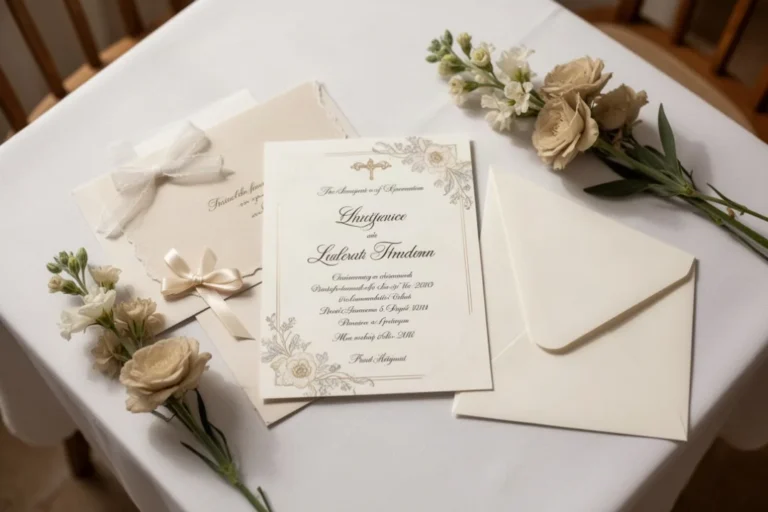
The design should make the event details easy to find. A soft color palette, a family photograph, a cross or dove motif, or a simple floral border can suit a christening, but the decoration should not compete with the child’s name, ceremony time, or location.
Choose a readable typeface and use enough contrast between the lettering and background. Script fonts can look elegant for a name or short heading, but long paragraphs in decorative lettering are difficult to read. If older relatives are among the guests, prioritize clear type and a generous font size.
A photograph is optional. If you use one, choose a well-lit image that feels suitable for the occasion. A professional portrait is not necessary; a natural photograph of the child can make the invitation personal. Avoid including private information such as a home address unless it is also the reception location.
Traditional etiquette does not require a gift request on the christening invitation. If guests ask what the child needs, the parents can answer privately. A registry may be included on a separate information page when culturally appropriate, but placing gift details prominently on a religious invitation can make the celebration feel transactional.
Dress guidance is helpful when the ceremony has a formal expectation or when the reception takes place outdoors. Use plain wording such as “Sunday best attire requested”, “Please dress for an outdoor reception”, or “The church is not climate controlled”. Do not assume every guest knows local church customs.
Review the wording for both accuracy and tone. Check that the child’s name is spelled correctly, the date includes the correct day of the week, and the RSVP contact can be reached. Ask another person to proofread because the host often overlooks familiar details.
Read the invitation from the guest’s point of view.
Confirm that the ceremony and reception times cannot be confused.
Check all names, punctuation, phone numbers, email addresses, and web links.
Explain whether guests should attend the ceremony, reception, or both.
Make sure the design is readable in print and on a phone.
Keep a digital copy and a record of who received an invitation.
Finally, send a brief reminder a few days before the event if guests need directions, parking details, or a change in schedule. The reminder should support the original invitation, not replace it. A clear invitation gives the day a thoughtful beginning and helps family and friends arrive prepared to celebrate with you.
Frequently asked questions
Is a christening invitation different from a baptism invitation?
The wording can be different depending on your church’s tradition, but the practical information is largely the same. Use the term preferred by your congregation and include the child’s name, ceremony details, reception information, and RSVP instructions. If you are unsure which term is correct, ask the church office before ordering printed invitations.
Should godparents be named on the christening invitation?
Naming godparents is optional. Include them if they have a visible role in the ceremony or if recognizing their relationship is meaningful to your family. If the invitation becomes crowded, list the parents and child on the main invitation and mention godparents on a separate program, reception card, or personal note.
How far in advance should christening invitations be mailed?
Send them several weeks before a local event, allowing more time when guests must travel, the ceremony falls near a holiday, or the reception has limited seating. A save-the-date message can help guests plan while you finalize the church, venue, menu, and other arrangements.
Can I send a christening invitation by text or email?
Yes, digital invitations are suitable when they fit your guest list and the formality of the event. Make sure every guest receives the complete ceremony and reception details, and test any RSVP link before sending it. For older relatives or a formal celebration, you may prefer printed invitations or a combination of print and digital messages.







Leave a Reply