March for Jesus: meaning, history, and how to participate
March for Jesus: meaning, history, and how to participate
If you have seen a March for Jesus advertised in your city, you may wonder whether it is a parade, a worship service, a protest, or something else. The short answer is that it is a public Christian gathering in which people walk, pray, sing, and openly express their faith in Jesus Christ.
The exact format depends on the organizers and location. Some marches are small neighborhood events with local churches. Others bring together congregations from many denominations for music, prayer, short messages, and community outreach. Most are intended to be peaceful, welcoming, and centered on Jesus rather than on a political party or a single church.
A March for Jesus gives Christians a visible way to celebrate their faith outside a church building. Participants may carry signs with Christian messages, sing worship songs, pray for their city, and speak with people along the route. The public setting matters because the event connects private belief with shared worship and community presence.
For many participants, the march expresses several ideas at once. It can be an act of praise, a prayer for local neighborhoods, an invitation to learn about Christianity, and a statement that Christians from different traditions can cooperate. Organizers often emphasize unity, peace, hope, service, and love of neighbor.
The word “march” can make the event sound confrontational, but a March for Jesus is generally not designed as a demonstration against a particular person or group. It is usually a faith-based procession. Some events include outreach projects or calls to serve the community, but their central purpose is public Christian witness and worship.
Keep the focus clear: A March for Jesus is usually about publicly honoring Jesus and praying for the community, not pressuring people to agree or turning a worship gathering into a partisan rally.
How the March for Jesus movement developed
Modern March for Jesus events grew from Christian prayer and evangelism gatherings in the United Kingdom during the late 1980s. Churches and Christian leaders from different backgrounds began organizing large public walks that combined worship, prayer, and outreach. The idea later spread to other countries and was adapted to local customs, laws, and church communities.
Because the movement crossed denominational lines, it did not belong to one particular church organization. Evangelical, charismatic, Pentecostal, mainline Protestant, Catholic, and independent Christian groups may participate in different places, although the mix varies from city to city. Some events use a broad statement of faith, while others are organized by a narrower network.
Over time, organizers have used different names and formats. A local gathering might be called a March for Jesus, a Jesus march, a prayer walk, or a citywide worship procession. The name alone does not tell you exactly what will happen, so checking the official event information is wise.
Large international gatherings have sometimes drawn attention to the global nature of Christianity, while smaller marches have focused on a town, campus, neighborhood, or region. The scale can range from a few congregations walking together to a substantial public event requiring route planning, permits, volunteers, medical support, and transportation coordination.
What usually happens at a March for Jesus
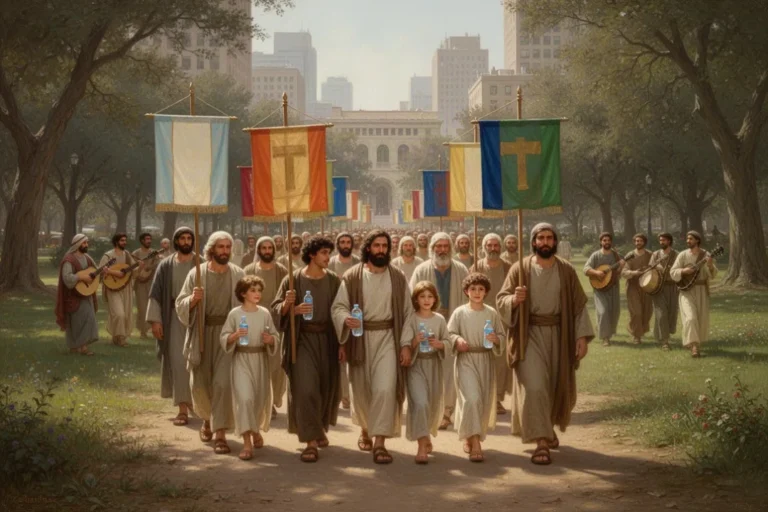
Although every event is different, the day often follows a recognizable pattern. Participants gather at a starting point, receive instructions, and join an opening prayer or worship session. The group then follows a planned route, often with music, banners, and prayer stations, before ending at a park, church, stadium, or other public venue.
A typical schedule may include:
Arrival and registration: Participants meet volunteers, learn the route, and receive wristbands, maps, or group instructions.
Opening worship: Musicians, pastors, or prayer leaders help set the spiritual focus of the gathering.
Prayer along the route: Groups may pray for schools, families, public officials, churches, hospitals, businesses, or neighborhoods.
Music and public messages: Worship songs, personal testimonies, brief sermons, and announcements may take place during the walk or at the final gathering.
Community activities: Some organizers offer food distribution, service projects, children’s activities, counseling, or information about local churches.
Closing service: The event may end with collective prayer, worship, a message about Jesus, or an invitation to connect with a church or ministry.
Not every participant takes part in every activity. Some people join for the entire route, while others attend only the opening or closing gathering. Families may come for a short portion, and volunteers may arrive early to help with logistics. The event’s official schedule will tell you whether there are age limits, accessibility arrangements, registration requirements, or transportation changes.
How to decide whether a local event is right for you
Before attending, read the organizer’s public information carefully. Look for the sponsoring churches or ministries, the stated purpose, the route, the schedule, and a contact person. A trustworthy event should explain its expectations without hiding who is responsible for it.
Ask yourself what you hope to do there. You may want to worship with other Christians, pray for your community, learn about local churches, accompany a family member, or observe the event. Knowing your purpose can help you choose the right portion of the day and avoid feeling pressured to participate in activities that do not fit your needs.
These questions can help you evaluate the event:
Who organized the march, and which churches or ministries are involved?
Does the event describe itself as worship, outreach, prayer, protest, or a combination?
Are the route and meeting locations clearly published?
How will children, older adults, and people with disabilities be supported?
Are there instructions about weather, water, restrooms, parking, and public transportation?
Does the event have a clear policy against harassment, threats, and discriminatory behavior?
Will photography or video recording take place in public areas?
A public Christian event may include teaching or practices that differ from your own church tradition. That does not necessarily make it inappropriate, but you should know what to expect. If you are attending with children or someone unfamiliar with Christianity, explain that the event may include singing, prayer, preaching, personal stories, and invitations to visit a church.
How to prepare for a March for Jesus
Preparation is mostly practical. A march may involve standing or walking for several hours, waiting in a crowded area, and spending time outside. Check the forecast, wear comfortable shoes, and bring clothing suitable for changing conditions. A small bag with water, sunscreen, necessary medication, identification, and a portable phone charger can be useful.
Read the instructions about what you may bring. Some venues or public safety plans restrict large bags, glass containers, umbrellas, signs, amplified equipment, or outside food. If you plan to carry a banner, make sure its wording and size follow the organizer’s rules and local requirements.
People who have medical conditions should plan ahead rather than assume they can find assistance after arriving. Tell a trusted companion about relevant needs, keep medication accessible, and identify rest points or exits. If you use a wheelchair, walker, or other mobility device, ask in advance whether the route includes steep grades, stairs, uneven sidewalks, or alternative access.
Families benefit from a simple meeting plan. Public gatherings can separate people quickly, especially when music, crowds, and movement are involved. Choose a meeting location, write down a contact number for each child, and make sure children know which volunteers or uniformed officials they can approach for help.
Confirm the details: Recheck the date, start time, meeting point, route, and ending location shortly before the event.
Plan transportation: Expect road closures, limited parking, and changes to public transit near the route.
Dress for the conditions: Wear supportive shoes and bring weather-appropriate layers.
Pack the essentials: Carry water, identification, medication, and a charged phone.
Set a meeting plan: Decide where your group will reunite if anyone becomes separated.
Agree on boundaries: Discuss how your group will respond to conversations, photography, and invitations from other ministries.
How to participate respectfully in public
Joining a public religious event gives you an opportunity to represent your faith through conduct as well as words. Follow the route, listen to volunteers, keep entrances and sidewalks clear, and avoid blocking emergency access. Treat people who are watching, asking questions, or declining conversation with basic courtesy and freedom of conscience.
Public witnessing does not require arguing with strangers. If someone asks a sincere question, answer honestly and briefly. If a conversation becomes hostile, step away and alert an event volunteer when appropriate. Do not pursue people who have said no, and do not use threats, insults, or personal information to make a religious point.
Signs and chants should reflect the event’s stated purpose. Messages about Jesus, prayer, hope, forgiveness, service, and peace are generally consistent with a worship-centered march. Messages that target a race, religion, nationality, sexual orientation, political affiliation, or individual person can damage the event’s witness and may violate the organizer’s rules or local law.
Photography deserves consideration too. Public events are often photographed, but children and people who prefer not to appear in images should be treated with care. Ask before taking close photographs of individuals, and follow any designated policies for media, livestreaming, and recording.
A useful standard: Let your public behavior support the message you are carrying. Patience, self-control, hospitality, and care for vulnerable participants often communicate Christian conviction more effectively than confrontation.
Prayer is commonly one of the central activities, not merely an opening or closing ceremony. Participants may pray silently or aloud as they pass schools, government buildings, hospitals, neighborhoods, houses of worship, or areas affected by poverty and violence. The prayers may ask for peace, wisdom, healing, justice, repentance, protection, and opportunities to serve.
Different churches understand public prayer in different ways. Some groups use prepared prayer points, while others invite spontaneous prayers from small teams. A prayer leader may encourage participants to pray quietly rather than speak through a loudspeaker. These variations are normal, and you can participate in a way consistent with your conscience.
Christian prayer during a march should not be used to shame people who happen to be nearby. A prayer for a city can acknowledge real needs without treating residents as problems to be fixed. The most constructive approach combines spiritual concern with practical compassion, such as supporting shelters, mentoring programs, food assistance, addiction recovery services, or neighborhood partnerships.
Many participants connect the march with biblical themes such as loving God, loving one’s neighbor, caring for the poor, seeking peace, and sharing the message of Jesus. Those themes can guide the event’s tone even when organizers come from different traditions. Scripture references may be used in speeches or on signs, but quotations should be presented accurately and respectfully.
How a March for Jesus differs from a political demonstration
The distinction is not always absolute. Christians may care deeply about public issues, and an event may include prayer for government or concern about a social problem. Still, a March for Jesus is generally defined by worship and Christian witness, while a political demonstration usually seeks to influence a policy, support a candidate, oppose a government action, or pressure a public institution.
Review the event’s language before attending. If the organizers emphasize a candidate, ballot measure, legislative demand, or campaign organization, the gathering may function primarily as a political rally even if Christian language is used. If the stated purpose is praise, prayer, evangelism, and unity among churches, it is closer to the traditional March for Jesus model.
This distinction matters for participants who want a nonpartisan religious gathering. It also matters for churches that have policies about political activity, endorsements, or use of church property. Ask organizers how speakers and signs will be handled if the event’s purpose is not clear.
How churches and volunteers can organize one
Organizing a public march requires more than choosing a date and inviting people to walk. The planning team needs a defined purpose, a realistic route, responsible leadership, and communication with local authorities and affected communities. Requirements differ by city, so organizers should contact the appropriate municipal offices well in advance.
A strong planning process usually covers these areas:
Purpose and message: Write a short statement explaining the event’s Christian focus, intended audience, and expectations.
Church cooperation: Invite congregations to participate without requiring them to abandon their distinctive traditions.
Permissions and insurance: Determine whether permits, liability coverage, traffic control, sound approvals, or park reservations are required.
Route design: Choose a manageable path with safe crossings, rest opportunities, accessible surfaces, and a suitable ending location.
Volunteer roles: Assign leaders for registration, route guidance, first aid, children, accessibility, transportation, media, and conflict response.
Communication: Publish accurate details and provide a way to report changes, emergencies, or lost participants.
Aftercare: Offer follow-up connections for people seeking prayer, a church, counseling, Bible study, or practical support.
Organizers should speak with nearby residents, businesses, schools, houses of worship, and public agencies when the route affects them. Advance notice reduces confusion and demonstrates respect for people who are not attending. Clear signage, cleanup teams, and prompt removal of temporary materials can help the event leave a positive impression.
Safety planning should be specific rather than symbolic. Assign people to watch for heat illness, dehydration, falls, lost children, crowd compression, and emergencies. Establish how leaders will respond if weather changes, the route becomes unsafe, a participant needs medical attention, or a disagreement escalates.
How to connect the march with lasting service
A single public gathering can encourage people, but its effect is stronger when it leads to consistent local service. Churches can use the event to introduce existing ministries rather than presenting the march as an end in itself. Participants may be invited to volunteer with food programs, visit nursing homes, support foster families, mentor students, or help with disaster recovery.
Good follow-up respects the needs of the community. Instead of assuming that a neighborhood needs outside rescuers, churches can listen to local leaders and partner with organizations already doing the work. Practical help should be offered without making assistance conditional on attending a service or making a public profession of faith.
Organizers can evaluate the event by asking more than how many people attended. Useful questions include whether the route was safe, whether local residents were treated respectfully, whether newcomers found clear information, and whether the event created reliable opportunities for prayer and service. Honest evaluation can improve future gatherings and keep the focus on faithfulness rather than spectacle.
What to expect if you are exploring Christianity
You do not need to know every Christian belief or belong to a church before attending as a guest. You may observe, ask questions, sing if you wish, or simply walk with the group. A respectful event should allow you to participate without pretending to believe something you do not yet accept.
You may hear a short explanation of the gospel, which usually centers on humanity’s need for reconciliation with God through Jesus, Jesus’ death and resurrection, and the invitation to respond with faith. Different churches explain these teachings with different language and emphasis. If a speaker’s message raises questions, ask for a one-on-one conversation afterward rather than feeling obligated to make an immediate decision.
Use ordinary discernment. You should not be asked for money in a coercive way, pressured to reveal private information, or told to ignore medical, family, or legal responsibilities. If someone offers prayer, you can decide whether to accept. A healthy Christian gathering makes room for questions, protects personal dignity, and points people toward trustworthy local support.
Why Christians continue to participate
For committed Christians, a March for Jesus can provide a visible expression of belonging to a wider church. People who worship in different congregations may discover shared convictions and form relationships that continue beyond the event. The public setting can also remind participants that faith involves how they treat neighbors, not only what they say during worship.
Some attend because they want to pray for their city. Others come to support friends, volunteer, worship with family, or encourage churches to cooperate. The reasons may differ, but the event’s strongest expression is usually found in humble public faith: honoring Jesus while treating every person along the route with dignity.
A well-organized March for Jesus leaves people with more than images of a crowd. It creates space for prayer, honest conversation, worship, and practical service. Whether you attend for an hour or help plan the entire gathering, the most meaningful participation combines clear Christian conviction with patience, safety, and genuine concern for the community.
Frequently asked questions
Is March for Jesus affiliated with one denomination?
No single denomination owns every March for Jesus event. The movement has traditionally brought together Christians from multiple church traditions, but each local gathering has its own organizers, beliefs, speakers, and policies. Check the event’s official statement of faith and participating churches to understand its theological background before attending.
Can someone who is not Christian attend a March for Jesus?
Usually, yes. Public events commonly welcome guests, observers, and people who are exploring Christianity. You can listen, walk with friends, or ask questions without claiming beliefs you do not hold. Review the organizer’s rules, and remember that participation in singing, prayer, or other activities is generally a personal choice.
Do I need to register before attending?
Registration requirements vary. A free public march may not require individual registration, while organizers might request sign-ups for crowd planning, transportation, volunteer assignments, or access to a closing venue. Check the official event page for deadlines, identification requirements, group registration instructions, and any capacity limits.
What should I do if I disagree with something at the event?
You can remain respectful, step away from a conversation, or leave the event. If you experience harassment, threats, or unsafe conduct, contact an event volunteer or public safety official. For a theological disagreement, ask a sincere question when appropriate, but do not feel obligated to debate in a crowded public setting.






Leave a Reply