Psalm 24 KJV: Text, meaning, and prayerful reflection
Psalm 24 KJV: Text, meaning, and prayerful reflection
Psalm 24 KJV presents the Lord as the owner of the whole earth, the holy King who deserves faithful worship. The psalm begins with God’s authority over creation, asks who may stand before him, and ends with a repeated call for the King of glory to enter.
Its ten verses move through three connected ideas: God owns the world, his worshipers should pursue integrity, and the Lord reigns as the victorious King. The complete King James Version text appears below, followed by an explanation of its language, structure, and meaning.
1 The earth is the LORD'S, and the fulness thereof; the world, and they that dwell therein.
2 For he hath founded it upon the seas, and established it upon the floods.
3 Who shall ascend into the hill of the LORD? or who shall stand in his holy place?
4 He that hath clean hands, and a pure heart; who hath not lifted up his soul unto vanity, nor sworn deceitfully.
5 He shall receive the blessing from the LORD, and righteousness from the God of his salvation.
6 This is the generation of them that seek him, that seek thy face, O Jacob. Selah.
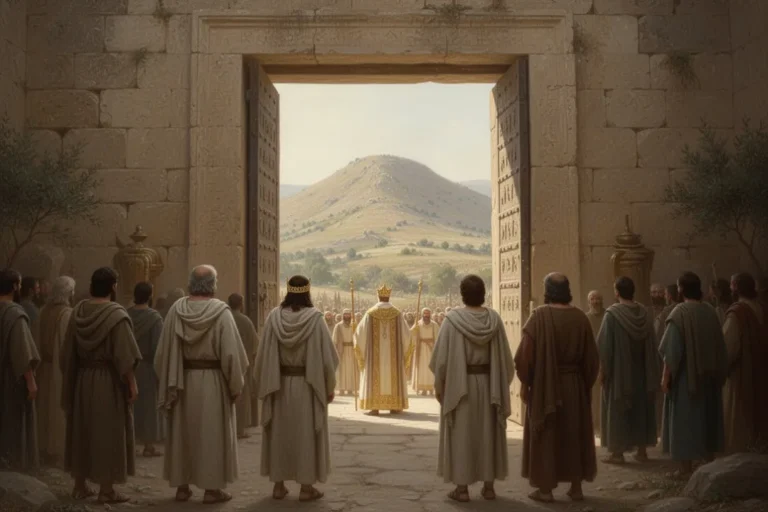
7 Lift up your heads, O ye gates; and be ye lift up, ye everlasting doors; and the King of glory shall come in.
8 Who is this King of glory? The LORD strong and mighty, the LORD mighty in battle.
9 Lift up your heads, O ye gates; even lift them up, ye everlasting doors; and the King of glory shall come in.
10 Who is this King of glory? The LORD of hosts, he is the King of glory. Selah.
Central message: Psalm 24 joins worship with character. The God who owns creation calls people to approach him with honest actions, sincere hearts, and a persistent desire to seek his presence.
Context and setting of Psalm 24
Psalm 24 is traditionally associated with David, although the psalm itself does not identify the event that prompted its composition. Its language fits a public procession or worship gathering in which the people celebrate the Lord’s presence and kingship. The references to gates, doors, and the “King of glory” create the sense of a formal entrance into a sacred place.
The psalm may be read as a liturgical dialogue. A worship leader or group announces a truth, asks a question, or gives a command. Another group responds, especially in the repeated question, “Who is this King of glory?” The effect is both instructional and celebratory: worshipers learn who God is and answer by naming his strength and authority.
The earth and the seas: These images point to God as Creator and rightful owner of everything that exists.
The hill and holy place: They refer to the place of worship and, more broadly, to the privilege of coming into God’s presence.
The gates and everlasting doors: They portray a majestic entrance for the divine King.
The King of glory: This title emphasizes God’s honor, power, and victorious rule.
The psalm is short, but its movement is carefully arranged. It starts with the widest possible view—the whole earth—and then turns inward to the moral life of an individual worshiper. It finishes by lifting the reader’s attention upward again, toward the Lord’s universal reign.
How Psalm 24 is organized, step by step
Reading the psalm in sections makes its progression easier to see. Each movement answers a different question about worship and God’s rule.
Who owns the world? Verses 1–2 answer that the earth belongs to the Lord because he created and established it.
Who may approach God? Verses 3–6 describe a person whose conduct and inner motives are marked by integrity.
What does God give his people? Verse 5 speaks of blessing and righteousness from the God who saves.
Who enters through the gates? Verses 7–10 identify the entering King as the Lord, strong and mighty, the Lord of hosts.
How should worshipers respond? They should seek God’s face, recognize his authority, and welcome his righteous rule.
This structure prevents the psalm from being reduced to only one theme. It is not merely a creation psalm, a moral instruction, or a royal hymn. It brings all three concerns together: creation, holiness, and kingship.
What “the earth is the LORD’S” means
The opening statement is comprehensive: “The earth is the LORD’S, and the fulness thereof.” In KJV English, “fulness” means everything that fills or belongs within the earth. The next phrase, “the world, and they that dwell therein,” makes the scope even clearer. God’s claim extends to the land, its resources, its nations, and every human being.
Verse 2 grounds that claim in creation. The Lord “founded” the earth upon the seas and established it upon the floods. The language presents a world that exists because God ordered and sustains it. It is poetic rather than a technical description of physical geography. The point is that even what appears unstable or overwhelming remains subject to the Creator.
This opening has ethical consequences. If the earth belongs to God, human beings are not ultimate owners in an absolute sense. People may possess homes, land, money, or authority under ordinary social arrangements, but those gifts remain accountable to the One who made them. Ownership becomes stewardship.
The verses also challenge a narrow view of worship. God is not limited to a building or a religious gathering. The Lord of the holy place is also the Lord of the oceans, communities, workplaces, families, and ordinary human responsibilities. Recognizing his ownership can shape how you treat other people and how you use what has been placed in your care.
What “clean hands and a pure heart” means
Psalm 24:3 asks, “Who shall ascend into the hill of the LORD? or who shall stand in his holy place?” The question is about access to God. Verse 4 answers with two complementary descriptions: clean hands and a pure heart.
“Clean hands” represent visible conduct. Hands can symbolize what a person does—whether those actions are honest, just, compassionate, or harmful. The phrase does not claim that a worshiper has never failed. It points toward a life that is not characterized by deliberate wrongdoing or hypocrisy.
“A pure heart” concerns the inner person: motives, desires, loyalties, and thoughts. Someone may perform an outwardly respectable action while seeking selfish recognition or concealing a dishonest purpose. Psalm 24 therefore refuses to separate religious behavior from inward sincerity. God cares about both what people do and why they do it.
The two phrases work together:
Clean hands without a pure heart can describe outward respectability without genuine devotion.
A claimed pure heart without clean hands can become an excuse for ignoring practical obedience.
Clean hands and a pure heart together describe integrity between a person’s conduct and inner commitments.
This is why the verse is often used for self-examination. Before worship, prayer, leadership, or public service, you can ask whether your actions match your stated faith. The question is not whether you have achieved flawless perfection. It is whether you are willing to confess wrong, reject deceit, and let God reform both behavior and motive.
The meaning of “not lifted up his soul unto vanity”
The expression “lifted up his soul unto vanity” uses older language that can be misunderstood. In this context, vanity refers to what is empty, false, worthless, or morally deceptive. To lift up one’s soul to vanity is to give deep loyalty or desire to something that cannot rightly command it.
The phrase may include idolatry, but its application is broader. A person can treat wealth, status, pleasure, political power, or personal approval as an ultimate good. When a temporary thing becomes the center of trust, it becomes a form of vanity in the psalm’s sense. The issue is not simply possessing created things; it is allowing them to replace God as the object of devotion.
This line also speaks to the direction of desire. People do not merely think about idols or ambitions; they can lift their whole soul toward them. Psalm 24 asks whether your deepest allegiance is attached to what is true and lasting or to something that cannot save, satisfy, or endure.
Why the psalm condemns deceitful speech
The final description in verse 4 concerns the person who has not “sworn deceitfully.” This refers to dishonest promises, false testimony, and words used to mislead others. A vow gives another person a reason to trust you, so breaking it deliberately damages both truth and relationship.
The connection between deceitful speech and holy worship is significant. The psalm does not treat religious language as a substitute for trustworthy behavior. Someone may speak reverently about God while using promises, contracts, testimony, or private assurances to manipulate people. Psalm 24 places truthfulness at the center of spiritual integrity.
Practical honesty can involve small decisions as well as serious public commitments. It may mean correcting an exaggeration, admitting what you do not know, keeping a promise, or refusing to use spiritual words to conceal selfish motives. The psalm’s standard reaches beyond avoiding obvious lies; it calls for a life that can be trusted.
What blessing and righteousness mean in verse 5
Psalm 24:5 says that the faithful person will receive “the blessing from the LORD, and righteousness from the God of his salvation.” The verse does not present good behavior as a way to force God to reward someone. Instead, it describes the gracious response of the God who saves and establishes those who seek him.
Blessing in the Bible can include God’s favor, protection, provision, peace, and the good that comes from living under his care. It should not be reduced to financial success or a trouble-free life. The psalm does not promise that a faithful person will avoid every hardship. It points to the goodness of belonging to God.
“Righteousness from the God of his salvation” emphasizes that right standing is received from God. The worshiper is not presenting personal virtue as an independent achievement. The Lord is the source of both salvation and righteousness. This keeps the passage from becoming a simple lesson in self-improvement.
A useful balance: Psalm 24 calls for sincere obedience, but it also directs the worshiper to receive righteousness from God. Faithful living is a response to divine grace, not a way to make God indebted to you.
Who is “the generation” that seeks God’s face?
Verse 6 identifies “the generation of them that seek him.” Here, generation does not have to mean only people born during the same period. It can describe a community defined by a shared character and devotion. These are people who orient their lives toward God rather than merely participating in outward religious activity.
The phrase “seek thy face” expresses a desire for God himself. Seeking God’s gifts is not the same as seeking God’s face. A person may pray mainly for relief, success, health, or direction. Those requests can be appropriate, but this verse points beyond benefits to personal fellowship with the Lord.
The reference to “O Jacob” connects the worshiping community with Israel’s covenant identity. Jacob was the ancestor whose name became associated with the nation of Israel. The wording can also remind readers that the people seeking God are not presented as naturally flawless. They belong to a history marked by both God’s faithfulness and human weakness.
“Selah,” which appears at the end of verse 6 and verse 10, is a musical or liturgical marker found throughout the Psalms. Its exact meaning is uncertain, but it likely signals a pause, musical interlude, or moment for reflection. When reading Psalm 24, pause after the call to seek God’s face and again after the declaration that the Lord is King of glory.
Why the gates lift up their heads
Beginning in verse 7, the psalm changes from instruction to a dramatic proclamation: “Lift up your heads, O ye gates.” The gates are addressed as though they were living witnesses. They are commanded to rise or open so that the King of glory may enter.
The image can refer to the gates of a city or sanctuary, but the exact physical setting is less important than the message. The Lord is approaching as a royal conqueror, and the entrance must be worthy of him. The repeated command creates a sense of anticipation and grandeur.
“Everlasting doors” does not mean that the physical doors have existed eternally. The language magnifies their dignity and permanence in poetic form. They represent the boundary between ordinary space and the place associated with divine presence. Even the most imposing entrance must open before the Lord.
The command also has a personal application. Human beings can resist God’s rule through pride, fear, self-reliance, or cherished wrongdoing. The gates become a picture of the heart and community. To lift them up is to become receptive to the King whose authority is greater than every competing power.
Who is the King of glory in Psalm 24?
The question “Who is this King of glory?” is repeated twice, and the answers develop the description. First, he is “the LORD strong and mighty,” and “the LORD mighty in battle.” The second answer calls him “the LORD of hosts,” followed by the declaration that he is the King of glory.
These titles emphasize several aspects of God’s character:
Strong and mighty: The Lord possesses power that does not depend on human support.
Mighty in battle: God is portrayed as victorious over opposition and able to defend his purposes.
Lord of hosts: This title presents him as the commander of heavenly armies and the sovereign ruler over all forces.
King of glory: His majesty, honor, and worth exceed every earthly claim to kingship.
The repeated question is more than a poetic flourish. It teaches worshipers to identify the God they praise. Faith is not directed toward an undefined spiritual force. Psalm 24 names the Lord as Creator, Savior, warrior, and King.
For Christian readers, the language of the King entering through the gates has also been connected with the victory and exaltation of Jesus Christ. Psalm 24 itself speaks directly of the Lord’s kingship without narrating the New Testament events. Christians may read its royal imagery alongside passages about Christ’s resurrection, ascension, and reign, while keeping the psalm’s original emphasis on the glory and authority of God.
How to pray Psalm 24 KJV
Psalm 24 can guide a prayer that moves from praise to examination and then to surrender. Its sequence helps keep prayer from becoming only a list of requests. You can use the following pattern slowly, allowing each section to shape your words.
Praise God as Creator. Acknowledge that the earth, its people, and everything you possess belong ultimately to the Lord.
Examine your conduct. Ask where your “hands” have been unclean through harmful, dishonest, or unjust actions.
Examine your motives. Consider whether your heart is divided by pride, resentment, approval-seeking, greed, or misplaced trust.
Confess false loyalties. Name the “vanity” that has occupied too much of your attention or dependence.
Ask for truthful speech. Seek grace to keep promises, speak accurately, and repair damage caused by dishonesty.
Seek God’s face. Pray not only for what God can provide, but for deeper desire to know and obey him.
Welcome the King. Surrender a specific area of resistance and acknowledge the Lord’s authority over it.
You can pray the psalm in the morning before work, before a worship service, or during a period of moral decision-making. It also fits communal worship because the repeated questions naturally invite a leader-and-congregation response.
How Psalm 24 applies to daily life
The psalm’s first application is stewardship. Since the earth belongs to the Lord, your treatment of people and possessions should reflect responsibility rather than entitlement. This can affect how you handle money, property, natural resources, time, and authority.
Its second application is integrity. “Clean hands and a pure heart” calls for consistency when no one else can see what you are doing. Private choices matter because worship is not limited to public appearances. A sound reputation is valuable, but Psalm 24 reaches deeper than reputation to character.
Its third application is discernment. The warning about vanity asks you to identify what has captured your trust. Ask what you fear losing most, what occupies your thoughts, and what you believe you must have in order to be secure. Those answers may reveal where a good thing has become an ultimate thing.
Its fourth application is hope. The final verses do not portray the world as ruled by chaos or human strength. They proclaim the Lord as the strong and victorious King. That confidence can steady you when circumstances appear beyond your control, while still calling you to act truthfully and responsibly.
Questions for personal reflection on Psalm 24
Use these questions for private prayer, group discussion, or Bible study:
What changes when you regard the people and resources around you as belonging to God?
Which part of your outward conduct needs greater honesty or correction?
What desire has begun to receive more trust than it deserves?
Are your spoken promises dependable, or do you sometimes use words to avoid responsibility?
Do you seek God’s presence, or mainly the benefits you hope to receive from him?
What would it mean to welcome the Lord’s authority in one specific area of your life?
Which title for the King of glory—strong, mighty, victorious, or Lord of hosts—speaks most clearly to your present circumstances?
Psalm 24 does not separate reverence from everyday conduct. It begins with the whole world under God’s ownership, examines the worshiper’s hands and heart, and ends with the Lord entering as King. Its lasting invitation is to live with humble stewardship, truthful character, and confidence in God’s authority.
Frequently asked questions
What is the main message of Psalm 24 KJV?
Psalm 24 teaches that the Lord owns the entire earth, deserves worship, and reigns as the glorious King. It also explains that those who approach God should pursue honest actions, sincere motives, and truthful speech. The psalm joins God’s universal authority with a personal call to integrity and a community’s joyful recognition of his presence.
What does “clean hands and a pure heart” mean?
“Clean hands” describe upright outward behavior, while “a pure heart” describes sincere inner motives. Together, the phrases call for integrity between what you do and why you do it. They do not suggest that a person earns salvation through flawless conduct; they describe the character of someone who genuinely seeks God and turns away from deceit.
Why does Psalm 24 repeat “Who is this King of glory?”
The repetition creates a dramatic worship dialogue and reinforces the identity of the Lord. The answers describe him as strong, mighty in battle, and the Lord of hosts. Repeating the question allows worshipers to declare together that God—not human rulers, military power, wealth, or personal ambition—is the true and glorious King.
How can I use Psalm 24 in prayer?
Read the psalm slowly and respond to each movement. Praise God as Creator, confess actions or motives that need correction, ask for truthful speech, and surrender misplaced loyalties. End by acknowledging God as the King of glory. You can use it privately, in family worship, or as a responsive reading with a congregation.







Leave a Reply