Hymns: meaning, history, types, and how they shape worship
Hymns: meaning, history, types, and how they shape worship
Hymns are songs written for praise, prayer, teaching, or shared religious reflection. They are usually designed for a congregation to sing together, often with a melody that can be repeated across several verses. Some hymns are ancient, while others were written recently for churches, funerals, ceremonies, and personal devotion.
The word can describe both a musical form and a religious purpose. A hymn may celebrate God, retell a biblical theme, express sorrow, ask for guidance, or give thanks. Its value is not limited to the age of the text: a hymn works when its words are meaningful, its melody is singable, and its message suits the people using it.
What hymns are and how they differ from other religious songs
A hymn is generally a structured song of faith intended for worship or spiritual use. It commonly has multiple stanzas, also called verses, that share one melody. Each stanza develops a related idea, so the singer moves through a sequence of praise, confession, teaching, remembrance, hope, or commitment.
Many hymns use a regular meter. Meter describes the pattern of stressed and unstressed syllables in each line, helping different words fit the same tune. A familiar tune can therefore be paired with more than one text. Churches sometimes name these pairings separately, with the text and tune treated as distinct parts of the hymn.
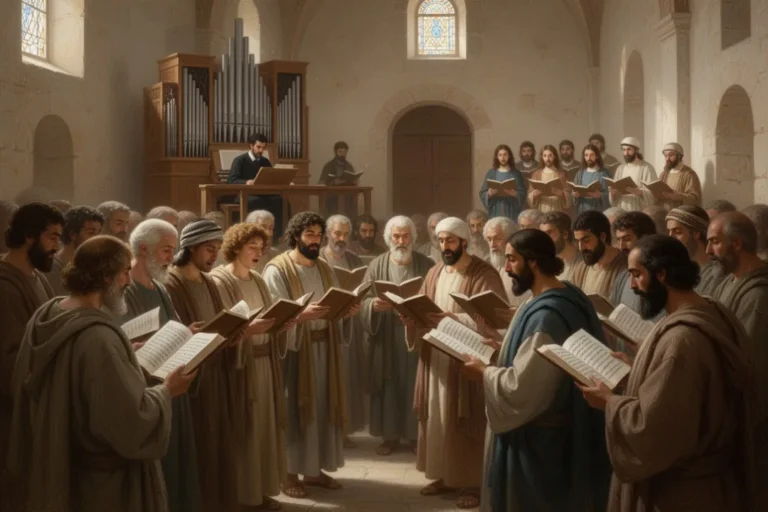
Congregational singing is central to the traditional hymn. The music normally stays within a range that many people can sing, and the rhythm tends to be steady enough for a group to follow. A hymn does not need to be musically simple, but its design usually supports participation rather than placing the entire burden on a soloist.
The boundary between a hymn, a worship song, a spiritual, and a religious anthem is not fixed. Different denominations and musicians use these terms in different ways. Still, these general distinctions can help:
Hymns often use several stanzas, a regular meter, and a melody intended for communal singing.
Worship songs may use repeated refrains, contemporary musical styles, and a less formal verse structure.
Spirituals emerged from the religious experience of African Americans, especially under slavery, and often carry distinctive rhythms, call-and-response patterns, and themes of deliverance.
Anthems are frequently performed by a choir or ensemble, although a congregation may listen rather than sing every part.
Psalms are sacred poems associated with the biblical Psalter; they may be spoken, chanted, or adapted into hymn form.
These categories overlap. A modern song may be called a hymn because a church uses it regularly for communal praise, while an older hymn may be performed as a choral anthem. Use and context often matter as much as musical structure.
A practical test: Ask whether the song helps a group sing a shared religious message. If the answer is yes, it may function as a hymn even if it does not follow every traditional convention.
How hymns developed from ancient worship to modern churches
The history of hymns reaches back to the earliest religious communities. Ancient peoples used songs to praise their gods, remember sacred stories, mark festivals, and express grief or gratitude. In the Jewish tradition, the Psalms provided a large collection of poetic prayers and songs that later influenced Christian worship.
Early Christians inherited Jewish scripture and worship practices while developing their own songs about Jesus, salvation, resurrection, and the life of the church. Some New Testament passages appear to preserve early Christian poetic material, but the text does not always tell us exactly how these passages were performed. Early Christian communities also used psalms, short acclamations, and longer devotional compositions.
As Christian worship developed, different regions created distinct musical traditions. Plainchant, including the form often associated with Gregorian chant, used flowing melodies for worship in medieval Western churches. Much of this music was sung by clergy or choirs rather than by a full congregation, although it shaped the sound and structure of later sacred music.
The Protestant Reformation changed congregational singing in many parts of Europe. Reformers promoted songs in languages ordinary worshipers could understand, and printed hymn collections helped spread them. Martin Luther wrote and adapted hymns for German-speaking congregations, linking memorable melodies with teaching and participation.
In England, hymnody expanded significantly during the seventeenth and eighteenth centuries. Isaac Watts wrote paraphrases and original texts that connected biblical themes with Christian experience. Later, Charles Wesley produced a large body of hymns covering repentance, grace, communion, Christmas, Easter, and personal faith.
American churches developed their own traditions through European inheritance, revival movements, camp meetings, gospel publishing, and African American musical creativity. Nineteenth-century hymnody included formal church hymns, simple revival songs, and gospel songs designed for strong emotional response. Composers and writers such as Fanny Crosby contributed texts that became widely known in Protestant worship.
The twentieth and twenty-first centuries brought further changes. Churches adopted new instruments, popular musical styles, local languages, and forms influenced by global Christianity. Some communities continue to sing hymns from older hymnals, while others use newly written songs alongside them. Many congregations combine both approaches, valuing historical depth and current expression at the same time.
Common types of hymns and the purposes they serve
Hymns can be grouped by subject, occasion, musical style, or place in a service. These categories are not exclusive. One song may be both a Christmas hymn and a hymn of praise, while another may serve as a prayer of confession and a song of hope.
Hymns of praise and adoration
These hymns focus on the character, power, goodness, or holiness of God. Their language may celebrate creation, divine mercy, majesty, or faithfulness. They are often used at the beginning of worship, but they can appear anywhere a congregation wants to turn its attention toward praise.
Hymns about Jesus and Christian belief
Many hymns describe the life, death, resurrection, or teaching of Jesus. Others express central beliefs about the Trinity, salvation, grace, or the church. Because a hymn can present ideas in memorable poetic form, it often functions as theology set to music. People may remember a theological concept through a stanza long after they have forgotten a spoken explanation.
Seasonal and festival hymns
Church calendars have inspired large bodies of music. Christmas hymns may focus on the birth of Jesus, incarnation, peace, or wonder. Easter hymns commonly address resurrection and new life. Other seasonal collections cover Advent, Lent, Pentecost, harvest celebrations, saints’ days, weddings, and funerals.
Prayer, confession, and lament
Not every hymn is joyful in tone. Some ask for forgiveness, guidance, strength, or healing. Others give voice to grief, doubt, injustice, or spiritual absence. Lament hymns are especially valuable because they allow a congregation to acknowledge suffering without pretending that every experience is easy or resolved.
Mission, justice, and service hymns
These songs call worshipers to love their neighbors, care for the vulnerable, seek justice, or serve the wider world. They may draw on biblical images of hospitality, liberation, compassion, and reconciliation. Their use can connect private faith with public responsibility, although the wording should be considered carefully so that complex social issues are not reduced to vague slogans.
Hymns for particular ceremonies
Weddings, baptisms, funerals, ordinations, and memorial services often use hymns chosen for their subject and emotional tone. A wedding hymn might emphasize covenant and shared love. A funeral hymn may express trust, grief, resurrection hope, or the promise of God’s presence. The best choice respects both the religious setting and the people taking part.
For praise: choose a text that celebrates God clearly and gives the congregation a comfortable range.
For reflection: choose words that allow silence, uncertainty, or emotional honesty.
For teaching: select a hymn whose language supports the service’s central theme.
For a ceremony: consider the occasion, the community’s tradition, and the experience of guests who may not know the song.
How hymn words, melodies, and structure affect worship
A hymn communicates through several elements at once. Words carry the explicit message, melody shapes emotional response, rhythm influences energy, and repetition helps people remember. When these parts support one another, a congregation can sing with both understanding and feeling.
The text usually develops through a series of stanzas. The first may introduce a theme, later stanzas may explain or deepen it, and the final stanza may turn toward hope, commitment, or praise. Reading the words before singing can reveal a progression that is easy to miss when attention is focused only on the tune.
Poetic language gives hymns lasting power, but it can also create difficulties. Older texts may use unfamiliar vocabulary, formal grammar, or images that no longer communicate clearly. Some contain ideas about gender, suffering, human worth, or other subjects that a congregation may need to examine rather than repeat automatically.
Melody determines who can participate. A tune that rises too high, moves too quickly, or contains irregular rhythms may work well for a trained soloist but frustrate a congregation. Leaders can select a different key, introduce the melody before the first verse, or choose a simpler arrangement without changing the text.
Harmony adds another layer. Four-part hymn singing, often written for soprano, alto, tenor, and bass, allows different vocal lines to combine into a full sound. Some churches read these parts from a hymnal, while others rely on an organ, piano, guitar, band, or recorded accompaniment.
Repetition can support memory and shared identity. Singing the same hymn at regular times may connect different generations and link a present service with the community’s history. At the same time, too much repetition without explanation can make a song feel automatic. Familiarity is most meaningful when singers understand why the hymn belongs in that moment.
Hymns also create a form of collective speech. A person may hesitate to say a prayer aloud, yet feel able to join a group in singing one. The shared voice can express beliefs that individuals hold with different levels of certainty, making room for personal interpretation within a common act.
“Make a joyful noise unto the Lord.” — Psalm 100:1
This biblical reference is often associated with congregational music because it emphasizes participation rather than polished performance. The phrase does not require every singer to have formal training. It suggests that worship music can be an offering of the whole community, including people whose voices are quiet, changing, or imperfect.
For worship leaders: Test a hymn in the actual space, with the available instruments and likely singers. A strong choice on paper may not work if the key, pace, or arrangement makes participation difficult.
How to choose, teach, and use hymns well
Choosing a hymn begins with the purpose of the gathering. A service centered on comfort calls for different words from one focused on celebration or repentance. Start with the theme of the occasion, then consider the congregation’s musical ability, tradition, age range, and familiarity with the text.
Review the words rather than choosing by title alone. A hymn may have a familiar tune but contain several stanzas that no longer fit the service. You may use selected verses, provided the sequence still makes sense. If the text is difficult or historically dated, decide whether a brief explanation, a modern adaptation, or another hymn would serve the congregation better.
Melody selection deserves equal attention. A tune may be beautiful but unsuitable for the room or the singers. Consider these practical questions:
Can most people sing the highest and lowest notes comfortably?
Does the rhythm allow worshipers to enter together?
Is the tempo slow enough for clear words but active enough to maintain direction?
Will the accompaniment support the melody without overpowering the voices?
Does the tune match the emotional character of the text?
Teaching an unfamiliar hymn does not require a long rehearsal. A leader can explain the theme in one or two sentences, sing or play the melody once, and invite the congregation to join on the next pass. Dividing the song into short phrases may help, especially when the tune includes unusual intervals or a repeated refrain.
Printed hymnals remain useful because they provide words, musical notation, indexes, and information about authors or tunes. Digital displays can make large type and selected verses easier to see, but they should be checked carefully for errors. Accurate wording matters, particularly when a hymn is being used to teach or preserve a tradition.
Accessibility should be part of the decision. Provide large-print materials when possible, make sure the room’s acoustics support people with hearing loss, and avoid assuming that everyone can stand for the entire song. Instrumental volume, lighting, projected text, and the amount of time between verses can all affect participation.
Copyright can also matter when using newer hymns. A church, school, publisher, or event organizer may need permission or a license to reproduce words, print music, project lyrics, or make recordings. Older works may be in the public domain, but the specific arrangement or edition can still have separate rights. Check the relevant publisher or licensing service instead of assuming that a familiar song is free to copy.
Hymns can be used beyond a formal worship service. Families may sing them at home, teachers may use them to introduce religious history, and choirs may perform them in concerts. In each setting, explain the cultural or theological context when needed. A song becomes more accessible when listeners know why it was written and what its images mean.
How to explore hymns across traditions and generations
Exploring hymns thoughtfully means listening beyond one denomination or language. Different traditions emphasize different musical forms, instruments, vocal styles, and theological themes. A hymn sung with an organ and four-part harmony may sound very different from one led through call and response, yet both can support communal worship.
Begin with a hymnal or collection from the community you want to understand. Look at its index by topic, season, scripture reference, and first line. Notice which subjects appear often and which voices or historical periods are represented less frequently. The contents of a hymnal can reveal what a community teaches, remembers, and considers important.
Compare several versions of the same text when available. A translation may change the wording, poetic rhythm, or theological emphasis. A new tune can make an old text feel solemn, celebratory, intimate, or expansive. Listening to these differences shows that hymns are living forms, not museum pieces with only one correct performance.
Pay attention to authorship and cultural setting. A hymn may have traveled across countries, been translated into many languages, or entered a tradition through colonial or missionary history. Appreciating a hymn does not require ignoring those histories. Responsible use includes learning who created it, how it was adopted, and whether the original community’s meaning has been preserved.
For personal reflection, choose a small group of hymns rather than trying to hear everything at once. Read each text slowly, identify its central image, and notice the movement from one stanza to the next. Then listen to or sing the melody and ask how the music changes your understanding of the words.
A useful listening plan can include:
Select one hymn of praise, one hymn of lament, and one hymn connected to a festival or ceremony.
Read the words without music and mark unfamiliar terms or images.
Learn who wrote the text and tune, when possible, using a reliable hymnal or publisher’s information.
Listen to more than one arrangement, paying attention to tempo, instruments, harmony, and vocal style.
Consider whether the hymn speaks clearly to your setting and how it might be adapted respectfully.
Hymns endure because they combine communal memory with present expression. They can carry a congregation through celebration, grief, uncertainty, and hope while giving people language to share. Their forms continue to change, but their central purpose remains recognizable: bringing people together through meaningful words and music shaped for faith.
Frequently asked questions
Are all hymns meant to be sung in church?
No. Many hymns are written for congregational worship, but they are also used in homes, schools, funerals, weddings, concerts, and private devotion. Some are read as poetry or played instrumentally. Their religious purpose remains central, even when the setting is not a formal service.
Why do some hymns have several different tunes?
Hymn texts and melodies are often treated as separate works. A text with a regular meter can fit multiple tunes with the same syllable pattern. Churches may choose different melodies because of regional custom, musical preference, season, or the skill of the available singers and musicians.
What makes a hymn easy for a congregation to sing?
A singable hymn usually has a comfortable vocal range, a steady rhythm, clear phrasing, and a melody that can be learned through repetition. The accompaniment should support rather than cover the voices. Familiar words and a well-organized verse structure also make participation easier.
Can a contemporary worship song be considered a hymn?
Yes, depending on how the term is being used. Traditional definitions often emphasize stanzas, regular meter, and congregational singing, while broader modern usage includes many newer songs written for shared worship. The distinction varies among churches, publishers, and musicians.


Leave a Reply