The Trinity is the Christian belief that there is one God in three distinct persons: God the Father, God the Son, and God the Holy Spirit. Christians do not mean that God is one person who appears in three forms, or that Christianity teaches belief in three separate gods.
In traditional Christian teaching, the Father, Son, and Holy Spirit share the same divine nature and are each fully God. They are distinct from one another, yet they are not divided into three beings. The Trinity describes who God is: one divine being existing eternally as three persons.
The word Trinity does not appear in the Bible. Christians use it as a concise term for a teaching they believe is shown across Scripture: there is one God, the Father is God, the Son is God, the Holy Spirit is God, and the three are personally distinct.
The term developed as Christians sought a clear way to express these biblical claims together. The doctrine does not claim that the word itself is a biblical title. Instead, it serves as a theological description of the relationship among the Father, Son, and Holy Spirit.
The Trinity became especially important because early Christians were trying to answer several questions at once. How could they remain faithful to belief in one God while worshiping Jesus? How should they understand the Holy Spirit, who acts personally and divinely? And how could they describe the relationship between the Father and the Son without making either one less than fully divine?
The central statement: Christianity teaches one God in being or essence, eternally existing in three persons. The Father is not the Son, the Son is not the Spirit, and the Spirit is not the Father—but each is fully God.
The four claims that form the doctrine
Understanding the Trinity becomes easier when the teaching is separated into its main claims. Christians hold all of these claims together rather than choosing only one or two.
There is one God. Christianity is monotheistic, meaning it teaches that only one true God exists.
The Father is God. The Father is the source and sender described throughout the New Testament.
The Son is God. Jesus Christ is not merely a human teacher or an exalted created being; orthodox Christianity teaches that he shares the divine nature.
The Holy Spirit is God. The Spirit is not simply an impersonal force but acts, speaks, guides, and relates to believers as a divine person.
The Father, Son, and Holy Spirit are distinct persons. The Father sends the Son, the Son prays to the Father, and the Spirit is sent by the Father and the Son in Christian teaching.
These claims explain why the Trinity can sound difficult. If someone says “the Father is God, the Son is God, and the Spirit is God,” it may seem to follow that there are three Gods. The doctrine responds that the three share one divine being, not three separate divine beings.
What “one God in three persons” means
The words being and person are useful, though they do not remove every mystery. “Being” answers the question, What is God? The Christian answer is one divine nature. “Person” answers the question, Who is God? The answer names the Father, the Son, and the Holy Spirit.
In everyday speech, “person” usually means an independent individual with a separate nature. That ordinary meaning can make the phrase “three persons in one being” sound like three human individuals sharing a category. Trinitarian theology uses the word more precisely to describe real personal distinctions within the one divine life.
The Father, Son, and Spirit are not three parts that add up to God. Each is fully and completely divine. The Father is not one-third of God, and the Son is not another third. Christians also do not teach that God changes from one person into another at different times.
The three persons are distinguished by their relationships. The Father is not begotten and does not proceed from another person. The Son is eternally begotten of the Father, and the Spirit eternally proceeds according to traditional Christian language. These expressions describe eternal relationships, not events that happened at a point in time.
What Christians believe about the Father, Son, and Holy Spirit
The Father
The Father is presented as the one who sends the Son into the world and gives the Spirit. Calling God “Father” does not mean God is male in a biological sense. It expresses a personal relationship within God and God’s relationship with creation.
The Father is not older than the Son or greater in divine nature. Although Christian worship and Scripture often describe different actions associated with the persons, the Father remains fully equal in deity to the Son and the Holy Spirit.
The Son, Jesus Christ
Christianity teaches that Jesus Christ is the eternal Son of God who became human. This means Jesus has a genuine human nature while remaining fully divine. The incarnation is therefore different from the idea that an ordinary person was later promoted to divine status.
Jesus’ prayers to the Father, obedience, suffering, and death belong to his human life and mission. They do not prove that the Son is a lesser deity. Instead, Trinitarian Christianity distinguishes between Christ’s divine identity and the human life he assumed.
The Son’s role is central to Christian salvation. Christians believe that through Jesus’ life, death, and resurrection, God acts to reconcile people to himself. The Son reveals the Father and makes God known in a uniquely personal way.
The Holy Spirit
The Holy Spirit is understood as God’s personal presence and active power, not as an impersonal energy. The Spirit teaches, leads, comforts, gives spiritual gifts, convicts people, and empowers the Christian community.
The Spirit is sometimes represented symbolically by wind, fire, water, or a dove. These images describe the Spirit’s activity, but they do not reduce the Spirit to a physical object or force. The Spirit remains a distinct divine person who acts intentionally.
In Christian experience, the Spirit applies the work of Christ to believers. The Spirit is associated with new life, holiness, prayer, worship, and the formation of the church as a community.
Where Christians see the Trinity in the Bible
The Bible does not present the Trinity in a single paragraph containing a formal definition. Instead, Christians draw the doctrine from several patterns and passages. The Old Testament strongly emphasizes that there is one God, while the New Testament gives Jesus and the Holy Spirit roles and identities that Christians understand as divine.
Some passages distinguish the Father, Son, and Spirit together. At Jesus’ baptism, for example, the Son is baptized, the Spirit is associated with a dove-like sign, and the Father speaks from heaven. The scene does not provide a philosophical explanation, but it presents the three as distinct and active at the same time.
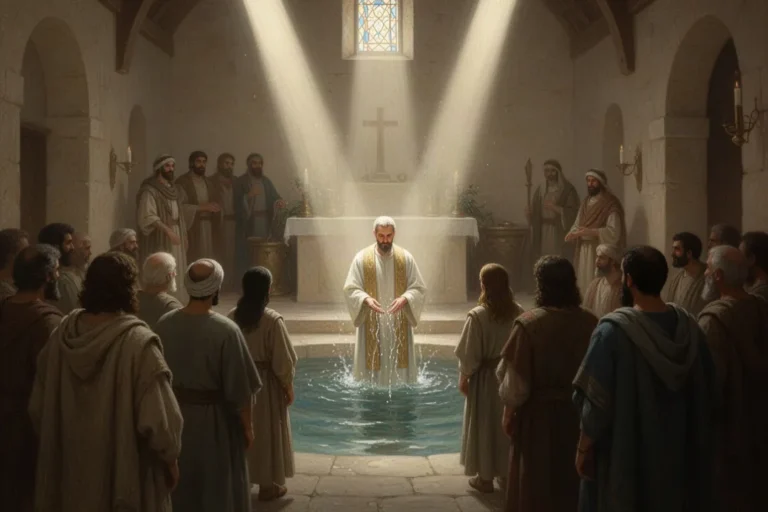
Jesus also commands his followers to baptize people in the name of the Father, Son, and Holy Spirit. Christians see the singular word “name” paired with the three persons as significant, because it places them together within one sacred identity.
Other New Testament passages describe Jesus in ways Christians understand as divine. The opening of John’s Gospel presents Jesus as the eternal Word who was with God and shared God’s nature, then explains that the Word became human. Other passages identify Jesus with God’s creative work, authority to forgive sins, and role as the object of worship.
The Holy Spirit is likewise described in personal and divine terms. The Spirit searches, speaks, teaches, and can be resisted or grieved. In the account of Ananias and Sapphira, deception directed toward the Holy Spirit is treated as deception directed toward God.
God is one: Deuteronomy 6:4 and Isaiah 45:5 emphasize monotheism.
The Father, Son, and Spirit appear together: Matthew 3:13–17 and Matthew 28:19 provide important triadic passages.
Jesus is presented as divine: John 1:1–18, Philippians 2:5–11, and Colossians 1:15–20 are central texts for Christian interpretation.
The Spirit acts personally and divinely: John 14–16 and Acts 5:1–11 are frequently discussed in this connection.
The three are named together in blessing: 2 Corinthians 13:13 is often used as evidence of an early Trinitarian pattern.
These references should be read in context rather than treated as isolated proof texts. Different Christian traditions emphasize different passages, but the broad Trinitarian pattern comes from reading the Bible’s teaching about God, Jesus, and the Spirit as a unified whole.
How the doctrine developed in early Christianity
The first Christians inherited Jewish belief in one God. At the same time, they worshiped Jesus, prayed in his name, and experienced the Holy Spirit as God’s presence among them. The doctrine of the Trinity developed as the church worked to express these convictions without abandoning monotheism.
Early Christian writers used Greek terms such as ousia, meaning essence or nature, and hypostasis, meaning person or subsistence. English explanations often summarize their position as one essence and three persons. The vocabulary was philosophical, but the underlying concern was practical: Christians wanted language that protected the central claims of their faith.
The Council of Nicaea in the fourth century rejected the idea that the Son was a created being who was less divine than the Father. Its creed described the Son as sharing the same divine essence as the Father. Later discussions gave more precise attention to the Holy Spirit and helped establish the language used in historic Christian creeds.
These councils did not create the belief that Christians had never considered before. They formalized boundaries around teachings that had been debated for generations. The resulting creeds became influential in Roman Catholic, Eastern Orthodox, Anglican, and many Protestant churches.
Not every Christian group accepts the Trinity. Some churches teach that Jesus is subordinate to God or created by God. Others teach that God is one person who appears in different modes. These views differ from historic Trinitarian Christianity, which maintains that the three persons are eternally distinct and equally divine.
Many common explanations accidentally change the doctrine. A careful understanding becomes clearer by identifying the ideas Christianity rejects.
Not three gods: The Father, Son, and Holy Spirit are not three separate divine beings who cooperate like a committee.
Not one person wearing three masks: God is not a single person who sometimes acts as Father, sometimes as Son, and sometimes as Spirit.
Not three parts of God: The persons are not partial pieces that must be combined to make a complete God.
Not one God who changes forms: The Father, Son, and Spirit are distinct at the same time, not successive appearances across history.
Not a ranking of divine beings: The Son and Spirit are not lesser gods or semi-divine creatures.
Not a claim that God is three in the same way he is one: Christians say God is one in essence and three in person, not one and three in the same sense.
These distinctions matter because the Trinity is not meant to be a mathematical statement such as one equals three. It is a claim about different categories: one “what” and three “whos.” That formula is a teaching aid, not a complete explanation of divine existence.
A caution about illustrations: Ice, water, and steam suggest one substance in three forms, while an egg suggests three parts of one object. Both examples can misrepresent the Trinity because they imply changing modes or incomplete portions rather than three eternal, fully divine persons.
Why the Trinity is connected to Christian salvation
For Christians, the Trinity is more than an abstract definition of God. It shapes the way salvation is understood. The Father sends the Son, the Son lives, dies, and rises for humanity, and the Holy Spirit brings people into the benefits of Christ’s work.
This pattern does not mean the three persons have conflicting goals. Christian theology teaches that the Father, Son, and Spirit act together as one God. At the same time, Scripture and Christian worship assign distinct roles to each person so believers can speak meaningfully about God’s work.
The doctrine also explains why Jesus can reveal God without being merely a messenger. If the Son is eternally divine, then Jesus’ life is understood as God personally entering human history. Christians therefore see the incarnation as God’s own action rather than the mission of a created representative.
The Holy Spirit’s role gives the doctrine a present dimension. Christians believe the Spirit does not merely provide information about God but brings believers into fellowship with God. Prayer, worship, moral transformation, and the life of the church are understood as works of the Spirit.
How the Trinity shapes Christian prayer and worship
Christian prayer may be addressed to the Father, through the Son, and in the Holy Spirit. This pattern reflects the belief that access to God comes through Christ and is made possible by the Spirit. Christians may also pray directly to Jesus or invoke the Holy Spirit, depending on their tradition.
Baptism is commonly performed in the name of the Father, Son, and Holy Spirit. Many churches also use Trinitarian blessings, hymns, and creeds. These practices teach that Christian faith is not directed toward an anonymous deity but toward the God known through these three persons.
Trinitarian worship also influences how Christians understand love. The Father, Son, and Spirit are believed to exist in eternal relationship, so love is not something God began to practice only after creating the world. The doctrine presents relational communion as part of God’s eternal life.
That idea should not be used to reduce God to a human family or social group. The persons of the Trinity do not have separate wills that compete with one another. Christian theology maintains both real relationship and perfect unity.
Why the Trinity is considered a mystery
When Christians call the Trinity a mystery, they do not necessarily mean that it is meaningless or irrational. They mean that the doctrine refers to a reality believed to be revealed by God but not fully comprehensible to finite human minds.
Christians can state what the doctrine denies and affirms, but they cannot picture God as though God were a physical object. The Trinity concerns the eternal nature of God, which is not directly available to ordinary human observation.
A mystery can therefore have a clear outline without being completely explainable. Christians can say that God is one, that the Father, Son, and Spirit are each divine, and that the three are distinct, while admitting that no analogy perfectly captures how this is possible.
Questions people commonly ask about the Trinity
Is the Trinity explicitly stated in the Bible?
The word itself is not used in the Bible, and no single passage gives the full doctrine in later creedal language. Christians see the teaching as the combined result of biblical claims about one God, the divine identity of Jesus, the deity and personhood of the Holy Spirit, and the distinction among the three.
Jesus’ statements are interpreted differently by Christian groups, but historic Christianity understands his words, actions, worship, and relationship with the Father as evidence of his divine identity. The New Testament presents Jesus’ divinity through a collection of claims and narratives rather than one modern-style sentence.
Does believing in the Trinity mean believing in three gods?
No. Trinitarian Christianity is monotheistic. It teaches that the Father, Son, and Holy Spirit are three distinct persons who share one divine nature. The persons are not separate beings with separate divine substances, so the doctrine does not mean that three gods cooperate or divide the work of deity.
Why is the Trinity difficult to explain?
The doctrine describes God’s inner nature rather than something humans can observe directly. Ordinary examples tend to compare the Trinity with objects that have parts or forms, which can distort the teaching. Christians therefore use careful language while recognizing that the Trinity remains partly beyond complete human comprehension.
How major Christian traditions describe the Trinity
Roman Catholic, Eastern Orthodox, Anglican, and most Protestant churches affirm the historic doctrine of the Trinity. They generally agree that the Father, Son, and Holy Spirit are one God, equal in divinity, eternal, and personally distinct.
Some differences concern the wording used to describe the Spirit’s eternal relationship to the Father and the Son. These differences contributed to a long-standing division between Western and Eastern Christian traditions, but both sides confess belief in the Trinity.
Many contemporary churches focus less on technical terms and more on the practical language of worship: the Father creates and sends, the Son redeems, and the Spirit gives life and transforms. Such descriptions are meaningful as long as they do not imply that the persons have unequal divine status or operate independently.
When a church’s teaching is unclear, its creed, catechism, statement of faith, or worship practices can show whether it holds the historic Trinitarian position. The labels used by individual churches are not always enough, because groups may use similar words with different meanings.
What to remember when explaining the Trinity
A clear explanation should begin with the central claim instead of an imperfect analogy. Say that Christianity teaches one God in three persons, then identify the Father, Son, and Holy Spirit as each fully divine and personally distinct.
It also helps to explain why the doctrine exists. Christians are trying to remain faithful to monotheism while taking seriously the biblical presentation of Jesus and the Holy Spirit. The Trinity is the traditional framework used to hold those convictions together.
If someone finds the teaching difficult, that reaction is understandable. The doctrine is not intended to make God easy to visualize. Its purpose is to speak carefully about the God Christians believe has made himself known as Father, Son, and Holy Spirit.
Frequently asked questions
Is the Trinity the same as the Christian belief in one God?
Yes. The Trinity is how historic Christianity explains monotheism alongside belief in the Father, Son, and Holy Spirit. Christians believe there is one divine being, not three gods. The three persons share the same divine nature, while remaining genuinely distinct from one another in their relationships and actions.
Are the Father, Son, and Holy Spirit equal?
Historic Christian teaching says they are equal in divinity, eternity, and glory. The persons may have different roles in creation, redemption, and spiritual transformation, but those roles do not make one person more divine than another. Jesus’ human submission to the Father is understood in connection with his incarnation, not as proof that the Son is a lesser deity.
Do all Christians believe in the Trinity?
Most historic Christian traditions do, including Roman Catholic, Eastern Orthodox, Anglican, and many Protestant churches. Some groups reject the doctrine or define God differently, teaching ideas such as one person appearing in different modes or Jesus being a created being. Their views are outside the historic Trinitarian consensus.
Can someone understand the Trinity completely?
Christians can understand the doctrine’s main claims and the distinctions it makes, but they do not claim to comprehend God’s inner nature exhaustively. The Trinity is considered a mystery because it describes divine reality beyond ordinary human experience. A limited understanding does not make the teaching meaningless; it means the explanation has boundaries.

Leave a Reply