Baptism of infants: meaning, practice, and Christian views
Baptism of infants: meaning, practice, and Christian views
Baptism of infants is the practice of baptizing a baby or young child within a Christian church, usually with water applied by pouring, sprinkling, or immersion. Churches that practice it generally see baptism as a sign of God’s grace, belonging, and welcome into the Christian community, not as a reward for a child’s mature understanding.
Other Christian traditions do not baptize infants because they believe baptism should follow a person’s own profession of faith. The central difference is not whether baptism matters, but what baptism signifies, who should receive it, and how faith, family, and the church relate to one another.
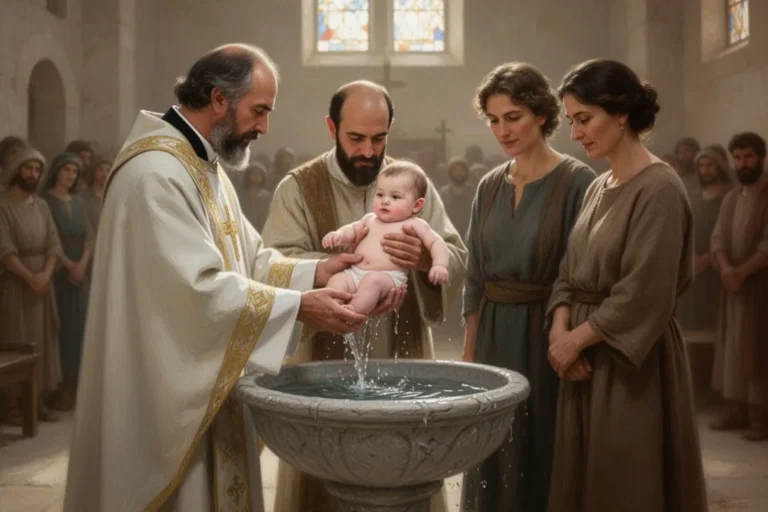
Infant baptism is a church ceremony in which parents or guardians present a child to be baptized. A minister, priest, or pastor uses water and speaks words connected with the Father, Son, and Holy Spirit. The congregation typically promises to support the child’s growth in Christian faith.
In traditions that baptize babies, the ceremony is commonly understood as a sacrament or holy sign of God’s initiative. The child has not made a personal statement of belief, so the parents and church make commitments on the child’s behalf. Later, the child may be invited to affirm those commitments personally through confirmation, profession of faith, or another rite.
The ceremony can also express the belief that a child is already part of a family and a community before being able to explain that belonging. Baptism does not mean the baby has achieved spiritual maturity. It places the child within a pattern of teaching, worship, prayer, and Christian care.
Essential distinction: Infant baptism and infant dedication are not the same ceremony. Baptism uses water as a Christian rite, while dedication usually presents the child to God and commits the parents to raising the child in faith without baptizing the child.
Why some churches baptize babies
Churches that practice infant baptism usually draw on several connected ideas rather than one isolated passage. They may emphasize God’s grace before human response, the inclusion of children in the covenant community, the baptism of households in the New Testament, and the historic practice of the wider church.
For these churches, baptism is not limited to people who can describe a conversion experience. The church baptizes infants because salvation is understood to begin with God’s action, and because children are received as members of the Christian community while their faith is still developing.
Some traditions also connect baptism with the Christian understanding of original sin, meaning humanity’s universal need for God’s mercy. In that framework, infant baptism does not suggest that a baby has committed deliberate personal sins. It signifies the child’s need for grace and the church’s trust in God’s mercy.
Why other churches wait until a person can believe
Many Baptist, nondenominational, Pentecostal, and other evangelical churches practice believer’s baptism rather than infant baptism. They generally teach that baptism should follow a person’s conscious repentance and personal faith in Jesus Christ.
These churches often point to New Testament accounts in which people hear the Christian message, believe, and then are baptized. They understand baptism primarily as a public testimony of an individual’s faith and union with Christ. Since an infant cannot yet make that confession, baptism is postponed until the child can respond personally.
These Christians may still hold children as precious members of the church community. Instead of baptism, families may take part in a child dedication, a prayer service, or a congregational commitment to help parents raise the child in Christian teaching.
How an infant baptism usually takes place
The exact order varies by denomination and congregation, but the ceremony generally follows a recognizable pattern. Parents should ask their church for its own requirements, wording, and preparation process.
Parents contact the church. The family speaks with a pastor, priest, or church office about scheduling the baptism and learning the congregation’s expectations.
The family attends preparation. Some churches offer a class or meeting about the meaning of baptism, parental promises, church teaching, and the role of sponsors or godparents.
The child is presented. During a worship service or a separate baptismal service, the child is brought before the minister and congregation.
Parents answer questions. The parents may be asked whether they intend to raise the child in the Christian faith and bring the child to worship and instruction.
Sponsors or godparents make commitments. When the tradition uses sponsors, they promise to support the child and parents in Christian life.
The church prays for the child. Prayers may ask for protection, wisdom, faith, and a lifelong relationship with God.
Water is applied. The minister pours or sprinkles water on the child, or briefly immerses the child, while using the church’s baptismal formula.
The congregation welcomes the child. The church may light a candle, give a certificate, make a sign of the cross, or receive the child as part of the worshiping community.
Some churches conduct baptism during the main Sunday service to show that the congregation shares responsibility for the child’s formation. Others hold a quieter service with close family and friends. Neither setting changes the central role of water, Christian prayer, parental promises, and congregational support.
Parents are usually asked to make promises that extend well beyond the ceremony itself. The wording differs, but the commitments often include teaching the child about Christianity, praying with the child, participating in worship, and helping the child grow in moral and spiritual understanding.
Parents may also promise to seek forgiveness, practice compassion, and model Christian life in the home. The church does not expect perfect parents. The promises recognize that children learn faith through repeated experiences of love, example, correction, worship, and community.
Before scheduling baptism, parents should consider whether they understand and can honestly make the church’s required commitments. If they are uncertain about a particular doctrine, they can discuss it with the minister rather than treating the ceremony as a purely social event.
What godparents and sponsors do
The terms godparent and sponsor can refer to similar roles, although their meaning depends on the denomination. These people are normally chosen because they can encourage the child’s Christian development, pray for the child, and support the parents over time.
A godparent is not automatically a legal guardian. Unless a separate legal document says otherwise, the role does not determine who will care for the child if the parents die or become unable to provide care. Families should make guardianship arrangements separately according to their state’s legal requirements.
Good sponsors understand the church’s teaching and are willing to remain involved. Helpful support may include attending important services, answering the child’s questions, giving age-appropriate faith resources, and being a trustworthy adult who takes the child seriously.
Ask whether the person is an active member of the relevant Christian tradition.
Explain the promises the person would be expected to make.
Choose someone who can maintain a genuine relationship with the child.
Discuss practical support rather than treating the role as only ceremonial.
Confirm how many sponsors the church permits and whether specific qualifications apply.
What the Bible says about baptism and children
The Bible does not give a single direct command that says, in those exact terms, “baptize infants,” nor does it provide a universal rule that children must wait until a particular age. Christians therefore interpret several themes and passages differently.
Supporters of infant baptism point to passages in which baptism is associated with an entire household. Examples include Acts 16 and 1 Corinthians 1. These accounts do not list the ages of household members, so they do not settle the question by themselves. Those who support infant baptism see them as consistent with family inclusion; those who oppose it observe that the texts do not explicitly mention babies.
Supporters also point to Jesus welcoming children and teaching that the kingdom of God belongs to those who receive it with childlike dependence, as recorded in the Synoptic Gospels. They do not necessarily claim that these passages describe baptism. Instead, they see them as evidence that children have a meaningful place within the people of God.
Another argument connects baptism with circumcision, the sign given to male children in the Old Testament covenant community. Some churches reason that baptism is the New Testament sign of belonging and should therefore include children of believers. Other Christians reject that comparison or emphasize that the New Testament calls for personal faith before baptism.
Those who practice believer’s baptism often emphasize the order found in passages such as Matthew 28, Acts, and Romans: people hear the message, respond in faith, repent, and receive baptism. They understand baptism as an outward confession that requires personal understanding and voluntary commitment.
Christian traditions agree that baptism points beyond the water to a person’s relationship with God, even when they disagree about the proper age and meaning of the rite.
Does infant baptism save a child?
The answer depends on what a church means by salvation and how it understands baptism. Some sacramental traditions teach that baptism is a genuine means of grace and should not be treated as an empty symbol. They may say that baptism incorporates the child into the church and begins a life of Christian discipleship.
Even within these traditions, baptism is not normally treated as a mechanical guarantee that removes the need for later faith. Parents, sponsors, and the church are expected to help the child grow in belief and practice. The baptized person may later reject Christian teaching or fail to live according to the promises made at baptism.
Many Protestant churches that reject infant baptism teach that water itself does not save. They locate salvation in God’s grace received through faith in Christ and regard baptism as an important act of obedience and testimony. They may still trust God’s mercy toward infants who die, while distinguishing that question from the proper administration of baptism.
Because the language of salvation can carry different meanings, families should ask their church specific questions: Is baptism a sacrament, an ordinance, or both? Does the church consider an unbaptized infant outside God’s care? What later response is expected from the child? Clear answers can prevent unnecessary fear.
For parents who feel anxious: Churches differ on baptismal theology, but no responsible Christian teaching should turn a baby’s ceremony into a source of panic or superstition. Ask the minister how the church understands God’s mercy, the child’s future faith, and the purpose of the rite.
Infant baptism, confirmation, and personal faith
In churches that baptize infants, baptism and personal faith are often seen as related stages rather than competing choices. Baptism marks the child’s reception into the church; later instruction gives the child language for understanding the Christian faith; confirmation or profession allows the person to respond personally.
The timing and name of the later rite vary. In some traditions, confirmation is associated with the strengthening of baptismal grace. In others, it is a public renewal of promises or a mature declaration of faith. Some congregations do not use confirmation but invite baptized children to make a profession of faith, receive communion, or become active members at a later age.
Parents should avoid presenting baptism as something the child has “already finished” in every sense. The ceremony begins a continuing process of learning, questioning, worshiping, serving, and choosing. A baptized child still needs opportunities to understand the faith and express a personal response.
What age is appropriate for infant baptism?
There is no single Christian-wide age requirement. Some churches baptize babies within the first few months, while others baptize children later in infancy or early childhood. The church’s calendar, family circumstances, health considerations, and preparation requirements can all affect scheduling.
If the child is older, the church may use a service designed for young children rather than infants. The essential question is usually not whether the child is a specific number of weeks old, but whether the family understands the rite and is prepared to participate in the child’s Christian formation.
Parents should contact the church early because some congregations require a preparation class, membership, documents, or a meeting with the clergy. If the family belongs to more than one congregation, ask which church will record the baptism and how both communities can be involved.
What happens if parents belong to different churches?
Interdenominational families should discuss baptism before choosing a date or asking relatives to serve as sponsors. Churches may differ over whether they recognize one another’s baptisms, what wording is required, and whether the parents must promise to raise the child within a particular tradition.
A practical conversation should cover the following points:
Which church’s baptismal teaching will guide the ceremony?
Will the other parent be asked to make the same promises?
Can relatives from another denomination serve as sponsors or witnesses?
How will the child receive religious education afterward?
What later ceremony, if any, will affirm the child’s personal faith?
In many families, a respectful agreement is possible when both parents distinguish essential convictions from preferred customs. The goal is not merely to produce a pleasing ceremony, but to make promises the parents can keep together.
How to prepare a child and family for the ceremony
An infant will not remember the service, so preparation mainly concerns the adults and the wider family. Parents can learn the meaning of the baptismal words, read the church’s service ahead of time, and decide which promises they are prepared to make honestly.
Practical planning also matters. Babies may be hungry, tired, or unsettled during the service. Feed and change the child beforehand when possible, bring a quiet comfort item if the church permits it, and tell close family members where to sit and when photographs can be taken.
Confirm the date, service time, location, and rehearsal arrangements.
Ask about required classes, forms, certificates, and membership rules.
Choose clothing that is comfortable and safe for holding.
Learn who will hold the child during each part of the service.
Confirm the church’s policy on photography, video, and candles.
Plan how the family will continue Christian teaching after the ceremony.
Clothing, flowers, photographs, and a family meal can make the day meaningful, but they are secondary. The central event is the church’s prayerful use of water and its commitment to help the child grow within the Christian faith.
How baptism differs from dedication
Infant baptism is a water rite recognized by churches that believe children may be baptized before personal profession of faith. Child dedication is usually a service in which parents publicly dedicate themselves to raising a child according to Christian principles and ask the congregation to support them.
Dedication services often reflect the belief that baptism should follow an individual’s own repentance and faith. The child may later choose believer’s baptism when able to understand and confess those beliefs. The two ceremonies can look similar because both may include prayers, Scripture readings, parental promises, and congregational support.
Families should use the church’s exact terminology. Calling a dedication a baptism, or assuming that a baptism is only a dedication, can create confusion about what the church believes and what the ceremony records.
Questions to ask the church before scheduling baptism
A short conversation with the clergy can clarify both theology and logistics. Churches often welcome questions, especially when parents are unfamiliar with the tradition or are making decisions across denominational lines.
What does this church believe baptism accomplishes?
Must one or both parents be members of the congregation?
Are baptism preparation classes required?
Who may serve as a godparent or sponsor?
Does the church recognize baptisms performed in other traditions?
What promises will the parents and congregation make?
How will the child later be taught and invited to affirm the faith?
What records, certificates, or fees are involved?
These questions help you distinguish a church’s theological requirements from its local customs. They also give the family a clearer understanding of what support will remain after the service ends.
How to continue the promises after baptism
The meaning of infant baptism is carried through ordinary life rather than preserved by one ceremony alone. Parents can pray with the child, attend worship, talk about moral choices, celebrate Christian seasons, read age-appropriate Bible stories, and introduce the child to people who practice faith with humility and care.
As children grow, they need room to ask difficult questions without being shamed. Christian formation includes learning the tradition, seeing how it shapes daily behavior, recognizing failure, receiving forgiveness, and deciding how to respond personally to God. A baptized child should encounter both clear teaching and patient listening.
The congregation also has a continuing role. Teachers, youth leaders, pastors, relatives, and friends can help make the church a dependable community rather than a location associated only with a baby ceremony. When baptism is understood as the beginning of a life within the church, long-term support becomes part of its meaning.
Frequently asked questions
Can a baby be baptized if the parents are not married?
Policies differ by church, but many congregations will baptize a child without making the parents’ marital status a condition. The minister may ask the parents to explain their commitment to raising the child in the faith. Speak directly with the church, since some traditions have specific expectations about participation, preparation, or family circumstances.
Do babies need to understand baptism for it to be valid?
Churches that practice infant baptism generally say personal understanding is not required at the time of the ceremony. The parents and congregation make promises while the child receives the rite. Churches that practice believer’s baptism reach the opposite conclusion and wait for the person to understand and confess faith. The answer depends on the tradition’s theology.
Can an infant be baptized in one denomination and confirmed in another?
This may be possible, but the second church might require instruction, a profession of faith, or evidence that it recognizes the first baptism. Rules vary about baptismal wording, the use of water, and whether a second baptism is permitted. Contact both churches before making plans, since many Christian traditions do not repeat a recognized baptism.
What should a child wear for an infant baptism?
Choose clothing that is comfortable, safe, and easy for the minister to work around. Some families use a white outfit to represent new life or purity, while others follow family or cultural tradition. Ask whether the church has expectations about color, head coverings, shoes, or baptismal garments, and avoid anything that makes holding or applying water difficult.



Leave a Reply