Christian baptism is a symbolic and sacred use of water that identifies a person with Jesus Christ, expresses faith and repentance, and welcomes them into the Christian community. Depending on the denomination, baptism may be understood as a public sign of personal faith, a means through which God gives grace, or both.
The ceremony usually involves water applied by immersion, pouring, or sprinkling in the name of the Father, Son, and Holy Spirit. Its meaning is rooted in Jesus’ baptism, his command to make disciples and baptize them, and the New Testament picture of believers sharing in Christ’s death and resurrection.
Baptism brings several Christian ideas together in one visible action. A person enters water or has water placed upon them, and the church recognizes a spiritual commitment that cannot be seen directly. The water itself is not treated as ordinary decoration; it points to cleansing, death to an old way of life, renewal, and belonging.
Christian baptism is not simply a naming ceremony, a graduation from a church class, or a general statement that someone believes in God. It is connected specifically with Jesus Christ and with participation in his people. The rite does not make a person morally perfect, and Christians do not generally understand it as a substitute for ongoing faith, repentance, prayer, and obedience.
At the same time, baptism is more than a private expression. It is normally performed in the presence of other believers because it marks a person’s relationship with the church. The congregation may promise to support the baptized person, while the person publicly identifies with the Christian faith.
Central meaning: Christian baptism uses water to signify identification with Christ, cleansing from sin, new life, and incorporation into the community of believers.
What Christian baptism represents step by step
The meaning becomes clearer when baptism is considered through its main symbolic movements. These points overlap, but each highlights a different part of Christian belief.
Responding to God’s call: A person comes to baptism because of faith in God’s work through Jesus, or because a family and church present a child within a tradition that baptizes infants.
Turning toward God: In many churches, baptism follows repentance, meaning a sincere change of direction away from sin and toward God.
Being washed with water: The water represents cleansing and forgiveness. It does not imply that physical water removes guilt by itself.
Being joined to Christ: Going beneath the water or receiving it points to sharing in Christ’s death and resurrection.
Receiving a new identity: Baptism declares that a person belongs to Christ and is part of his people.
Entering the church’s fellowship: The baptized person is recognized publicly within a Christian community, with responsibilities as well as encouragement.
Beginning a life of discipleship: Baptism marks a starting point for following Jesus rather than a finish line that removes the need for spiritual growth.
These meanings are often expressed in a baptism service through Scripture readings, a profession of faith, prayers, vows, and a welcome from the congregation. The exact wording differs, but the ceremony usually connects the person’s baptism with the gospel and the life of the church.
How baptism connects with Jesus’ death and resurrection
The New Testament frequently presents baptism as a picture of union with Christ. The apostle Paul describes baptism in Romans 6 as being joined to Christ’s death and resurrection. The passage does not mean that the baptized person physically repeats those events. Instead, it presents baptism as a sign that believers leave behind their former allegiance and receive a new direction of life through Christ.
Immersion makes this symbolism especially visible. Going down into the water can represent death to the old life, while rising from the water can represent resurrection and new life. Churches that pour or sprinkle water also affirm the same basic meaning, even though the physical image is less extensive.
This connection explains why baptism is not only about having sins washed away. It also points toward new identity and new conduct. A baptized Christian is called to live as someone connected with Christ: turning from sin, practicing love, seeking reconciliation, and growing in trust and obedience.
Baptism points beyond the water to a life joined to Christ and shaped by his resurrection.
What baptism says about repentance and forgiveness
Repentance is a central part of baptism in many Christian traditions. It means more than feeling regret. Repentance involves recognizing sin, turning toward God, and becoming willing to live differently. In Acts 2, Peter connects baptism with repentance and receiving God’s forgiveness in response to the message about Jesus.
Christians disagree about how baptism relates to forgiveness in the exact order of salvation, but they commonly agree that forgiveness comes from God’s grace through Jesus Christ, not from human effort. Baptism is the appointed sign or sacrament through which that grace is proclaimed and received, depending on the church’s theology.
Water cannot erase a lie, repair harm, or automatically change a person’s character. A person who has been baptized may still need to confess wrongdoing, make amends, and resist future temptation. The power Christians associate with baptism rests in God’s promise and Christ’s saving work, not in the water as a magical substance.
How different churches understand baptism’s spiritual effect
Christian denominations use the same basic rite but do not explain its spiritual effect in exactly the same way. The differences can involve the meaning of grace, the role of personal faith, the age of the person baptized, and whether baptism is called a sacrament or an ordinance.
Many Baptist, Pentecostal, and non-denominational churches describe baptism as an ordinance commanded by Jesus and as a public testimony that follows personal faith. They often practice believer’s baptism by immersion.
Many Lutheran, Anglican, Roman Catholic, Orthodox, Methodist, and Reformed churches describe baptism as a sacrament or means of grace. They emphasize God’s initiative and may baptize infants as well as adults.
Some churches allow either immersion, pouring, or sprinkling, while others strongly prefer one method.
Some traditions view baptism as ordinarily necessary for full participation in the church, while others regard it as an essential act of obedience that does not itself determine a person’s salvation.
These distinctions should not be reduced to a simple division between churches that “take baptism seriously” and those that do not. Most Christian traditions consider baptism important. Their disagreement concerns how the rite relates to faith, grace, church membership, and God’s covenant.
Practical distinction: Ask a church how it understands baptism, who may receive it, what the water signifies, and whether it recognizes baptisms performed in other Christian traditions.
Why some Christians baptize infants
Churches that baptize infants usually understand baptism as a sign of God’s grace and inclusion in the church, not as a reward for a child’s mature personal decision. Parents and sponsors may make promises to raise the child in the Christian faith, and the congregation may commit to support that upbringing.
Infant baptism is often connected with a church’s understanding of covenant and family faith. Supporters point to the way children were included in God’s covenant community in the Bible and to New Testament references to the baptism of households, although those passages do not spell out every detail of the practice.
In traditions that baptize infants, later confirmation, profession of faith, or personal discipleship may give the baptized person an opportunity to affirm the faith for themselves. The timing and name of that later step vary from one denomination to another.
Why other Christians practice believer’s baptism
Churches that practice believer’s baptism emphasize that baptism should follow a person’s conscious trust in Jesus Christ. The candidate normally hears an explanation of the gospel, confesses faith, and chooses to be baptized as an act of obedience and public identification.
This view often treats baptism as a visible testimony. The person is not claiming to have reached spiritual perfection. Instead, they are declaring that they rely on Christ, want to follow him, and accept the identity of a Christian within the church.
Believer’s baptism is frequently performed by immersion because the movement into and out of the water illustrates burial and resurrection. Some churches that require personal faith still permit pouring or sprinkling in special circumstances, such as illness or lack of access to a suitable body of water.
What happens during a Christian baptism service
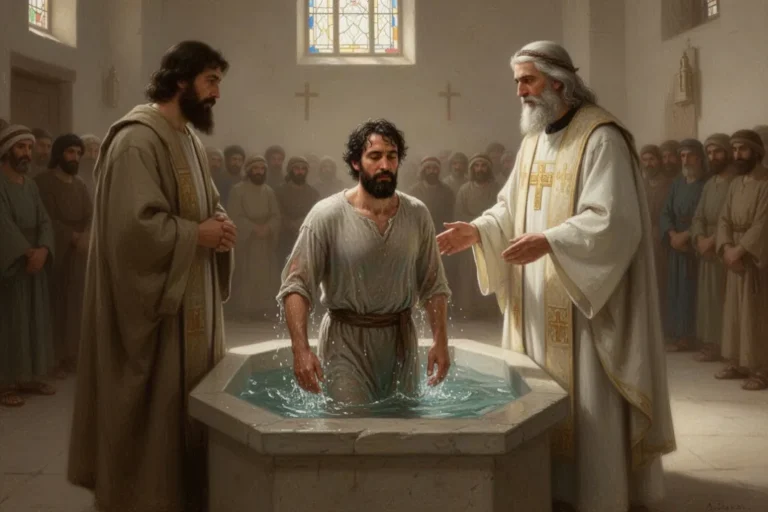
A baptism service can be quiet and formal or simple and informal. The setting may be a sanctuary, a baptistry, a river, a lake, or another place approved by the church. The location matters less than the church’s confession of faith and the meaning assigned to the act.
A typical service may include the following elements:
Presentation of the candidate: The church identifies the person who is seeking baptism.
Questions or profession of faith: The candidate may be asked about faith in Jesus, repentance, and a desire to follow him.
Teaching and Scripture: A minister explains baptism’s connection with the gospel and the Christian life.
Prayer: The church asks for God’s blessing, grace, and guidance.
Application of water: The person is immersed, or water is poured or sprinkled upon them.
Welcome: The congregation receives the baptized person as a fellow member or participant in the church community.
Some services include a baptismal gown or other special clothing. Others use ordinary clothing suitable for water. A person may be asked to bring a towel, change of clothes, and a witness or sponsor, but practical requirements are set by the local church.
Does baptism save a person?
The answer depends on what a Christian tradition means by “save” and how it relates baptism to faith and grace. Churches that stress believer’s baptism usually say that baptism does not earn salvation; it follows a person’s faith in Christ and publicly expresses that faith.
Churches with sacramental theology may say that baptism is a genuine means through which God gives grace and incorporates a person into Christ and the church. They still do not generally teach that the ritual works as a mechanical action detached from God’s grace, the church’s faith, and the person’s ongoing relationship with God.
Across these differences, Christians commonly affirm that salvation is God’s work. Baptism is not a way to bargain with God or accumulate spiritual merit. It is an act of faith and obedience, a sacramental sign, or both, according to the church’s teaching.
The New Testament gives baptism a serious place, yet it also emphasizes trust in Christ, God’s grace, repentance, and the transformed life. A person should not treat baptism as a substitute for genuine faith or assume that avoiding baptism is unimportant when they understand it as Christ’s command.
Is baptism a one-time event or an ongoing promise?
Most Christian churches practice baptism once. The one-time act represents a lasting identity and God’s enduring claim, even though the baptized person continues to grow, fail, confess, and return to God throughout life.
When Christians struggle with sin or doubt, they normally do not repeat baptism. Instead, they return to its meaning through repentance, prayer, worship, communion or the Lord’s Supper, and the promises of the gospel. Some churches offer services of reaffirmation or remembrance of baptism, but these are not usually considered a second baptism.
Because baptism is public, it can also remind the church of its responsibility. The congregation is called to teach, encourage, correct, and care for its members. The baptized person is called to worship with other believers, practice love, serve others, and pursue a life consistent with Christian faith.
How baptism relates to the Holy Spirit
Water baptism and the work of the Holy Spirit are closely connected in Christian teaching, but churches explain their relationship differently. In the New Testament, baptism is associated with receiving the Spirit, entering the Christian community, and belonging to Christ. Some traditions expect these realities to occur together, while others distinguish water baptism from a later experience of spiritual empowerment.
Many Pentecostal churches speak of a separate baptism in the Holy Spirit, often associated with empowerment for witness and spiritual gifts. Other churches use “baptism in the Spirit” to describe the work of the Spirit that occurs when a person becomes a Christian. These differences affect teaching and worship, but all emphasize that Christian life depends on God’s Spirit rather than on water alone.
The practical implication is that baptism should lead toward a Spirit-shaped life. Christians look for growing love, patience, self-control, courage, service, and faithfulness rather than treating the ceremony as the whole of spiritual maturity.
How to prepare for baptism
Preparation depends on your church and your age, but thoughtful preparation usually includes both learning and personal reflection. A minister, pastor, priest, or church leader can explain the local practice and help you understand what you are affirming.
Learn the church’s teaching: Ask what baptism means in that congregation and whether it is considered a sacrament, ordinance, covenant sign, or public testimony.
Read the relevant biblical passages: Useful references include Matthew 3, Matthew 28:18–20, Acts 2, Romans 6, Galatians 3, and 1 Peter 3. Read them in context and compare your questions with the church’s teaching.
Examine your faith: Consider whether you trust Christ, understand repentance, and are willing to grow as part of a Christian community.
Ask practical questions: Find out what clothing to wear, who may attend, how the service works, and whether you need a class or meeting beforehand.
Discuss family expectations: If you are a parent or sponsor, understand the promises you are making and the support the church offers.
Prepare for life afterward: Identify a congregation, mentor, study group, or regular practice that can help you continue in discipleship.
You do not need to understand every Christian doctrine before baptism. You should, however, know what the service means in your church and avoid making promises you do not understand. Honest questions are a normal part of preparation.
What baptism does not mean
Baptism does not mean that a person will never sin again or that every personal problem will disappear. Christian teaching expects discipleship to involve continued struggle, confession, learning, and dependence on God.
It also does not mean that one denomination owns the only valid form of water baptism in every circumstance. Churches have real disagreements, and some do not recognize every baptism as sufficient for their membership. Those questions are best discussed with the particular congregation you hope to join.
Baptism does not guarantee that a person will feel an immediate emotional change. Some people experience deep joy, while others feel calm, nervous, or uncertain. The meaning of baptism does not depend entirely on the intensity of the moment.
Finally, baptism is not a replacement for the church community. A person may be baptized once, but Christian faith is lived through worship, relationships, service, moral choices, forgiveness, and continued attention to Jesus’ teaching.
How baptism shapes Christian identity and community
Baptism gives Christians a public language for belonging. The baptized person is not merely saying, “I have private spiritual beliefs.” They are identifying with a worldwide community that confesses Jesus Christ and seeks to live under his teaching.
Paul’s discussion of the church as one body in 1 Corinthians 12 connects baptism with shared membership and mutual responsibility. The image challenges individualism: Christians belong to one another and are expected to care for people whose backgrounds, abilities, and experiences differ from their own.
Baptism therefore has an ethical dimension. It calls Christians to reject contempt, injustice, exploitation, and persistent unrepentant wrongdoing. It also calls them to practice hospitality, truthfulness, compassion, reconciliation, and service. The water ceremony is brief, but the identity it signifies has consequences for ordinary decisions.
For many Christians, remembering baptism is a source of assurance during seasons of doubt. It recalls that faith is not built only on changing emotions or personal performance. It points back to God’s grace, Christ’s saving work, and the church’s promise to help the believer persevere.
How to understand baptism if you are unsure about your church’s practice
Start by asking precise questions rather than relying on labels. Find out whether the church baptizes infants, children, or only professing believers; whether it requires immersion; how it understands forgiveness and grace; and whether it accepts baptism received in another Christian tradition.
Then compare the answers with your own convictions and the teaching of the church community you intend to join. A decision about baptism often involves family history, conscience, pastoral guidance, and biblical interpretation. It deserves patient conversation rather than pressure.
If you were baptized as an infant and later come to a church that practices believer’s baptism, ask how that church views your previous baptism. If you were baptized as a believer and a new church asks you to be baptized again, ask why. Churches differ on whether a second baptism is appropriate, and the answer may affect membership.
Whatever form it takes, Christian baptism is meant to direct attention away from the ceremony as an isolated event and toward God’s grace, faith in Christ, life in the Spirit, and belonging to the church. Its full meaning appears over time as the baptized person lives out the identity the water represents.
Frequently asked questions
What is the main meaning of baptism in Christianity?
Baptism mainly represents a person’s identification with Jesus Christ, cleansing from sin, repentance, new spiritual life, and belonging to the Christian community. Some churches also understand it as a sacrament through which God gives grace. The exact emphasis differs among denominations, but Christian baptism is consistently connected with Christ, water, faith, and life within the church.
Can someone be Christian without being baptized?
Christian traditions answer this differently. Many say a person can have genuine faith in Christ before receiving baptism, while still teaching that baptism should normally follow as an act of obedience. Sacramental churches may describe baptism as ordinarily important for entering the church and receiving grace. Anyone unable to be baptized should discuss their circumstances with a trusted church leader.
What is the difference between infant baptism and believer’s baptism?
Infant baptism emphasizes God’s initiative, family faith, and inclusion in the church’s covenant community. Parents and sponsors usually promise to raise the child in Christian teaching. Believer’s baptism emphasizes a personal profession of faith and repentance, so it is normally reserved for people able to make that commitment themselves. Both practices are found among historic Christian churches.
Does baptism have to be performed by full immersion?
No single method is used by every Christian church. Immersion strongly illustrates dying and rising with Christ, but pouring and sprinkling are also accepted by many denominations. Churches differ in their preferred practice and in whether they recognize other methods. The wording, connection to Christian faith, and the church’s understanding of the rite also matter.



Leave a Reply