Augustine of Hippo was a North African Christian bishop, theologian, and author who lived from 354 to 430. He is best known for Confessions, his account of spiritual transformation, and The City of God, a defense of Christianity during a period of political and religious upheaval.
Born in Thagaste in Roman North Africa, Augustine pursued education, rhetoric, and public influence before converting to Christianity in his early thirties. He later became a priest and bishop in Hippo Regius, where he preached, wrote, debated, and cared for a demanding local church. His work continues to shape Christian teaching about grace, sin, memory, prayer, the church, and the human desire for God.
Augustine was not simply a philosopher who later became religious. He was a late Roman Christian whose thought developed through Scripture, pastoral ministry, classical education, and personal struggle. His writing often combines careful argument with vivid reflection, making him influential in both theology and literature.
His importance comes from the range of questions he addressed. He asked how people can know truth, why human beings repeatedly choose what harms them, how divine grace works, what the church is for, and how Christians should live amid political instability. Later theologians in Catholic, Protestant, and other Christian traditions frequently returned to his arguments, even when they disagreed with him.
At a glance: Augustine’s life moved through several stages: classical education, a long search for wisdom, conversion in Milan, ordained ministry in North Africa, and decades of service as bishop of Hippo.
The historical setting that shaped Augustine’s life
Augustine was born on November 13, 354, in Thagaste, a town in Roman North Africa located in present-day Algeria. His father, Patricius, followed traditional Roman religious practices for much of his life, while his mother, Monica, was a committed Christian. Augustine grew up within a society where Roman civic culture, Christian communities, traditional religions, and competing philosophical schools existed alongside one another.
His education prepared him for a career in rhetoric, the public art of persuasive speaking and writing. That training was valuable in courts, government, and civic life. It also left a permanent mark on his prose: Augustine paid close attention to language, interpretation, memory, and the emotional force of speech.
The Roman world of his adulthood was under strain. Political authority was changing, the empire faced military threats, and Christianity had become increasingly prominent in public life. When Rome was captured by the Visigoths in 410, critics claimed that Christianity had weakened the empire. Augustine answered such accusations in The City of God, arguing that earthly states should not be confused with the lasting purposes of God.
Augustine’s life in five major stages
A useful way to understand Augustine is to follow the sequence of decisions and changes that shaped his vocation. His life was not a straight line from unbelief to certainty; it involved competing loyalties, intellectual experiments, disappointments, and gradual changes in what he considered true and worth pursuing.
Education in North Africa: Augustine studied language, literature, and rhetoric, eventually teaching rhetoric himself.
Search through philosophy and religion: He explored Manichaeism, read influential classical authors, and wrestled with questions about evil, truth, and human desire.
Career in Italy: He moved to Rome and then Milan, where he taught rhetoric and encountered Bishop Ambrose’s preaching.
Conversion and baptism: In Milan, Augustine became a Christian, was baptized by Ambrose in 387, and began reshaping his life around Christian discipleship.
Pastoral service in North Africa: He returned home, became a priest and bishop, and spent the rest of his life serving the church in Hippo.
These stages are closely connected. Augustine’s early interest in rhetoric helped him become an effective preacher, while his earlier doubts gave him a detailed understanding of the objections raised by non-Christian philosophies and rival Christian movements.
Augustine’s early education and search for truth
Augustine received a strong education but did not begin life as a committed Christian. As a young man, he was drawn to the question of how a person should live and what kind of wisdom could provide a stable answer. The death of a close friend intensified his awareness of grief, attachment, and the instability of ordinary happiness.
Reading Cicero’s philosophical dialogue Hortensius, now lost except for fragments and reports, encouraged Augustine to seek wisdom rather than pursue only status or pleasure. He wanted an account of truth that could explain both the order of the universe and the conflicts within his own mind.
For a period, Augustine followed Manichaeism, a religious movement that described reality as a conflict between forces of light and darkness. Its explanation of evil appealed to his desire for a clear account of moral failure, but he eventually became dissatisfied with its teachings and leaders. His disappointment pushed him toward other philosophical and religious resources.
Augustine also experienced the pull of ambition and family expectations. He formed a long-term relationship with a woman whose name he does not give in his surviving works, and they had a son, Adeodatus. He later separated from her while pursuing a socially advantageous marriage arrangement, a decision that he presents with regret and emotional conflict in Confessions.
What happened during Augustine’s conversion
Augustine’s conversion took place in Milan in 386, after years of intellectual and moral struggle. He had encountered Christian teaching through the preaching of Ambrose, bishop of Milan, and had also been influenced by Neoplatonic writings. These philosophical texts helped him think of spiritual reality as higher than material things, although Christian Scripture and the person of Christ became decisive for him.
In Confessions, Augustine describes a moment in a garden when he heard a child’s repeated words and understood them as a prompt to read. He opened the letters of Paul and found a passage that directed him away from self-indulgence and toward a life centered on Christ. He presents this experience not as a private achievement but as the result of grace working through inner conflict.
After this change, Augustine withdrew for a period of prayer and study at Cassiciacum near Milan. He was baptized by Ambrose at the Easter season in 387, along with others in his circle. His mother Monica died soon afterward at Ostia, while the group was preparing to return to North Africa.
How to read the conversion story: Augustine’s account is both biography and prayer. He is not merely listing events; he is interpreting his past as a record of desire, resistance, memory, and divine mercy.
How Augustine became bishop of Hippo
After returning to North Africa, Augustine established a religious community and continued writing. In 391, while visiting Hippo Regius, he was ordained a priest, reportedly in response to the local church’s need for clergy. He became bishop of Hippo around 395 and remained there until his death.
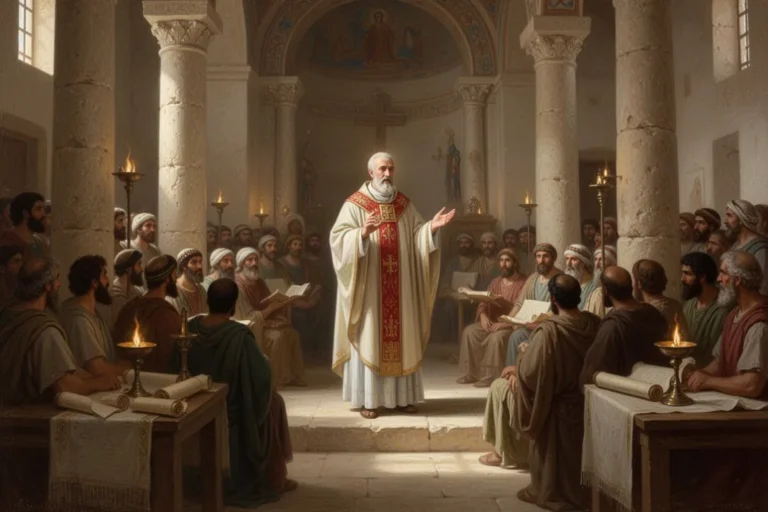
Being a bishop in late Roman North Africa involved much more than leading worship. Augustine preached regularly, interpreted Scripture, handled disputes, advised individuals, corresponded with other church leaders, and participated in regional debates. He also dealt with legal and social matters affecting people in his community.
Hippo was a port city with connections to the wider Mediterranean world. Augustine’s church included people from different social backgrounds, and his surviving sermons show him addressing practical concerns such as wealth, family relationships, sexual ethics, debt, church discipline, and care for the poor.
His ministry was demanding partly because North African Christianity was divided. Augustine debated Donatists, who argued that clergy who had compromised during persecution could not validly exercise ministry. He defended the church’s unity and argued that the church’s holiness depends ultimately on Christ rather than on the flawless character of every minister.
What Augustine wrote and what each work does
Augustine produced a large body of sermons, letters, biblical commentaries, theological treatises, philosophical dialogues, and polemical works. His writings can seem difficult if they are treated as one uniform system. Each work responds to a particular setting, question, or controversy, even though recurring themes connect them.
Confessions: A prayerful account of Augustine’s life, conversion, memory, desire, and understanding of God. It is often described as an autobiography, but its form is also theological meditation.
The City of God: A wide-ranging defense of Christianity that reflects on Roman religion, political power, history, human pride, and the hope of eternal life.
On Christian Doctrine: A guide to interpreting Scripture and communicating Christian teaching, including the relationship between signs, meaning, understanding, and love.
On the Trinity: A sustained effort to explain Christian teaching about the Father, Son, and Holy Spirit while acknowledging the limits of human language.
Enchiridion on Faith, Hope, and Love: A concise account of Christian life organized around the theological roles of faith, hope, and love.
On Free Choice of the Will: A dialogue exploring freedom, moral responsibility, and the origin of evil.
Retractions: A later review in which Augustine revisited some of his earlier works and clarified or corrected parts of his thinking.
Reading the works in context helps prevent confusion. Augustine’s reflections on freedom in an early dialogue arose in a different setting from his later arguments about grace during the controversy with Pelagius. He developed his language over time rather than repeating a single argument unchanged.
Why Confessions remains Augustine’s most widely read work
Confessions is famous because it combines personal honesty with theological reflection. Augustine discusses childhood, ambition, friendship, sexuality, grief, intellectual pride, and conversion, but he addresses God throughout. The result is not simply a memoir written for curious readers; it is a long prayer about how a life can be understood in relation to its Creator.
One of the book’s central ideas is that human beings are restless because their desires are directed toward temporary goods that cannot provide lasting fulfillment. Augustine does not treat every created thing as evil. Instead, he distinguishes between loving good things rightly and demanding from them the complete security that only God can provide.
Memory receives extended attention in the later books. Augustine describes memory as more than a storage place for facts. It holds images, skills, emotions, language, and experiences, and it becomes a place where the self encounters both absence and presence. His analysis anticipates later philosophical and psychological interest in consciousness, identity, and recollection.
The book’s biblical interpretation also matters. Augustine reads the creation account in Genesis as a source of theological questions about time, change, creation, and divine action. He does not treat the opening of Genesis only as a sequence of physical events; he explores several possible meanings while emphasizing that Scripture should be read with humility and charity.
Augustine’s understanding of grace, sin, and human freedom
Augustine’s teaching about grace developed in response to questions about moral effort and salvation. He argued that people need God’s healing action because sin affects human desire, not merely isolated behavior. Human beings remain responsible for their choices, yet their ability to turn fully toward God depends on grace.
This position became especially prominent during Augustine’s dispute with Pelagius and Pelagius’s supporters. Pelagius emphasized moral responsibility and the possibility of obeying God, while Augustine stressed humanity’s dependence on divine help. The controversy produced strong formulations about original sin, baptism, the will, and predestination.
Augustine did not describe human beings as lifeless objects. He continued to speak of willing, choosing, loving, and acting. His distinctive claim was that the will is not most free when it can choose in every direction; rather, true freedom is found when a person is healed and ordered toward the good.
Later Christian traditions have interpreted these ideas in different ways. Catholic, Lutheran, Reformed, Anglican, and other theologians have all drawn on Augustine while disagreeing about how his views should be applied to baptism, predestination, human cooperation, and the church’s role.
How Augustine explained the problem of evil
Augustine rejected the idea that evil is an independent substance equal to God. Influenced in part by Neoplatonic thinking and guided by Christian doctrine, he described evil as a privation of good: a corruption, disorder, or loss in something that was created good.
This explanation addressed a problem that had troubled him for years. If God created all things good, how can evil exist? Augustine’s answer was that evil does not require a second divine power. Created wills can turn away from the highest good, and that turning produces disorder in individuals and communities.
His account does not remove the emotional force of suffering. Augustine wrote about grief, war, injustice, disease, and death with a strong awareness of pain. His theory of evil should therefore be read alongside his pastoral work, where he comforted people facing losses that could not be solved by an abstract argument.
What The City of God says about politics and history
The City of God was written over many years after the sack of Rome in 410. Augustine challenged the claim that Christianity was responsible for Rome’s troubles by examining Roman religion, imperial ambition, moral corruption, and the fragility of political institutions.
He distinguishes between two communities shaped by different loves: the earthly city is marked by self-love and the desire to dominate, while the city of God is defined by love of God and a rightly ordered relationship with others. These are not simply two visible states located on a map. They describe competing orientations that can exist alongside each other within history.
Augustine did not teach that Christians should abandon public life. He recognized the need for peace, law, government, and social order, even though he viewed all earthly institutions as limited and morally mixed. His political thought is therefore neither a simple endorsement of empire nor a call for total withdrawal from society.
The work also presents history as meaningful without treating every event as easy to explain. Human beings cannot see the whole design of providence. Christians are called to practice justice and compassion while remembering that no empire, nation, or political program can become the final city of human hope.
Augustine’s teaching about the church and Christian community
Augustine’s experience as a bishop shaped his understanding of the church. He described the church as a community that receives grace through Christ, hears Scripture, celebrates the sacraments, and lives among people whose spiritual condition cannot always be judged from the outside.
In debates with the Donatists, Augustine argued that the validity of Christian baptism and ministry does not depend entirely on the moral perfection of the minister. This was a significant development in his account of the church’s universality and sacramental life. At the same time, he did not treat moral failure as unimportant; church discipline and repentance remained serious responsibilities.
Augustine often used the language of love to describe Christian maturity. A person may possess knowledge, religious practice, or public respect, but these goods become distorted when they are not directed toward love of God and neighbor. His reading of Scripture therefore placed charity and rightly ordered love near the center of Christian interpretation.
Augustine’s approach to Scripture and preaching
Augustine believed that biblical interpretation requires both intellectual care and moral formation. Readers need to consider language, context, figurative meaning, and the unity of Scripture, but they must also resist interpretations that encourage cruelty, pride, or contempt for others.
In On Christian Doctrine, he distinguishes between things and signs. Words function as signs that point beyond themselves, and interpretation involves understanding how those signs communicate meaning. He also advises Christian teachers to communicate at different levels, adapting their style to the needs of particular listeners.
His sermons show this principle in practice. Augustine could move from close examination of a biblical passage to direct advice about money, marriage, fasting, generosity, or conflict. He expected listeners to connect worship with conduct, because understanding that does not shape love and action remains incomplete.
Augustine’s lasting influence on Christian theology and culture
Augustine became one of the most influential Latin Christian writers in history. Medieval theologians used his work to discuss the Trinity, grace, sacraments, the church, moral life, and the relationship between faith and reason. His writings were copied, debated, and incorporated into theological education across Western Europe.
During the Protestant Reformation, Martin Luther and John Calvin drew heavily on Augustine’s teaching about grace and sin, while Catholic theologians also appealed to him in debates about human freedom, salvation, and the church. His influence extends beyond confessional theology into philosophy, political thought, literary studies, and theories of memory.
Modern readers may recognize questions in Augustine that remain familiar: Why do people act against their own better judgment? Can happiness be built from achievement and pleasure alone? How should societies respond to violence and political collapse? What does it mean to remember who you are?
His influence is not uniformly positive or uncomplicated. Some later uses of Augustine supported coercive religious policies, pessimistic accounts of sexuality, or political arrangements he may not have intended. A responsible reading distinguishes Augustine’s own arguments from later adaptations and recognizes both his intellectual power and the limits of his historical setting.
How to begin reading Augustine today
The best starting point depends on what you want to understand. Readers interested in personal experience can begin with Confessions. Those interested in history and politics may prefer The City of God, although its length and digressions require patience. Students of Christian interpretation can begin with On Christian Doctrine.
For autobiography and prayer: Read Confessions, especially the sections on memory, conversion, and desire.
For politics and history: Read selected books of The City of God alongside background on the Roman world of the fifth century.
For biblical interpretation: Study On Christian Doctrine and compare its principles with Augustine’s sermons.
For theology: Approach On the Trinity slowly, using a reliable introduction to late antique Christian doctrine.
For his changing ideas: Read Retractions after an earlier work to see how Augustine revised his own positions.
Translations differ in tone and readability, so an edition with explanatory notes can make a substantial difference. It also helps to remember that Augustine frequently writes as a preacher, pastor, or participant in a controversy rather than as a detached modern academic.
What Augustine of Hippo can still teach readers
Augustine’s enduring contribution is not a single slogan or isolated doctrine. It is his sustained attention to the relationship between truth, desire, memory, and love. He asks readers to examine not only what they believe but also what they are becoming through the things they pursue.
His work also demonstrates that intellectual questions and personal questions cannot always be separated. The problem of evil is connected to grief; theories of freedom are connected to habits; biblical interpretation is connected to humility; and political judgment is connected to the loves that govern a community.
Reading Augustine well requires historical care and moral discernment. He belongs to late antiquity, not the modern world, but his accounts of divided desire, restless ambition, public fear, and the search for lasting meaning remain unusually direct. That combination of historical distance and personal immediacy explains why Augustine of Hippo continues to command attention.
Frequently asked questions
Was Augustine of Hippo Catholic?
Augustine served as a bishop in the Christian church of late Roman North Africa, centuries before the divisions associated with modern Protestantism. He is recognized as a major saint and Doctor of the Church in Roman Catholicism, and his writings also strongly influenced Eastern Christian, Anglican, Lutheran, Reformed, and other traditions.
What is Augustine of Hippo’s most famous book?
His most famous book is Confessions, written as a prayerful reflection on his life, conversion, memory, sin, and understanding of God. It is widely regarded as one of the earliest major Christian autobiographical works, although it is more accurately read as spiritual autobiography and theological meditation than as a modern memoir.
Did Augustine believe people had free will?
Yes, Augustine continued to affirm human willing and responsibility, but he argued that sin damages the will and that people need divine grace to turn fully toward God. His later writings place more emphasis on grace than some of his earlier works, which is why his views are discussed in relation to both freedom and dependence on God.
Where was Hippo Regius?
Hippo Regius was an important port city in Roman North Africa, located near present-day Annaba in northeastern Algeria. Augustine served there as a priest and bishop. The city was later affected by the political and military changes that reshaped North Africa after the decline of Roman imperial control.




Leave a Reply