When you are facing a conflict that feels bigger than your strength, you may wonder where your confidence should come from. The biblical name Jehova Nissi points to a clear answer: the Lord is your banner, the one who represents, protects, and strengthens his people.
Jehova Nissi is a traditional English rendering of the Hebrew name often written Yahweh Nissi or Jehovah-Nissi. It appears in Exodus 17:15, after Moses and the Israelites experienced God’s help during a battle with the Amalekites. The name does not mean that believers will avoid every hardship. It expresses trust that God is present and that victory, endurance, and identity ultimately come from him.
The name Jehova Nissi is commonly translated as “the Lord is my banner.” In the ancient world, a banner or standard could identify a military group, mark a gathering place, and represent the authority of a king or leader. To call God a banner was to say that his people gathered under his leadership and depended on his strength.
The name joins God’s covenant name with the Hebrew word associated with a banner, standard, or signal. English Bibles handle the spelling of God’s name differently. Some use “Jehovah,” while many modern translations use “the LORD,” following a long tradition of representing the divine name in capital letters. The meaning remains centered on God’s faithful presence.
In Exodus 17, Moses builds an altar and gives it this name after Israel defeats Amalek. The altar turns a temporary military victory into a lasting act of worship. Moses does not name the place after Israel’s weapons, strategy, or courage. He directs attention to the Lord who helped them.
Core meaning: Jehova Nissi does not describe a lucky charm or a guarantee of easy success. It is a confession that God is the one his people honor, follow, and rely on when they face opposition.
The Exodus 17 setting behind the name
The story begins after the Israelites leave Egypt and travel through the wilderness. They are newly freed, still learning how to live as a community, and dependent on God for water, food, direction, and protection. Their journey is not peaceful. Amalek attacks them at Rephidim, creating an immediate threat to a vulnerable people.
Moses tells Joshua to choose men and lead them into battle. Moses then goes to a hill with the staff of God in his hand. Exodus 17 describes a connection between Moses’s raised hands and the course of the battle: when his hands remain raised, Israel gains ground; when he becomes tired and lowers them, Amalek gains ground.
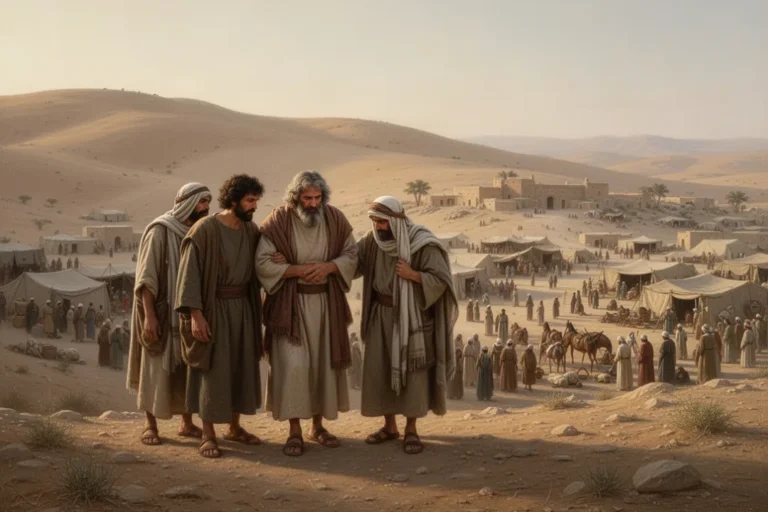
Aaron and Hur support Moses by helping him sit and by holding up his hands until sunset. Joshua and the fighting men engage the enemy below, while Moses, Aaron, and Hur participate through steadfast support and prayerful dependence above. The passage presents the victory as involving obedient action, spiritual dependence, and community support.
After the battle, God tells Moses to record what happened and ensure that Joshua remembers it. Moses builds an altar and names it Jehova Nissi. The name therefore belongs to a specific act of remembrance. It teaches future generations to interpret the battle through God’s faithfulness rather than human self-sufficiency.
How the story explains “the Lord is my banner”
The image of a banner becomes clearer when you follow the events in order. Each part of the story adds something important to the name:
Israel faces a real enemy. Trust in God does not mean pretending that danger is imaginary. The Amalekite attack is serious, and the people must respond.
Joshua takes responsible action. He leads the fighting men rather than waiting passively for a miracle. Faith and practical obedience work together.
Moses seeks God’s help. His position on the hill and his raised staff show dependence on the Lord, not confidence in military power alone.
Aaron and Hur provide support. Moses cannot continue by himself. The community helps sustain the person carrying responsibility.
God gives the victory. The outcome is remembered as divine help, not merely as the achievement of one leader or one army.
Moses builds an altar. Worship becomes the proper response. The event is marked so that the people will remember who sustained them.
Under this interpretation, the banner is not an object Israel carries into battle as a magical source of power. God himself is the rallying point. His people gather around his authority, receive courage from his presence, and remember that their success is not independent of him.
Why Moses built an altar after the battle
An altar gives the name Jehova Nissi a worshipful meaning. Moses could have celebrated the victory as proof of Israel’s military ability, but he instead creates a place associated with God’s character. The altar says that the event should be remembered as part of the relationship between the Lord and his covenant people.
In Scripture, naming an altar often connects a physical place with a spiritual truth. The name helps the community remember what God has done. Jehova Nissi therefore functions as a testimony: when Israel looks back on the battle, it should see God’s protection and leadership at work.
The altar also guards against misplaced confidence. Victories can create pride just as easily as failures create fear. By naming the altar after God, Moses teaches Israel to receive success with humility and gratitude. The people fought, but they did not have to worship their own strength.
For Christians and other readers of the Hebrew Bible, this pattern remains useful. When a crisis passes, you can easily move on to the next problem without remembering how you were helped. Setting aside time for prayer, worship, or a written record can help you recognize God’s faithfulness in specific circumstances.
What Jehova Nissi teaches about difficult seasons
God’s presence does not remove every struggle
The Israelites are not protected from conflict simply because God has brought them out of Egypt. Their freedom begins a demanding journey that includes fear, scarcity, uncertainty, and attack. Jehova Nissi should not be used to promise that faithful people will never experience illness, loss, injustice, opposition, or disappointment.
Instead, the name offers a different kind of assurance. God remains worthy of trust during the struggle, not only after the desired outcome appears. The story’s message is about dependence and faithful presence rather than a formula that forces every circumstance to end in the way you want.
Faith can include practical responsibility
Joshua’s role matters. He organizes the fighting force and leads the people into action. Moses’s dependence on God does not cancel Joshua’s responsibility, and Joshua’s effort does not replace dependence on God. Together, these parts show that prayer and action are not enemies.
For a person facing a difficult decision, this may mean praying for wisdom while gathering accurate information, asking for help, making a plan, and taking the next responsible step. Trusting God is not the same as refusing to act. It is acting with the recognition that your ability and outcome are not entirely under your control.
People need one another
Moses becomes physically tired, and Aaron and Hur help him continue. The detail is simple but significant: the leader cannot carry the visible responsibility alone. The battle account honors the contributions of people who strengthen someone else’s faithfulness.
Jehova Nissi can therefore shape the way you receive and offer support. You may need friends, family members, pastors, counselors, or a congregation to help you remain steady. At another time, you may be the person who brings encouragement, practical assistance, or quiet presence to someone who is exhausted.
Remembering matters after the crisis
God instructs Moses to preserve the memory of the conflict, and Moses marks it with an altar. The people are not meant to treat the victory as a passing event. Remembering becomes part of spiritual formation because it gives the community evidence of God’s past faithfulness when future difficulties arise.
You can practice this without creating a physical altar. Keep a prayer journal, write down answered prayers, mark meaningful dates, or tell your family what you learned during a difficult season. The purpose is not to glorify yourself. It is to make gratitude concrete and keep fear from erasing your memory of help.
How to apply Jehova Nissi to your own situation
The name becomes useful when it shapes your response to a real problem. It can guide your thoughts without turning into a slogan detached from the biblical story. Use it as a framework for honest prayer, wise action, and remembrance.
Name the conflict honestly. Identify what you are facing instead of minimizing it. This could be a strained relationship, a financial burden, a health concern, grief, workplace hostility, or an internal struggle.
Ask what faithfulness requires today. You may need to apologize, set a boundary, seek medical care, contact a qualified adviser, prepare carefully, or refuse an unethical demand.
Pray for strength rather than control. Ask God to help you act with wisdom, courage, patience, and integrity, even when you cannot determine the outcome.
Invite trustworthy support. Tell an appropriate person what is happening. Choose people who will pray with you, speak honestly, and offer practical help rather than inflame fear.
Separate God’s character from your preferred result. A difficult outcome does not automatically mean God has abandoned you, and a favorable outcome does not make you invulnerable.
Record what you learn. When the season changes, write down where you saw provision, correction, comfort, protection, or growth.
This process keeps Jehova Nissi connected to humility and discernment. You are not claiming authority over other people or declaring that every personal ambition has divine approval. You are acknowledging that God is the one you want to follow while you face the situation in front of you.
A careful prayer practice: Ask God for victory in the biblical sense of faithfulness, wisdom, justice, and endurance—not merely for the defeat of another person or the achievement of a personal desire.
How Jehova Nissi differs from using God’s name as a slogan
Religious names can become familiar phrases that lose their depth. Jehova Nissi is sometimes used on church signs, in worship lyrics, or as a personal declaration. Those uses can be meaningful, but the name should remain connected to the Exodus account and its call to trust God.
The name does not authorize pride, aggression, or contempt toward people who disagree with you. Israel’s battle with Amalek is a historical event in the biblical narrative; it should not be turned into a license for treating ordinary personal conflicts as holy wars. A disagreement at work, a family argument, or an online dispute does not make another person your spiritual enemy.
Nor does Jehova Nissi mean that your preferred plan is automatically God’s plan. Someone might say, “God is my banner,” while pursuing revenge, dishonesty, or control. The biblical setting points in the opposite direction: God’s people must depend on him, receive support, remember his help, and act under his authority.
A sound use of the name produces courage without arrogance. It helps you face difficulty without pretending to be self-sufficient, and it encourages gratitude without requiring you to deny pain. The name is strongest when it directs attention away from personal glory and toward God’s character.
The relationship between Jehova Nissi and other names of God
The Bible uses several names and descriptions for God, each emphasizing a particular aspect of his relationship with his people. Jehova Nissi belongs to this larger pattern of remembering who God is in a specific circumstance. It does not describe a different deity or a separate spiritual power.
Jehova Jireh is associated with God’s provision in Genesis 22.
Jehovah Rapha is connected with the Lord who heals in Exodus 15:26.
Jehovah Shalom appears in the account of Gideon and emphasizes the Lord as peace in Judges 6:24.
Jehovah Rohi reflects the shepherd image used in Psalm 23, especially in translations that render the phrase as “the LORD is my shepherd.”
Jehova Nissi emphasizes God as the banner or standard under which his people stand in Exodus 17.
These names should not be treated as separate techniques for obtaining a desired result. Together, they invite worship of the one God who provides, heals, gives peace, guides, and sustains. The emphasis is on God’s character and covenant faithfulness, not on manipulating a particular title.
How to pray using the meaning of Jehova Nissi
A prayer based on Jehova Nissi can be direct and honest. Begin by recognizing God as the one you serve rather than making yourself the center of the situation. Then describe the conflict plainly, including the fear, anger, exhaustion, or uncertainty it has produced.
Ask for wisdom about your responsibilities and for strength to carry them faithfully. Pray for the people supporting you, and remain open to receiving help. If another person is involved, ask for justice and truth without treating vengeance as the same thing as victory.
You might pray in your own words:
Lord, you are my banner. Help me stand under your authority, act with wisdom, receive the support I need, and remain faithful when the outcome is uncertain. Keep me from pride, fear, and revenge. Help me remember your faithfulness and honor you in what I do.
This prayer does not function as a guarantee that every problem will end immediately. Its purpose is to reorient your heart. God becomes the center of your confidence, while your actions remain guided by wisdom, truth, compassion, and responsibility.
English speakers may encounter several forms of the name: Jehova Nissi, Jehovah Nissi, Jehovah-Nissi, or Yahweh Nissi. The differences reflect transliteration choices and traditions for representing the Hebrew divine name. “Jehovah” is a longstanding English form, while “Yahweh” is widely used by scholars and many modern Bible readers.
The second word is also transliterated in different ways, including Nissi and נסי in Hebrew studies. English pronunciation varies, but “Jehovah Nissi” is commonly pronounced approximately juh-HO-vuh NISS-eye. More important than perfect pronunciation is using the name with an understanding of its biblical setting.
Some Christian communities use compound names of God frequently in worship and prayer. Others prefer to use the wording of their Bible translation, such as “the LORD is my banner.” Both approaches can point to the same truth when they preserve the name’s meaning and avoid treating it as a magical formula.
What Jehova Nissi means for personal identity
If the Lord is your banner, your deepest identity does not depend entirely on winning arguments, gaining status, controlling circumstances, or receiving public approval. You belong under God’s authority before you belong to a career, political group, social circle, or personal achievement.
That identity can bring stability during both success and failure. When you succeed, you have reason to practice gratitude instead of self-glorification. When you fail or suffer, your value is not erased by the result. The banner represents the Lord’s ownership and leadership, not your record of perfect performance.
This perspective also affects how you treat other people. If God is the one who gives strength, you have less reason to despise those who are weak or boast over those who lose. You can pursue justice while refusing cruelty, stand firm without becoming arrogant, and seek reconciliation when reconciliation is possible.
Jehova Nissi ultimately directs attention to a God who is present with his people in conflict and worthy of remembrance afterward. The name invites you to gather under God’s leadership, take faithful action, accept help, and trust him with results you cannot control. Its central confession is simple: the Lord—not human power—is the banner under which you stand.
Frequently asked questions
Is Jehova Nissi the correct spelling?
Jehova Nissi is an accepted traditional form, although readers also use Jehovah Nissi, Jehovah-Nissi, and Yahweh Nissi. The spelling depends on how English speakers transliterate the Hebrew words and represent God’s name. Many modern Bible translations express the meaning as “the LORD is my banner” rather than using the transliterated name.
Where does Jehova Nissi appear in Scripture?
The name appears in Exodus 17:15. Moses gives it to an altar after Israel’s battle with Amalek. The surrounding passage describes Moses receiving support from Aaron and Hur while Joshua leads the fighting below. The name remembers God’s help and identifies him as the banner under which Israel stands.
Does Jehova Nissi promise victory in every situation?
No. The name is not a guarantee of wealth, personal success, or victory over every opponent. It expresses dependence on God and confidence in his faithfulness. Applying it wisely includes accepting that God may provide endurance, wisdom, justice, or comfort rather than the specific outcome you hoped to receive.
How can I use Jehova Nissi in prayer?
You can address God as your banner while asking for courage, wisdom, humility, and faithful action. Describe your situation honestly, request help from trustworthy people, and pray for the ability to respond without revenge or pride. You can also use the name when thanking God for guidance or support after a difficult season.





Leave a Reply