The flood of Noah is told in Genesis chapters 6–9 as a story of widespread human violence, divine judgment, rescue through an ark, and a covenant symbolized by the rainbow. Noah, his family, and representatives of the animals survive the waters because Noah follows God’s instructions and enters the ark before the flood begins.
The account does more than describe a catastrophic storm. It explains why the flood came, how Noah was preserved, what happened after the waters receded, and what promise God made afterward. Readers also ask how the story relates to science, other ancient flood traditions, and the wider message of the Bible.
Genesis presents the flood as a response to the corruption and violence filling the earth. The narrative says that human wickedness had become pervasive and that people’s thoughts and intentions were continually directed toward evil. Against this setting, Noah is described as a righteous man who walked with God.
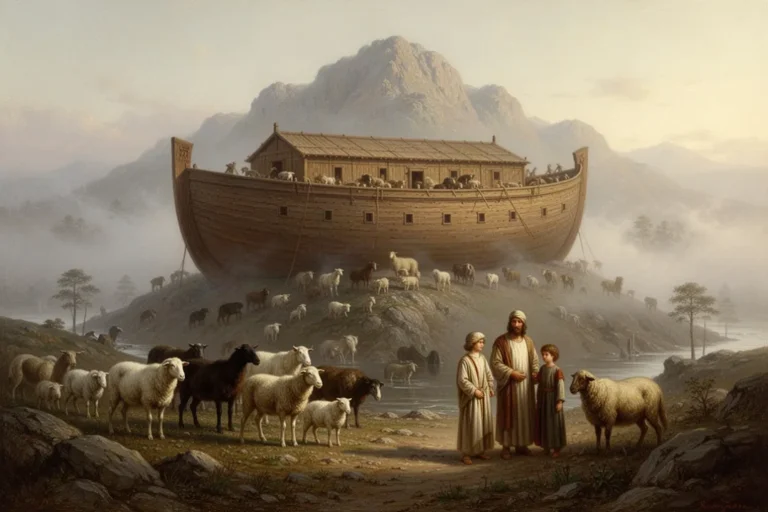
God tells Noah to build an ark, a large vessel made from wood and sealed against water. The instructions include its basic proportions and several levels. Noah is also told to bring his wife, his sons, and his sons’ wives into the ark, along with animals needed to preserve life after the flood.
The exact number of animals is discussed differently within the passage. Genesis first speaks of bringing pairs of living creatures, while a later instruction refers to additional animals suitable for sacrifice. The safest reading is that the account distinguishes between unclean animals and animals considered clean for worship and food.
Noah’s family enters the ark, and the floodwaters rise. Genesis describes rain falling for forty days and forty nights, while also describing waters coming from the deep. The waters cover the land, rise above the mountains as the story portrays them, and destroy living creatures outside the ark.
The flood remains high for an extended period. After the rain stops, the ark eventually comes to rest on the mountains of Ararat. Noah sends out birds to discover whether the waters have receded. A raven is sent first, followed by doves; the dove eventually returns with a freshly picked olive leaf, showing that dry land is appearing.
When the ground is dry, God tells Noah and those with him to leave the ark. The people and animals begin life again on the earth. Noah builds an altar and offers sacrifices, and God establishes a covenant that includes Noah, his descendants, and every living creature.
The central sequence: human violence leads to judgment, Noah receives a means of rescue, the waters destroy the old order, and the covenant establishes a new promise for life after the flood.
Why God sends the flood in Genesis
The stated reason for the flood is not simply that people have made individual mistakes. Genesis emphasizes a society marked by violence, corruption, and persistent evil. The flood narrative treats human wrongdoing as a condition that has spread through the world and damaged the relationship between humanity, creation, and God.
The story also connects the flood with the biblical theme of judgment against violence. Earlier chapters of Genesis describe conflict and bloodshed, including the murder of Abel by Cain. By the time of Noah, the account portrays violence as so widespread that the earth itself is described as filled with it.
At the same time, the narrative does not present judgment as God’s only response. Noah receives mercy and protection. Genesis describes him as finding favor with God, and his obedience becomes the means by which his family and the future of living creatures are preserved.
This combination of judgment and mercy is essential to the story. The flood is severe, but the narrative moves toward preservation rather than annihilation. The ark carries a remnant of life, and the covenant afterward places limits on the possibility of another flood destroying the earth.
Different Christian, Jewish, and other religious traditions place emphasis on different aspects of this account. Some focus on the seriousness of sin and the need for obedience. Others emphasize God’s patience, the value of human life, the preservation of creation, or the promise that judgment will not have the final word.
Noah’s character and obedience
Noah is not portrayed as a powerful king, military leader, or expert sailor. He is presented as a person who responds to an extraordinary command with faithful obedience. Genesis repeatedly connects his actions with doing what God commanded him.
The account does not claim that Noah is flawless in every respect. After the flood, it records his drunkenness and a troubling family incident. That detail prevents readers from treating Noah as a completely perfect person. His role in the story rests on his trust and obedience, not on a claim that he never fails.
For many readers, Noah’s long preparation for the flood represents obedience before visible evidence appears. He builds the ark before the rain arrives and gathers his household before the danger is apparent. The story therefore presents faith as action shaped by trust in God’s warning.
What the ark means in the story
The ark is the physical center of the flood narrative. It is not described as a ship designed for travel or exploration. Its purpose is to preserve life through the waters. The vessel floats, protects its occupants, and carries the living creatures that will repopulate the world afterward.
Genesis gives the ark a length of 300 cubits, a width of 50 cubits, and a height of 30 cubits. A cubit was an ancient unit based roughly on the length of a person’s forearm, so the exact modern measurements depend on which cubit is assumed. The text’s proportions create a long, broad vessel suited to stability rather than speed.
The ark has multiple levels, rooms or compartments, an opening near the top, and a door at its side. It is coated with pitch to make it watertight. These details show that the biblical account treats the ark as a carefully prepared structure, even though it does not provide every engineering detail a modern builder would expect.
Some Christian readers interpret the ark as a picture of salvation and refuge. In this reading, the ark represents God’s provision in the face of judgment. Other readers approach it primarily as an ancient narrative about obedience, survival, and a renewed relationship between God and creation.
The ark also makes the flood story broader than a family rescue. Animals are included in the command, and the covenant after the flood explicitly includes living creatures. The narrative therefore presents human responsibility as connected with the preservation of the nonhuman world.
Who enters the ark?
Noah enters with his wife, his three sons, and their wives. The account does not name Noah’s wife or the wives of his sons. The family group totals eight people, a number later recognized in the New Testament when the flood is used as an example of deliverance through judgment.
Animals enter according to the instructions given to Noah. Genesis refers to birds, livestock, and other land animals. The text focuses on animals that breathe air and live on land; it does not specifically explain the effect of the flood on aquatic life.
God is shown as directing the animals into the ark, while Noah’s responsibility is to receive and care for them. This detail reinforces the idea that survival depends on both divine provision and human stewardship.
What happens after the floodwaters recede
When Noah leaves the ark, the first recorded act is worship. He builds an altar and offers sacrifices from the animals identified as suitable for that purpose. The scene marks a transition from survival to restored fellowship and gives the post-flood world a religious foundation.
God then makes a covenant with Noah, his descendants, and every living creature. The promise is that the earth will not again be destroyed by a flood of that kind. The covenant is not limited to Noah’s personal lifetime; it reaches future generations and the broader living world.
The rainbow serves as the visible sign of this covenant. Whenever it appears in the clouds, it reminds God of the covenant promise, according to the biblical narration. The sign transforms an ordinary natural phenomenon into a lasting symbol of mercy, restraint, and the preservation of creation.
The rainbow does not mean that the Bible promises there will never be another destructive flood in any local region. The covenant concerns the destruction of the earth and all living creatures by a flood on the scale described in Genesis. Floods continue to occur in the natural world, but the story presents a promise against a repetition of that global judgment.
The covenant also includes responsibilities for human beings. Genesis later addresses the value of human life and establishes a prohibition against taking it unjustly. The passage connects human dignity with the fact that people are made in the image of God.
After the flood, Noah’s sons become the ancestors from whom the nations are presented as spreading across the earth. Genesis 10 gives a table of nations, followed by the story of Babel in Genesis 11. Together, these passages explain the biblical account of humanity’s expansion and division after the flood.
How the flood of Noah compares with other flood accounts
Flood stories appear in several ancient cultures, especially in the ancient Near East. Texts such as the Epic of Gilgamesh and the Atrahasis Epic also describe a devastating flood, a favored survivor, a large vessel, animals, birds, and a sacrifice after the waters recede.
These similarities have led scholars to ask whether the biblical story shares a cultural background with older Mesopotamian traditions. The stories may reflect memories of severe regional flooding, the movement of common ancient themes, or literary engagement between traditions. Similar elements alone do not prove that every account was copied directly from one particular source.
The differences are also significant. In Genesis, the flood is tied to human violence and moral corruption. The God of Genesis acts with a unified purpose, whereas some Mesopotamian stories portray multiple gods with conflicting motives. Genesis also places strong emphasis on the covenant and the rainbow as a promise concerning the future of the earth.
In the Epic of Gilgamesh, the survivor is Utnapishtim. In the biblical account, the survivor is Noah. The vessels, divine reasons for the flood, duration of the waters, and events after landing differ between the traditions, even though the broad pattern of catastrophe and survival is recognizable.
For readers of Genesis, comparison with other accounts need not remove the story’s theological meaning. Ancient writers often used shared images and narrative patterns to address different questions. Genesis uses the flood to speak about sin, judgment, mercy, creation, human responsibility, and God’s binding promise.
What people ask about the flood’s historicity and science
The flood raises questions that cannot be answered by theology alone. Readers often ask whether the event covered the entire planet, whether the ark could hold all animal species, and whether geological evidence confirms a worldwide flood. Christians and Jews do not all answer these questions in the same way.
Some readers interpret the Genesis flood as a global historical event that covered the whole earth. They generally understand the statements about the waters covering the mountains in a direct, worldwide sense and may propose that geological evidence has been interpreted incorrectly or that the event occurred within a framework different from standard scientific models.
Other readers interpret the flood as a large regional catastrophe remembered and presented through the language of the ancient world. On this view, “the whole earth” can describe the inhabited world known to the story’s audience, while the theological claims remain central even if the water did not cover every continent.
Still other readers understand the account primarily as theological or literary history rather than as a modern scientific report. They may believe that Genesis communicates real truths about God and humanity without providing the kind of geographic, biological, or chronological information expected from contemporary science.
Modern geology does not support a single recent flood covering all land on Earth in the straightforward way some literal readings propose. Scientists do recognize many enormous floods and ancient regional inundations. The distinction between a global flood, a major regional flood, and a theological narrative shaped by ancient literary conventions is therefore important.
The animal question involves similar differences. A literal global interpretation must account for the number of animals, their habitats, food, waste, migration, and later distribution. Other interpretations understand the animal categories in the text as referring to the creatures known within the story’s setting rather than every species recognized by modern biology.
Those questions should be approached honestly. The biblical text gives theological and narrative details, but it does not answer every modern scientific question. A careful reader can distinguish between what Genesis explicitly says, what a tradition infers, and what scientific investigation can test.
Read the account on two levels: ask what Genesis says about the flood itself, and separately ask what historical or scientific claims can be established from evidence outside the text.
How the flood is used elsewhere in the Bible
The flood of Noah becomes a reference point in later biblical writings. The prophet Isaiah uses the “waters of Noah” as a comparison for God’s promise not to abandon his people. The image links the flood covenant with later assurances of mercy and restoration.
In the New Testament, Jesus refers to the days of Noah when discussing the suddenness of future judgment. His point is that ordinary activities can continue while people remain unaware of approaching accountability. The emphasis is on readiness and moral seriousness, not on providing additional details about the ark.
The First Letter of Peter connects Noah’s preservation through water with Christian teaching about salvation. The passage does not simply equate the ark with a later religious practice; it uses the flood as a symbolic pattern involving judgment, rescue, and a response to God.
The Second Letter of Peter also refers to Noah as a preacher of righteousness and presents the flood as an example of divine judgment. These later references treat the story as a warning that wrongdoing has consequences while also highlighting God’s ability to preserve those who trust him.
The Book of Hebrews places Noah among examples of faith. It emphasizes that he acted in response to God’s warning about events not yet visible. This interpretation makes Noah’s obedience a model of confidence expressed through concrete action.
Across these references, the flood is not used only as a story about ancient weather. It becomes a framework for thinking about judgment, faith, patience, salvation, and covenant. The later biblical writers assume readers know the Genesis account and draw out particular aspects for their own teaching.
Practical questions the story raises for readers
The flood narrative asks how people respond when they recognize serious wrongdoing around them. Noah’s setting is described as violent and corrupt, yet his response is not to imitate that culture. He listens, builds, protects life, and follows the instructions he has received.
It also raises questions about responsibility toward others. Noah does not preserve only himself. His household and the animals are included in the rescue, suggesting that faithful action has consequences beyond one individual.
The covenant challenges the reader to see the natural world as part of the moral horizon. God’s promise includes every living creature, not only human beings. The rainbow therefore points to mercy toward creation as well as reassurance for humanity.
Readers who find the judgment in the account difficult should not avoid the difficulty. The story presents the destruction of life on a scale that naturally raises questions about justice, mercy, and the character of God. Different traditions respond by emphasizing human corruption, divine grief, the literary setting of Genesis, or the distinction between the narrative’s theology and modern ideas of history.
The most direct way to study the passage is to read Genesis 6–9 carefully and track the sequence of commands, events, and promises. Notice which details the text states clearly and which questions it leaves open.
Genesis 6: human corruption, Noah’s character, and the instructions for building the ark.
Genesis 7: entry into the ark, the rising waters, and the destruction outside it.
Genesis 8: the waters receding, the birds, Noah’s exit, and the altar.
Genesis 9: the covenant, the rainbow, human responsibility, and Noah’s family.
A helpful reading practice is to separate description from interpretation. First identify what happens in the passage. Then consider what it means in Jewish or Christian tradition, how later biblical writers use it, and how historical or scientific questions relate to it.
The flood of Noah remains one of the Bible’s most challenging narratives because it joins catastrophe with hope. Its central movement is from a violent and corrupted world, through judgment and preservation, toward a covenant that promises the continued existence of life.
Frequently asked questions
How long did Noah’s flood last?
Genesis describes rain for forty days and forty nights, but the entire period during which the waters remained high lasted much longer. The narrative says the waters prevailed for 150 days before beginning to recede. Noah and his family remained in the ark until God told them the ground was dry, so the complete period from entering to leaving extended well beyond the rainfall itself.
Where did Noah’s ark come to rest?
Genesis says the ark came to rest on the mountains of Ararat. The text does not identify one exact mountain or provide coordinates. “Ararat” may refer to a mountainous region associated with ancient kingdoms rather than a single peak. Various proposed landing sites have been suggested over time, but no location has been established as the ark’s confirmed resting place.
Did Noah take two of every animal?
Genesis first describes pairs of animals entering the ark, but it also gives instructions involving additional numbers of animals considered clean. This distinction is connected with sacrifice and worship after the flood. The passage does not use modern biological categories such as species, so applying today’s exact count of animal species directly to the narrative creates questions the text itself does not address.
What does the rainbow mean in Noah’s story?
In Genesis, the rainbow is the sign of God’s covenant with Noah, his descendants, and every living creature. It represents the promise that a flood will not again destroy all life on earth in the same way. The sign points to divine restraint and mercy, while also reminding readers that the covenant extends beyond humanity to the wider living world.




Leave a Reply