If you have heard that Jesus raised Lazarus from the dead, you may also wonder what relationship they had before that miracle. Lazarus was a close friend of Jesus, not one of the Twelve apostles or a distant stranger. He lived in Bethany with his sisters, Martha and Mary, in a household Jesus knew well and visited.
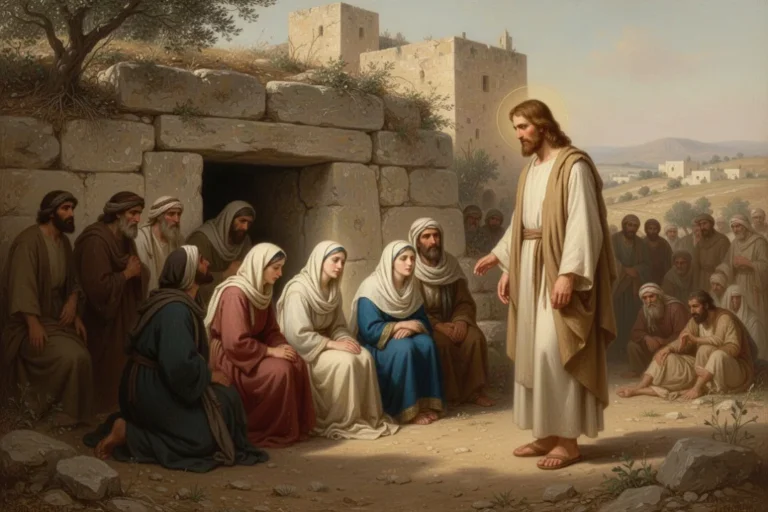
The Gospel of John presents Lazarus as someone Jesus deeply loved. When Lazarus became seriously ill, his sisters sent word to Jesus. Jesus eventually came to Bethany, spoke with the grieving family, and called Lazarus out of the tomb. The event became one of the most important signs in John’s account of Jesus’ identity and mission.
Lazarus appears mainly in John 11 and John 12. John identifies him as a man from Bethany, a village near Jerusalem, and names Martha and Mary as his sisters. The family seems to have been known personally by Jesus rather than merely mentioned as part of a crowd that heard him teach.
When Lazarus fell ill, his sisters sent Jesus a message that their brother was sick. Their message did not demand a specific action; it appealed to the relationship between Jesus and the family. John then emphasizes that Jesus loved Martha, Mary, and Lazarus (John 11:5).
That statement matters because Lazarus’ story is not simply about a miracle performed for an unknown person. It is also a story about friendship, grief, trust, and the difficult timing of Jesus’ actions. Jesus knew Lazarus was ill, yet he did not immediately leave for Bethany. By the time he arrived, Lazarus had already been in the tomb for several days.
Direct answer: Lazarus was Jesus’ beloved friend and the brother of Martha and Mary. His raising from the dead is recorded in John 11, where it serves as a sign pointing to Jesus’ authority over death.
The family relationship among Lazarus, Martha, and Mary
Lazarus lived with Martha and Mary, who are presented as his sisters. The Gospel does not give many details about their parents, occupations, ages, or wider family history. It also does not explain how Jesus first met them. What it does show is a household where Jesus was welcomed and where the sisters felt able to speak honestly with him.
Martha appears in the conversation with Jesus after Lazarus dies. She goes out to meet him and says that Lazarus would not have died if Jesus had arrived earlier, while also expressing confidence that God can answer Jesus’ request. Mary later comes to Jesus and expresses the same grief. Their words show both faith and disappointment.
Luke 10:38-42 also describes a visit to the home of Martha and Mary, although that passage does not name Lazarus. Many readers connect the sisters in Luke with the sisters in John, since both accounts place them in a close relationship with Jesus. John, however, is the Gospel that explicitly identifies Lazarus as their brother and records his illness, death, and restoration to life.
John 12 places Lazarus, Martha, and Mary together again at a meal in Bethany. Martha serves, Lazarus is among those eating with Jesus, and Mary anoints Jesus’ feet with expensive perfume. This scene confirms that Lazarus was alive after the miracle and that the family remained closely associated with Jesus during the period leading to his final Passover.
What happened when Lazarus became sick
The account in John 11 follows a sequence that helps explain why the story is so significant:
Lazarus becomes seriously ill. His sisters send a message to Jesus while he is elsewhere.
Jesus responds with a statement about God’s purpose. He says the illness will serve God’s glory and reveal something about the Son of God.
Jesus waits before traveling. He remains where he is for a period of time instead of leaving immediately.
Jesus tells his disciples that Lazarus has died. He uses sleep as an image before speaking plainly about Lazarus’ death.
The disciples travel with Jesus toward Bethany. They understand that returning near Jerusalem could expose Jesus to danger.
Martha and Mary meet Jesus separately. Both express sorrow that he was not there sooner.
Jesus goes to the tomb. He is deeply moved by the scene and by the grief of the people around him.
Jesus calls Lazarus out. Lazarus leaves the tomb alive, still wrapped in burial cloths, and the people are told to unbind him.
The delay is one of the hardest parts of the story for many readers. John does not portray Jesus as indifferent to Lazarus. Instead, the narrative holds together two truths: Jesus loves the family, and he allows events to reach the point where Lazarus has died before acting.
That timing makes the event different from a healing at a sickbed. The story removes any doubt that Lazarus had merely fainted or been mistaken for dead. His body had been placed in a tomb, and Martha warns that there will already be an odor. John’s narrative presents the act as a return from death, not a recovery from illness.
John 11:35 records that Jesus wept. The verse is brief, but the surrounding scene gives it emotional weight. Jesus sees Mary grieving, notices the people mourning with her, and comes to the tomb where his friend has been placed. His tears show that the death of Lazarus and the sorrow surrounding it are not abstract ideas to him.
Readers have offered several complementary ways to understand Jesus’ emotion. He may be grieving Lazarus’ death, responding to the family’s pain, confronting the destructive power of death, or reacting to the unbelief and confusion surrounding the event. The text describes Jesus as deeply troubled, but it does not reduce his tears to one simple explanation.
His grief also shows that knowing Lazarus will be restored does not make the family’s suffering unreal. Hope does not erase compassion. Jesus can know what he is about to do and still enter fully into the sorrow of the moment.
Jesus’ tears show that the story is not only about power over death; it is also about his presence with people who are mourning.
What Jesus meant by life and resurrection
Before going to the tomb, Jesus speaks with Martha about resurrection. Martha expresses a general belief that Lazarus will rise at the resurrection on the last day. Jesus then directs her attention to himself, explaining that he is the resurrection and the life. The point is not merely that he can perform an extraordinary deed. John presents Jesus as the source and embodiment of the life he promises.
Jesus asks Martha whether she believes. Her response identifies him as the Messiah and Son of God who has come into the world. The conversation connects Lazarus’ immediate restoration with a larger claim about Jesus’ authority and the future hope of resurrection.
The raising of Lazarus should not be confused with the final resurrection described in Christian teaching. Lazarus returns to ordinary human life and will eventually die again. Jesus’ own resurrection is presented differently in the New Testament: it is not simply a return to a previous mortal condition. Lazarus’ restoration functions as a sign pointing beyond itself to Jesus’ authority over death and to the promised resurrection of believers.
How Lazarus was raised from the tomb
At the tomb, Jesus first instructs the people to remove the stone. Martha objects that the body will already have begun to decay because Lazarus has been dead for several days. Jesus reminds her of his earlier promise about seeing God’s glory.
Jesus then prays aloud, thanking the Father for hearing him. The prayer makes clear that the event is not presented as magic or as an independent display of power. Jesus acts in unity with the Father and does so publicly, so that the crowd may believe that the Father sent him.
After the prayer, Jesus calls Lazarus by name. Lazarus comes out of the tomb with his hands and feet still covered by burial cloths and his face wrapped. Jesus then tells the people nearby to free him and let him go.
That final instruction is a small but vivid detail. The miracle restores Lazarus to life, but the surrounding community must participate in helping him return to ordinary human existence. The people remove the grave clothes, while Lazarus reenters the life of his family and community.
A useful distinction: Lazarus was brought back to mortal life, not described as receiving an immortal resurrection body. The event is a sign of Jesus’ power and a preview of the hope John associates with him.
Why Lazarus’ raising mattered to Jesus’ ministry
John calls Jesus’ miracles “signs” because they reveal something about who Jesus is. The raising of Lazarus is the climactic sign in the first half of John’s Gospel. It demonstrates that Jesus can give life where death appears final, and it leads many witnesses to believe in him.
The event also intensifies opposition from Jerusalem’s religious authorities. According to John 11:45-53, some people report what happened to the chief priests and Pharisees. The leaders fear that Jesus’ growing influence could create political and religious upheaval. Their discussion leads to a decision that Jesus must die.
This creates a striking contrast in the narrative: Lazarus receives life, while the miracle contributes to the authorities’ determination to take Jesus’ life. John therefore places the raising of Lazarus close to the beginning of the final sequence that leads to Jesus’ crucifixion.
Lazarus himself becomes part of the public evidence surrounding Jesus. In John 12:9-11, many people come not only to see Jesus but also to see Lazarus, whom Jesus raised from the dead. The chief priests then consider killing Lazarus as well, because his restored life is drawing people toward faith in Jesus.
What Lazarus did after he was raised
John does not provide a long biography of Lazarus after the miracle. The next significant reference appears at a dinner in Bethany, shortly before Passover. Lazarus is present with Jesus, Martha serves the meal, and Mary anoints Jesus’ feet with costly perfume and wipes them with her hair.
This meal shows Lazarus in a quiet, ordinary setting after an extraordinary event. He is not described as becoming a preacher, an apostle, or a public leader. His role in the Gospel remains that of the friend whose restoration reveals Jesus’ power and whose continued existence draws attention to what Jesus has done.
The Gospel of John does not state what happened to Lazarus later in life. Claims about his later ministry, travel, death, or burial come from traditions outside the biblical text and vary considerably. They should not be presented as established facts from the New Testament.
Was Lazarus one of Jesus’ apostles?
No. Lazarus was not one of the Twelve apostles. John names him as Jesus’ friend and as the brother of Martha and Mary, but he is not included among the disciples chosen as the Twelve.
That distinction helps clarify the different kinds of relationships shown in the Gospels. Jesus had the Twelve as a particular group of followers sent to participate in his ministry. He also had other disciples, supporters, family friends, and people who welcomed him into their homes. Lazarus belongs to the circle of people personally connected to Jesus in Bethany, not to the formal list of the Twelve.
The Gospels do not tell us whether Lazarus followed Jesus continuously from town to town before his illness. They do show that Jesus trusted this household enough to visit it and that the family had confidence in bringing their needs directly to him.
How Lazarus differs from the Lazarus in Luke 16
Another man named Lazarus appears in the parable recorded in Luke 16:19-31. He is a poor man who lies outside a rich man’s house and later appears in the afterlife with Abraham. That Lazarus is not identified as the same person as the friend of Jesus in John 11.
The two accounts have different settings, characters, and purposes. John’s Lazarus lives in Bethany, has two sisters, and is raised from a tomb. Luke’s Lazarus appears in a teaching story about wealth, suffering, judgment, and listening to Moses and the prophets. The shared name does not establish that they are the same man.
It is also significant that the Lazarus in Luke’s parable is not described as being raised from the dead. The story mentions a person named Lazarus in a symbolic narrative, while John reports a specific event involving Jesus and his friend.
What Lazarus’ story teaches about Jesus’ relationship with people
Lazarus’ story presents Jesus as more than a miracle worker. Jesus knows the family personally, receives their message, shares their sorrow, and speaks with Martha and Mary in a direct and personal way. His relationship with Lazarus gives the miracle a human setting that readers can recognize: a family facing illness, death, unanswered questions, and grief.
The story also avoids a simplistic idea that love always means preventing every painful event. Jesus loves Lazarus, yet Lazarus dies. Martha and Mary are not spared disappointment, and their faith develops through a conversation that includes both trust and protest.
Friendship: Jesus refers to Lazarus as a friend, showing personal affection rather than a merely formal connection.
Compassion: Jesus responds emotionally to the family’s grief and weeps at the tomb.
Faith under delay: Martha and Mary must wrestle with the fact that Jesus did not arrive before Lazarus died.
Authority over death: The raising of Lazarus points to Jesus’ power to give life.
Public witness: Lazarus’ restored life leads some people to believe and increases opposition from others.
Hope beyond one miracle: Lazarus’ return to mortal life points toward the broader Christian hope of resurrection.
What the Bible does not tell us about Lazarus
The biblical account leaves many personal details unanswered. It does not tell us Lazarus’ age, profession, marital status, financial situation, or exact relationship to Jesus before the illness described in John 11. It also does not record any words spoken by Lazarus after he leaves the tomb.
The silence is useful because it keeps attention on the purpose of the account. Lazarus is not presented as a hero because of his accomplishments or speeches. He is the person through whom John shows Jesus’ love, grief, authority, and approaching conflict with the leaders in Jerusalem.
Readers should also avoid treating every later tradition about Lazarus as though it came directly from Scripture. The New Testament gives a focused account: Lazarus belonged to a family in Bethany, Jesus loved him, Jesus raised him, and his restored life became a major sign before Jesus’ death.
Why Lazarus remains important to Christians
For Christians, Lazarus’ story is important because it links a personal friendship with one of the Gospel’s strongest declarations about Jesus. The event is intimate enough to include a grieving family and public enough to affect the course of Jesus’ ministry.
Lazarus also represents the boundary that human beings cannot cross by their own strength. He is placed in a tomb, and then Jesus calls him out. The scene does not suggest that death is trivial. Instead, it portrays death as real and sorrowful while declaring that Jesus’ authority reaches even there.
At the same time, Lazarus is not the central figure in the theological sense. Jesus is. Lazarus’ life, death, and restoration direct attention toward Jesus’ identity, his relationship with the Father, his compassion for mourners, and the promise of life that he gives.
So, who was Lazarus to Jesus? He was a beloved friend from Bethany, a brother in a family Jesus knew well, and the man whose raising from the dead became a decisive sign in John’s Gospel. His story shows both the tenderness of Jesus’ human relationships and the Gospel’s claim that Jesus has authority over death.
Frequently asked questions
Where did Lazarus live?
Lazarus lived in Bethany, a village near Jerusalem. He shared a home with his sisters, Martha and Mary. John’s Gospel identifies Bethany as the setting for his illness, death, burial, and raising by Jesus. The village later became the location of a meal attended by Lazarus, Jesus, Martha, and Mary shortly before Passover.
Did Lazarus say anything after Jesus raised him?
John’s Gospel does not record any speech by Lazarus after he came out of the tomb. The account focuses on Jesus’ command, Lazarus’ emergence in burial cloths, and the instruction for others to unwrap him. Lazarus later appears at a meal in Bethany, but the text still gives him no spoken dialogue.
Was Lazarus the first person Jesus raised from the dead?
The Gospels record several occasions when Jesus restored dead people to life, including Jairus’ daughter and the son of a widow at Nain. They do not establish a complete chronological list that lets readers say with certainty that Lazarus was the first. Lazarus’ raising is especially prominent because John presents it as a major sign before Jesus’ crucifixion.
Why did the authorities want Lazarus killed?
According to John 12:9-11, Lazarus’ restored life attracted crowds and led many people to believe in Jesus. The chief priests therefore considered killing Lazarus as well as Jesus. His continued presence served as visible evidence of what Jesus had done, making him a threat to leaders who wanted to stop Jesus’ influence.












Leave a Reply