First Corinthians: themes, meaning, and practical lessons
First Corinthians: themes, meaning, and practical lessons
When a church community is divided, proud of its leaders, confused about worship, and struggling with ethical questions, where can it turn for help? First Corinthians addresses that kind of situation directly. Paul writes to the Christians in Corinth about disagreements, sexual morality, marriage, worship, spiritual gifts, the resurrection, and the meaning of Christian love.
The letter is not a collection of abstract religious ideas. It is a practical response to a real congregation with competing loyalties and serious problems. Its central message is that the gospel of Christ must reshape how believers think about status, freedom, relationships, worship, and the body of the church.
First Corinthians is a letter in the New Testament traditionally associated with the apostle Paul. He wrote to the Christian community in Corinth, a major city in ancient Greece. The church had grown during Paul’s ministry, but reports and questions from the congregation showed that its members were struggling to live together faithfully.
Paul addresses the letter to the church, but he does not avoid uncomfortable subjects. He confronts factionalism, arrogance, lawsuits between believers, sexual misconduct, confusion about marriage, disputes over food connected with pagan worship, and disorder during the Lord’s Supper. He also answers questions about spiritual gifts and the resurrection.
The letter was likely written in the middle of the first century, during Paul’s wider missionary work. Corinth was commercially active, socially diverse, and shaped by many religious practices. That setting helps explain why the congregation faced questions about identity and public behavior.
Central idea: First Corinthians calls a divided church to let the cross of Christ—not social rank, personal preference, or spiritual pride—shape its shared life.
First Corinthians at a glance
Author: Paul, writing as an apostle of Jesus Christ.
Audience: Christians living in Corinth, including both Jewish and Gentile believers.
Main concern: How the gospel should transform a fractured Christian community.
Major themes: unity, holiness, wisdom, love, freedom, worship, spiritual gifts, and resurrection.
Distinctive passages: the message of the cross, the teaching on love, and the chapter on bodily resurrection.
The letter should be read as a whole. For example, Paul’s teaching about freedom makes more sense alongside his teaching about love and responsibility. His discussion of spiritual gifts belongs with his insistence that worship should build up the entire church. His teaching about the resurrection explains why Christian hope is grounded in a future bodily reality rather than merely an inner feeling.
How to read First Corinthians step by step
A careful reading becomes easier when you follow the movement of the letter instead of treating each chapter as an isolated saying. These steps provide a useful approach:
Identify the problem Paul is addressing. Ask whether the issue is division, pride, immorality, worship, freedom, or uncertainty about the resurrection.
Look for the gospel principle behind his response. Paul repeatedly points to Christ’s cross, resurrection, lordship, and call to holiness.
Notice the community dimension. Many instructions are not only about private behavior; they concern how one believer’s choices affect others.
Separate timeless principles from local circumstances. The ancient setting matters, but the underlying concerns—status, conscience, sexuality, leadership, and love—remain recognizable.
Read difficult passages in context. A single sentence should be interpreted alongside the surrounding argument and the letter’s wider emphasis.
Apply the teaching through love and edification. Paul’s standard is not simply personal correctness but the strengthening of the church.
Chapters 1–4: Christian unity is centered on the cross
Paul begins by confronting divisions within the Corinthian church. Some believers identify themselves with Paul, Apollos, Cephas, or Christ in a way that turns respected leaders into competing group symbols. The problem is not appreciation for teachers; it is the assumption that a particular leader gives someone superior status.
Paul responds by directing attention away from human reputation and toward Jesus Christ crucified. The cross appears foolish or weak according to ordinary standards of power, yet it reveals God’s wisdom. This challenges a culture—and a church—that measures people by education, eloquence, influence, wealth, or social standing.
The opening chapters also explain why Paul did not rely on impressive speech or philosophical performance when he proclaimed the gospel. The Christian message depends on God’s action in Christ, not on the speaker’s ability to win admiration. Christian leaders therefore have a real role, but they remain servants rather than owners of the church.
Paul uses several images to describe the congregation. The church is God’s field, God’s building, and God’s temple. These images emphasize both divine ownership and communal responsibility. If believers damage one another through rivalry or arrogance, they are not merely having a personality conflict; they are harming a community claimed by God.
These chapters also address spiritual pride. Some Corinthians appear to think they are already wise, strong, or secure. Paul contrasts that attitude with the pattern of Christ and the humble service of the apostles. The issue is not that knowledge has no value. Rather, knowledge must not become a reason to despise others or claim superiority.
Chapters 5–7: holiness, relationships, and responsible freedom
In chapter 5, Paul responds to a serious case of sexual immorality within the church. He criticizes the congregation not only for the behavior itself but also for its apparent pride and tolerance. His concern is that unchecked wrongdoing can spread through the community, just as a small amount of leaven affects a larger batch of dough.
Paul’s language about discipline is firm, but it is directed toward restoration and the protection of the church. The goal is not public humiliation or personal revenge. Christian communities are called to take serious wrongdoing seriously while remembering that discipline should serve repentance and spiritual health.
Chapter 6 challenges believers who are taking one another to court. Paul argues that the church’s internal disputes should not be handled in ways that publicly display hostility and undermine its witness. His larger point is that the community’s identity should change how members pursue justice and settle conflicts.
The same chapter connects Christian faith with the body. Paul rejects the idea that physical actions are spiritually irrelevant. Because believers belong to Christ, their bodies matter. Sexual conduct is therefore treated as a theological issue involving union, dignity, and the presence of the Holy Spirit—not simply as a private preference.
Chapter 7 answers questions about marriage and singleness. Paul recognizes marriage as a legitimate setting for mutual responsibility and sexual faithfulness, while also acknowledging the value of singleness for those who can live that calling. His advice is shaped partly by the pressures facing the Corinthians, so it should not be used to treat one marital status as spiritually superior to another.
Paul also speaks to believers married to nonbelievers. He does not instruct the Christian spouse to abandon the marriage merely because the other person does not share the faith. At the same time, he recognizes that separation and difficult circumstances can require careful pastoral judgment. The chapter’s emphasis is on faithfulness, peace, and responsible conduct within real relationships.
Chapters 8–10: freedom must be governed by love
Chapters 8 through 10 explore food associated with pagan temples. Some Corinthians understand that idols have no real divine power and conclude that eating such food is harmless. Others have a more vulnerable conscience because of their former religious background. Paul agrees that knowledge can clarify the issue, but he warns that knowledge without love can injure another believer.
This section offers a lasting principle: Christian freedom is not measured only by what you are permitted to do. It must also be measured by how your conduct affects someone else’s faith. A believer may have the right to make a particular choice and still decide not to exercise that right for the sake of another person.
Paul supports this teaching with his own example. Although he has rights as an apostle, he voluntarily limits those rights so that the gospel will not be hindered. His life shows that sacrifice is not a denial of freedom; it can be one of freedom’s most mature expressions.
Chapter 10 warns the Corinthians not to presume upon their spiritual status. Israel’s history contains examples of people who experienced God’s provision yet turned toward idolatry and disobedience. Paul uses that history as a warning: participation in Christian worship does not make a person immune to temptation.
He also teaches that temptation does not place believers in a hopeless position. God remains faithful and provides a way to endure without surrendering to sin. The practical response is not self-confidence but alertness, humility, and a willingness to leave situations that draw the believer toward idolatry.
Practical test for disputed choices: Ask not only, “Am I allowed to do this?” but also, “Will this strengthen love, protect another person’s conscience, and honor Christ?”
Chapter 11: worship, tradition, and the Lord’s Supper
Chapter 11 includes difficult instructions about head coverings, hair, gender, and public worship. These details reflect the social expectations of Corinth and the ways appearance communicated honor, shame, gender, and group identity in that setting. Interpretations differ on how directly every practice should be carried into modern congregations.
The broader principle is clearer: worship should respect the dignity of others and avoid conduct that creates needless shame or confusion. Paul does not treat public worship as a stage for individual self-expression. He evaluates customs according to whether they honor God and support the community.
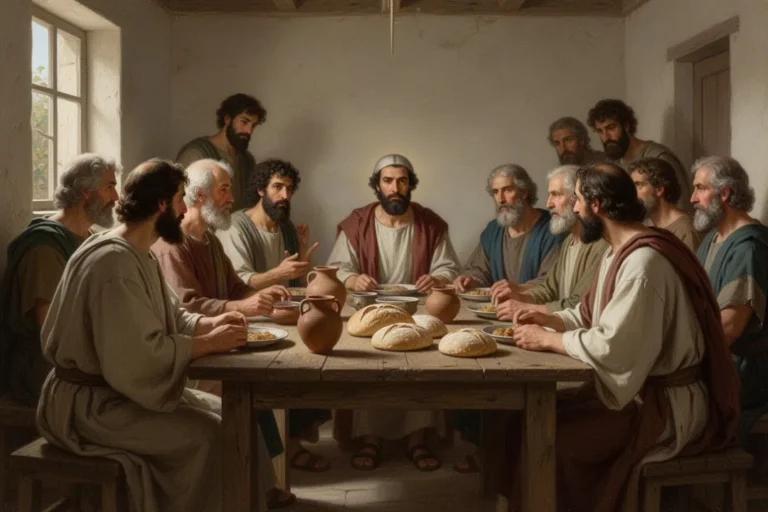
Paul then confronts the Corinthians’ behavior during the Lord’s Supper. Wealthier members appear to eat and drink while poorer members are left without enough food. This means the gathering celebrates social inequality instead of displaying the unity created by Christ.
Paul connects the meal with the Lord’s death and calls the church to examine itself. Self-examination here is not merely private introspection. It includes recognizing the body of believers and refusing to use a shared meal in a way that humiliates or excludes other members.
Chapters 12–14: spiritual gifts should build up the church
Chapters 12 through 14 form one of the clearest sections on spiritual gifts. Paul lists different forms of service, activity, and empowerment, but he insists that the same Spirit is at work. No gift makes one believer more valuable than another.
Paul compares the church to a human body with many parts. An eye cannot dismiss a hand, and one member cannot say that another is unnecessary. This image addresses both pride and insecurity. Prominent gifts do not justify superiority, while less visible gifts should not be treated as unimportant.
The list of gifts includes forms of speech, service, healing, discernment, faith, administration, and tongues. Paul’s purpose is not to create a ranking system. He wants the Corinthians to understand that diversity is part of the church’s design, provided every gift is used for the common good.
Chapter 13 appears in the middle of this discussion because love is the governing standard for every gift. Paul describes love as patient, kind, humble, truthful, and enduring. He also says that impressive spiritual abilities become empty when separated from love.
The famous chapter should not be reduced to a wedding reading. Its original setting is a divided congregation where people are competing over spiritual experiences. Paul is teaching that Christian maturity is shown less by public display than by the patient way believers treat one another.
“Love never fails.” — 1 Corinthians 13:8
Chapter 14 returns to prophecy and tongues in congregational worship. Paul values spiritual expression but gives priority to understandable communication that benefits the gathered church. Worship should not become a display that leaves most people confused or excluded.
His repeated concern is <strongedification—building up the community. He calls for order, participation, and self-control. Spiritual enthusiasm is not the enemy, but it must be guided by love and consideration for the whole congregation.
Chapter 15: the resurrection is the foundation of Christian hope
Chapter 15 responds to the claim that there is no resurrection of the dead. Paul treats this as a central theological crisis, not a minor disagreement. If the dead are not raised, then Christian preaching is empty, faith is misplaced, and the apostles are false witnesses about God’s action in Christ.
Paul begins with the gospel tradition that Christ died, was buried, was raised, and appeared to witnesses. He presents the resurrection of Jesus as the foundation for the future resurrection of believers. Christian hope is therefore tied to a real act of God, not only to the survival of a person’s influence or memory.
The chapter uses the image of a seed to explain the relationship between present and future bodily existence. A seed and the mature plant are connected, yet they do not look identical. In the same way, resurrection involves transformation rather than a simple return to ordinary mortal life.
Paul contrasts what is perishable with what is imperishable, and what is weak with what is raised in power. These contrasts do not mean the body is discarded. They affirm that God’s redemption includes the body and that death does not have the final word.
The chapter ends with a practical consequence: because resurrection hope is real, Christian work is not pointless. Faithful labor, service, and endurance have meaning even when they appear unnoticed. The future promise strengthens present obedience rather than encouraging escape from present responsibilities.
Chapter 16: generosity, leadership, and ordinary faithfulness
The final chapter includes instructions about a collection for believers in Jerusalem. Generosity is organized, regular, and shared across churches. Paul treats financial support as part of Christian fellowship, not as an optional emotional response to a crisis.
He also discusses travel plans, ministry partners, and the work of local leaders. The practical details show that Christian mission depends on real people, schedules, hospitality, courage, and cooperation. Spiritual life is not detached from administration or relationships.
Paul urges the Corinthians to remain alert, stand firm in the faith, act courageously, and do everything in love. That final combination matters. Courage without love becomes aggression, while love without conviction can become passivity. The church needs both steadfastness and tenderness.
Major themes that connect the whole letter
The cross overturns status
First Corinthians repeatedly challenges the human desire to rank people. The cross exposes the limits of worldly wisdom and shows that God’s saving work does not depend on prestige. Churches should therefore be cautious about celebrity leadership, impressive presentation, and social divisions disguised as spiritual preferences.
Christian freedom carries responsibility
Paul does not define freedom as doing whatever causes no immediate harm to yourself. Freedom is placed within love, conscience, and the good of the community. A mature believer can surrender a legitimate preference when exercising it would damage another person or distract from the gospel.
The body belongs to God
The letter gives the body serious theological importance. Sexual behavior, participation in worship, and the future resurrection all demonstrate that physical existence matters. Christian faith does not treat the body as disposable or morally irrelevant.
In First Corinthians, love is seen in patience, humility, restraint, truthfulness, and endurance. It refuses to use knowledge, wealth, freedom, or spiritual gifts to gain superiority. Love is therefore a pattern of action that protects the vulnerable and seeks the good of others.
The church needs both unity and diversity
Unity does not require every believer to have the same personality, role, gift, or preference. Paul’s body metaphor shows that the church becomes stronger when different members serve faithfully without competing for control. Unity is shared allegiance to Christ, not uniformity in every practice.
How First Corinthians can shape decisions today
First Corinthians offers a framework for situations that may look different from those in Corinth but involve similar pressures. When people argue over worship styles, church leaders, political identities, spiritual gifts, or personal rights, Paul directs attention back to the health of the community.
When a church is divided: evaluate whether loyalty to personalities has replaced loyalty to Christ.
When you have strong knowledge: use it to serve people, not to embarrass those with less understanding.
When you are exercising freedom: consider the conscience and spiritual welfare of others.
When you receive a visible gift or role: remember that every ministry exists for the common good.
When worship becomes confusing: prioritize clear communication, participation, and respectful order.
When suffering makes work feel pointless: remember Paul’s connection between resurrection hope and faithful labor.
Applying the letter does not mean copying every first-century custom without interpretation. It means asking what problem Paul is addressing and what gospel principle guides his answer. That approach helps readers distinguish between local social practices and enduring calls to humility, holiness, generosity, unity, and love.
Common misunderstandings about First Corinthians
One misunderstanding is that Paul’s main goal is to impose rules. His instructions are serious, but they arise from a concern for the church’s identity and spiritual health. He wants believers to become a community whose conduct reflects the gospel they proclaim.
Another misunderstanding is that the letter praises knowledge or spiritual experience above love. Paul does the opposite. Knowledge can be useful, and spiritual gifts can be valuable, but neither justifies arrogance or disorder. Love determines whether knowledge and gifts are being used faithfully.
Some readers also assume that the teaching about the resurrection is mainly symbolic. Paul’s argument does not support that reading. He treats resurrection as central to the Christian proclamation and insists that hope rests on God’s victory over death through Christ.
Finally, First Corinthians is sometimes used to settle modern disputes by quoting isolated lines. The letter should instead be read through its repeated concerns: Christ’s lordship, the unity of the church, holiness, care for the vulnerable, understandable worship, and love that seeks another person’s good.
A practical reading plan for First Corinthians
You can read the letter in one sitting to see its overall argument, then return to its major sections more slowly. Keep a journal with three columns: the problem Paul addresses, the gospel truth he presents, and the behavior he expects from the church.
Read chapters 1–4 and mark every reference to wisdom, boasting, leaders, or the cross.
Read chapters 5–7 while considering how holiness and relationships affect the church’s witness.
Read chapters 8–11 and list the ways personal freedom can affect another believer.
Read chapters 12–14 by comparing spiritual gifts with the standard of love and edification.
Read chapters 15–16 and connect resurrection hope with generosity, courage, and faithful work.
As you read, ask a final set of practical questions: Where am I tempted to seek status? Which freedoms might require restraint? Do my contributions strengthen the people around me? Does my understanding of resurrection make me more faithful in ordinary responsibilities?
First Corinthians remains valuable because it joins deep theology to recognizable human problems. It presents a church that is gifted but immature, informed but divided, enthusiastic but disorderly. Paul’s answer is not to abandon the community, but to call it back to the crucified and risen Christ, whose love creates a different way to live together.
Frequently asked questions
Who wrote First Corinthians?
First Corinthians is traditionally understood to have been written by the apostle Paul. He writes as a Christian messenger addressing the congregation in Corinth, responding to reports about its divisions and to questions the church had sent him. The letter reflects Paul’s authority, pastoral concern, and desire to correct serious problems without abandoning the community.
What is the main message of First Corinthians?
The main message is that the gospel of Jesus Christ must transform the way a church handles status, disagreement, morality, worship, freedom, and spiritual gifts. Paul repeatedly emphasizes that believers belong to one body and should use their knowledge, rights, and abilities to serve others rather than compete for superiority.
Why is 1 Corinthians 13 associated with weddings?
First Corinthians 13 is often read at weddings because it describes patient, kind, enduring love. In its original context, however, Paul was addressing conflict within a church, especially disputes about spiritual gifts and status. The chapter describes the kind of love that should govern the entire Christian community, not only romantic or marital relationships.
What does First Corinthians teach about resurrection?
First Corinthians 15 teaches that Jesus’ resurrection is central to Christian faith and that believers also hope for resurrection. Paul presents resurrection as a future transformation of the body, not merely the continuation of a person’s memory or spirit. This hope gives present Christian work lasting significance and encourages perseverance.





Leave a Reply