When you read the book of Zechariah, you may wonder why it moves so quickly from rebuilding a temple to mysterious horses, flying scrolls, symbolic crowns, and future kings. The answer is that Zechariah speaks to people living between disappointment and hope: they have returned from exile, but their city is still damaged and their worshiping community is still fragile.
Zechariah’s central message is that God has not abandoned his people. He calls them to return to him, encourages them to finish the temple, and shows through visions that God is working beyond what they can currently see. The book also looks ahead to a coming king, the cleansing of sin, the restoration of Jerusalem, and the day when God’s rule will be recognized throughout the earth.
Zechariah is one of the Twelve Minor Prophets in the Old Testament. “Minor” refers to the length of the books, not their importance. With fourteen chapters, Zechariah is the longest of the Minor Prophets and contains some of the Bible’s most detailed prophetic imagery.
The book combines several kinds of writing. Its opening chapters contain prophetic sermons and a series of nighttime visions. Chapters 7 and 8 address questions about fasting and faithful worship. Chapters 9 through 14 contain messages about judgment, restoration, a coming ruler, and the future of Jerusalem.
At its heart, Zechariah answers three connected questions:
Will God return to his people? Yes. The opening call to repentance is followed by promises of God’s renewed presence with Jerusalem.
Will the people’s broken community be restored? Yes, but restoration requires cleansing, justice, faithfulness, and renewed worship rather than merely rebuilding structures.
How will God’s purposes finally be accomplished? Through divine action, a purified people, and a humble but victorious king whose rule reaches beyond Jerusalem.
Central message: Zechariah urges a discouraged community to return to God, trust his unseen work, and live faithfully while waiting for his promises to be fulfilled.
When Zechariah was written and what was happening
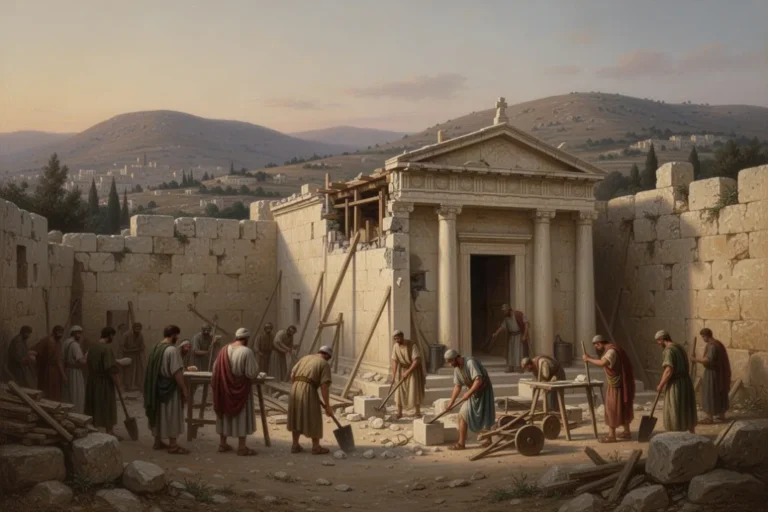
Zechariah began prophesying after the Babylonian exile, when some Jewish people had returned to Judah under Persian rule. Jerusalem had been destroyed decades earlier, and the temple had not yet been rebuilt. The returned community faced economic hardship, political uncertainty, and the discouragement that comes when a hoped-for restoration seems smaller than expected.
The prophet identifies himself as Zechariah son of Berechiah, son of Iddo. He began speaking in the second year of King Darius, which places the earliest messages around 520 BC. Haggai was also prophesying during this period, and both prophets encouraged the people and their leaders to resume work on the temple.
Zechariah’s ministry is closely connected with Zerubbabel, the governor of Judah, and Joshua the high priest. These two leaders represent civil and religious responsibility within the restored community. The book presents both of them as important figures, while also emphasizing that the future depends on God’s Spirit rather than human strength.
The temple was eventually completed during the reign of Darius. Zechariah’s messages, however, are not limited to construction. The rebuilt temple could not by itself solve the deeper problems caused by sin, injustice, divided loyalty, and failed leadership. The prophet therefore connects physical rebuilding with spiritual renewal.
How to read the book of Zechariah step by step
The book becomes easier to understand when you follow its movement instead of treating every symbol as an isolated puzzle. A useful reading plan is to notice how the message develops from repentance to restoration and then to the final reign of God.
Read the opening call to return. Zechariah begins by reminding the people that earlier generations ignored the prophets and suffered the consequences. The present generation is invited to turn back to God rather than repeat that history.
Trace the nighttime visions. Chapters 1 through 6 use symbolic scenes to show God’s concern for Jerusalem, his judgment on oppressive nations, and his intention to cleanse and restore his people.
Pay attention to Joshua and Zerubbabel. Their roles show how priestly and governing leadership are connected to God’s restoration, but neither leader is presented as the ultimate source of hope.
Read the fasting question as a heart issue. In chapters 7 and 8, the question is not simply which religious dates should be observed. God asks whether worship is joined to compassion, justice, and obedience.
Follow the shift toward future events. Chapters 9 through 14 use broader prophetic language about kings, nations, shepherds, conflict, purification, and the renewal of Jerusalem.
Read difficult images alongside clear themes. When a symbol is uncertain, anchor your interpretation in repeated ideas such as God’s presence, repentance, cleansing, justice, kingship, and holiness.
This approach prevents two common mistakes. One is reducing Zechariah to a list of predictions with no historical setting. The other is treating its visions as meaningless mysteries. The images have a purpose: they encourage a vulnerable community by showing that God sees its situation and is directing history.
What the eight visions in Zechariah 1–6 mean
Zechariah’s first major section contains a series of visions received at night. The exact boundaries are sometimes counted differently, but the main sequence includes eight visions. Each uses a memorable image to communicate God’s judgment, protection, cleansing, or restoration.
The horsemen among the myrtle trees
In the first vision, mounted figures report that the earth is quiet. The scene raises a troubling question: if the nations are at peace, why does Jerusalem remain devastated? God responds with concern for Jerusalem and promises that the city will again experience his presence and prosperity.
The vision does not suggest that political calm automatically means everything is well. The nations may be settled while God’s covenant people remain afflicted. Zechariah emphasizes that God notices suffering that appears forgotten and will not allow the nations’ violence to have the final word.
The four horns and four craftsmen
The second vision presents horns, a common biblical symbol of military power or political strength. These horns represent forces that scattered Judah, Jerusalem, and Israel. Craftsmen then appear to terrify or bring down those powers.
The message is not a detailed identification of every empire. It is a promise that the powers responsible for crushing God’s people are themselves subject to judgment. Human dominance may look permanent, but God can raise up means of confronting every oppressive power.
The man measuring Jerusalem
A man goes out to measure Jerusalem, but the vision quickly turns from measuring boundaries to promising a city too full to be contained by walls. God himself will be a wall of fire around it and will dwell within it.
This image combines safety and expansion. Jerusalem’s future will not depend only on stone defenses. Its deepest protection will be God’s presence, and its restored life will extend beyond narrow physical limits.
Joshua the high priest before the heavenly court
Joshua stands before the angel of the Lord wearing filthy garments while Satan accuses him. The filthy clothing represents guilt and uncleanness, and the accusation appears serious. Yet God rebukes the accuser, removes Joshua’s defilement, and gives him clean garments.
The vision offers a powerful picture of forgiveness and restored service. Joshua is not accepted because his condition is already clean. God acts to cleanse him and then commissions him to serve. The promise also points beyond Joshua to a coming figure called “the Branch,” associated with God’s future work of removing sin.
The golden lampstand and two olive trees
Zechariah sees a lampstand supplied continually by olive trees. The vision is explained through a message to Zerubbabel: the temple will be completed not by military power or human might, but by God’s Spirit.
For a small community with limited resources, this was direct encouragement. The project would not succeed because Judah possessed political influence. It would succeed because God’s Spirit empowers the work. The vision also identifies two anointed servants who stand by the Lord of all the earth, usually understood in relation to Joshua and Zerubbabel.
The flying scroll
A huge flying scroll represents a curse going out over the land. It targets theft and false swearing, two examples of wrongdoing that violate both neighbor and God. The vision shows that restoration cannot coexist comfortably with persistent injustice.
The temple may be rebuilt, but God is not satisfied with outward religious activity while people exploit one another. The flying scroll communicates that sin will be exposed and removed from the renewed community.
The woman in the basket
A woman sitting inside a basket is identified with wickedness. She is carried away to the land of Shinar, a place associated with ancient rebellion and opposition to God. The image portrays wickedness being removed from the land rather than normalized within it.
The vision is not a statement about women as a group. The woman functions as a personification of wickedness within a symbolic scene. Its focus is the removal of evil from the community that God is restoring.
The four chariots
The final vision shows four chariots emerging from between two bronze mountains. They are associated with the four winds or spirits of heaven and go out across the earth. The vision brings the series back to God’s sovereign rule over the nations.
Together, the visions move from God’s concern for Jerusalem to the removal of hostile powers and internal sin. They show that restoration requires more than returning exiles and rebuilding walls. It requires divine protection, cleansing, justice, and holiness.
Why Joshua, Zerubbabel, and the Branch matter
Joshua and Zerubbabel are central because they represent the two main forms of leadership in the restored community. Joshua serves as high priest, while Zerubbabel governs Judah under Persian authority. Their positions point to the need for both proper worship and responsible public leadership.
In chapter 3, Joshua’s cleansing is linked with the promise of the Branch. In chapter 6, a crown is placed on Joshua in a symbolic action connected with the Branch, and the language joins priestly and royal expectations. The passage is difficult because Joshua remains a priest while the Branch appears to represent a future ruler or representative of God’s purposes.
Many Christian readers understand these Branch passages as pointing ultimately to Jesus the Messiah. That reading reflects the New Testament’s use of Zechariah, but the original prophetic setting also matters: the book first speaks hope to a postexilic community waiting for complete restoration.
Zechariah therefore holds together present leadership and future fulfillment. Joshua and Zerubbabel have real responsibilities in their own time, yet the book suggests that God’s full plan cannot be exhausted by their immediate work.
What Zechariah teaches about worship, fasting, and justice
In chapters 7 and 8, people ask whether they should continue observing fasts that had marked the years after Jerusalem’s destruction. The question sounds practical, but God exposes a deeper problem: religious routines can continue while the heart remains unchanged.
The earlier prophets had already demanded more than mourning rituals. They called the people to fair judgment, mercy, compassion, and care for vulnerable neighbors. Zechariah specifically recalls the treatment of widows, orphans, foreigners, and the poor. Worship that ignores these people is not the faithful worship God seeks.
God then promises that former fasts will become occasions of joy and celebration. This does not mean that all remembrance of suffering is wrong. It means that God intends to transform the community’s grief as restoration advances.
The passage offers a practical test for religious observance:
Does worship lead you toward truthfulness and compassion?
Do religious practices make you more attentive to people who are vulnerable?
Are your public commitments consistent with your ordinary decisions?
Does your hope for restoration include the well-being of the wider community?
Zechariah does not dismiss fasting or ritual. Instead, he places them within a larger vision of covenant faithfulness. External practice has value when it expresses genuine loyalty to God rather than substituting for obedience.
How the book presents the coming king
One of Zechariah’s most recognized passages appears in chapter 9, where a king comes to Jerusalem humbly, riding on a donkey. He is described as righteous and victorious, yet his manner is unlike the proud warlords familiar to the ancient world.
The king’s rule brings peace to the nations and extends beyond the immediate boundaries of Judah. His authority does not depend on the usual display of military force. He is a humble ruler who brings deliverance, and his reign has international scope.
The New Testament applies this passage to Jesus’ entry into Jerusalem, especially in the Gospel accounts of Matthew and John. That connection is one reason Zechariah is frequently read as a significant messianic book by Christians. The prophecy’s original context also matters: it offers hope for a people who have experienced domination by empires and long for a different kind of king.
Later passages deepen this royal imagery. Zechariah speaks of a rejected shepherd, a pierced figure, a fountain for cleansing, and the striking of the shepherd with the scattering of the sheep. New Testament writers use several of these images in connection with Jesus’ suffering, death, and the scattering of his disciples.
Reading prophecy carefully: Zechariah often combines an immediate message for postexilic Judah with a wider promise of future restoration. Respecting both settings prevents the text from becoming either a detached code or a passage with no present relevance.
What the shepherd passages mean in Zechariah
Shepherd imagery appears throughout the Bible for kings, leaders, and God himself. In Zechariah 10, God promises to care for his people because their leaders have misled them. The people have been scattered like sheep without proper guidance, but God intends to gather and strengthen them.
Chapter 11 presents a more troubling scene involving shepherds who fail to care for the flock. The prophet uses symbolic actions to portray the breakdown of leadership and the rejection of a shepherd whose service has been undervalued. The passage is challenging because it moves through enacted symbolism, political criticism, and judgment without explaining every detail.
Chapter 13 speaks of a fountain opened for cleansing from sin and impurity. It also describes false prophets being removed and a shepherd being struck, causing the sheep to scatter. These images connect purification, leadership, suffering, and judgment.
Christians often connect these passages with Jesus because the Gospels refer to the striking of the shepherd in relation to Jesus’ arrest and the disciples’ scattering. Readers should still recognize that Zechariah’s language addresses the broader problem of failed leadership and the painful process by which God purifies his people.
How Zechariah describes the day of the Lord
The final chapter describes a climactic “day of the Lord” involving conflict around Jerusalem, divine intervention, and the transformation of the city. The imagery is dramatic and should not be flattened into a simple modern timetable. Prophetic visions frequently communicate theological certainty through symbolic scenes rather than providing a chronological chart.
Several themes stand out. God comes to act on behalf of his people. Living water flows from Jerusalem, suggesting abundant life and renewal. The Lord becomes king over all the earth, and his name is recognized as one.
The chapter ends with an image of extraordinary holiness: even ordinary objects in Jerusalem are marked as belonging to the Lord. This suggests that holiness will no longer be restricted to a sacred building or a specialized class of people. The whole community and its daily life will be ordered toward God.
Some details in chapters 12 through 14 are interpreted differently across Jewish and Christian traditions. Christians often read them in connection with Jesus’ crucifixion, resurrection, return, and final reign. The safest common ground is the book’s repeated emphasis on God’s victory, the cleansing of his people, the defeat of evil, and the universal recognition of God’s kingship.
Important themes to watch for while reading Zechariah
God’s presence is the foundation of restoration
Zechariah does not define restoration merely as economic improvement or national independence. The deepest promise is that God will dwell among his people. Jerusalem’s future depends on divine presence, not simply on stronger defenses or better political conditions.
Repentance comes before renewal
The first message is a call to return to God. The people cannot simply claim the promises made to their ancestors while ignoring the disobedience that led to judgment. Zechariah presents repentance as a genuine change of direction that opens the way for renewed fellowship.
The community’s rebuilding project appears unimpressive compared with Solomon’s temple and the grandeur of earlier days. Yet the visions teach that God is not limited by humble beginnings. A small community, a modest temple, and weakened leaders can still participate in a much larger divine purpose.
Justice belongs inside true worship
Zechariah links spiritual renewal with fair treatment of neighbors. The poor, foreigners, widows, and orphans are not side issues. A restored people must become a community where truth and compassion shape public and private life.
Hope includes judgment
The book’s hope is not based on pretending that evil does not exist. God judges oppressive nations, false leaders, dishonest practices, and persistent wickedness. Judgment is presented as part of the removal of what prevents peace and holiness.
The promised king is humble and universal
Zechariah’s king is not merely a local political figure. He brings peace, rules with righteousness, and extends his authority to the nations. His humility distinguishes him from rulers who rely on intimidation and conquest.
How Christians connect Zechariah with the New Testament
Zechariah is frequently quoted or echoed in the New Testament. The humble king riding into Jerusalem is connected with Jesus’ entry into the city. The shepherd who is struck is applied to Jesus’ arrest and the disciples’ scattering. The thirty pieces of silver in Zechariah 11 are associated with Judas’s betrayal in Matthew, although the Gospel’s use of the passage is complex and draws on more than one prophetic text.
John’s Gospel also echoes Zechariah’s language about looking on the one who was pierced. Revelation and other New Testament writings share themes with Zechariah, including final judgment, the renewal of Jerusalem, divine kingship, and the victory of God over hostile powers.
These connections do not require you to treat every image as a one-to-one prediction with only one possible detail. Biblical prophecy can work through patterns, symbols, promises, and later fulfillment. The New Testament presents Jesus as the one who brings the book’s major hopes into focus: cleansing from sin, shepherding God’s people, humble kingship, and the final triumph of God’s rule.
Practical ways to study the book of Zechariah
A useful study does not begin by trying to identify every horn, horse, or chariot. Begin by asking what the vision says about God, the people, the nations, and the community’s future. Then compare repeated images across the book.
Read one section at a time. Chapters 1–6, 7–8, and 9–14 have different styles and immediate concerns.
Record repeated words and ideas. Watch for return, presence, cleansing, holiness, shepherd, king, Jerusalem, Spirit, and nations.
Separate what the text explains from what it leaves symbolic. For example, the lampstand vision receives an interpretation, while some later images remain less specific.
Check the historical setting. Remember the returned exiles, the unfinished temple, Persian rule, and the weakness of the postexilic community.
Compare New Testament quotations carefully. Note how the Gospel writers use Zechariah while still reading each passage in its own setting.
Apply the ethical message. Ask how repentance, justice, clean worship, humble leadership, and hope should shape your conduct.
Some portions of chapters 9 through 14 are widely discussed by scholars because the text does not identify their historical setting as clearly as chapters 1 through 8. Some readers view the entire book as coming from Zechariah, while others see differences in style and historical perspective that may indicate later prophetic material. This debate does not erase the book’s unity of themes: God’s presence, judgment, restoration, holiness, and kingship run throughout.
What the book of Zechariah means for readers today
Zechariah speaks particularly well to people who feel that their work is unfinished and their circumstances are unimpressive. The returned exiles had a real promise, but they also had rubble, opposition, and memories of a greater past. The book teaches that discouragement is not proof that God has stopped working.
It also challenges shallow optimism. God’s promised restoration does not excuse injustice, dishonesty, or empty religious performance. The people must return to God, practice compassion, and allow him to cleanse what is corrupt.
For Christian readers, Zechariah directs attention to Jesus as the humble king, suffering shepherd, and source of cleansing. It also keeps hope pointed toward the future: God’s work in Christ has begun, but the full renewal of creation and the universal recognition of God’s kingship remain promises to anticipate.
The book’s final vision is therefore both comforting and demanding. God will dwell with his people, defeat evil, and make holiness pervasive. Those who trust that promise are called to live now as a community shaped by truth, mercy, worship, and confident hope.
Frequently asked questions
Why is the book of Zechariah difficult to understand?
Zechariah uses visions, symbolic actions, poetic descriptions, and references to ancient political conditions. Some symbols are explained within the text, while others are intentionally open-ended. Reading the book in sections, studying its postexilic setting, and focusing on repeated themes such as restoration, cleansing, leadership, and God’s presence makes the imagery more understandable.
Is Zechariah entirely about the end times?
No. The book addresses real concerns of the Jewish community after the exile, including the rebuilding of the temple, leadership, fasting, justice, and life in Jerusalem. It also looks toward future restoration and God’s universal reign. Its prophetic messages can therefore have an immediate historical setting and a broader fulfillment without being reduced to an end-times timetable.
What is the most famous prophecy in Zechariah?
The image of a humble king riding into Jerusalem on a donkey is probably the best-known passage, especially because the Gospels connect it with Jesus’ entry into Jerusalem. Other influential passages include the Branch, the cleansing fountain, the struck shepherd, and the promise that the Lord will be king over all the earth.
How many visions are in Zechariah?
Chapters 1 through 6 are commonly understood to contain eight nighttime visions. They feature horsemen, horns, a measuring line, Joshua the high priest, a lampstand, a flying scroll, a basket, and four chariots. The visions collectively address God’s concern for Jerusalem, judgment on evil, cleansing, leadership, and the restoration of his people.





Leave a Reply