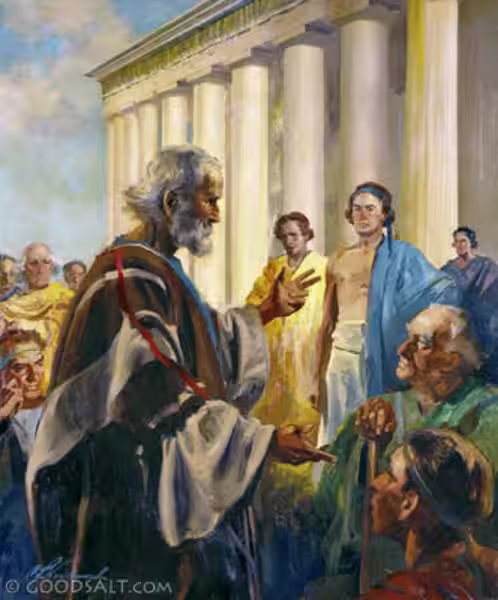
Imagine yourself transported back to ancient Athens, a bustling city of vibrant marketplaces, philosophical debates, and soaring temples. Picture the air thick with the scent of olive oil and incense, the echoes of voices arguing about the nature of existence. Within this rich tapestry of intellectual and cultural life, a figure emerged who would forever change the landscape of religious thought: Apostle Paul. His arrival in Athens, recounted in the Book of Acts, offers a fascinating glimpse into the clash and convergence of cultures, faith, and philosophy.
Paul’s arrival in Athens wasn’t accidental. Driven by a deep-seated desire to share the message of Jesus Christ, he traveled extensively throughout the Roman Empire, seeking out opportunities to connect with people from various backgrounds. Athens, with its famous Academy and the Areopagus, was a prime example of a place with both intellectual rigor and religious diversity, and it presented an intriguing challenge for Paul to spread his message. His missionary zeal, coupled with a deep understanding of human nature, led him to engage with Athenians in a manner that resonated with their unique intellectual inclinations. This engagement, as we will see, was essential for the spread of Christianity beyond its immediate community.
One of the most famous accounts of Paul’s Athenian journey is his speech on the Areopagus. This historic hill served as a central meeting place for the Athenian ruling council and was a symbol of the city’s intellectual and political power. Imagine Paul, standing before a crowd grappling with questions of existence, facing the prominent philosophers, orators, and influential citizens of Athens. His words were not meant to condemn but to engage, to offer an alternative perspective on the human condition. He referenced their own beliefs, their idols, highlighting common ground to build a bridge to faith. For example, recognizing the Athenian’s reverence for the unknown, Paul discussed the very concept of the “unknown God,” drawing them into a dialogue about a higher power.
Paul’s speech wasn’t simply a religious sermon; it was a philosophical conversation. He used their own language, their own concepts, and their own rituals to introduce the idea of a personal God, a God who interacted with humanity. This approach, though controversial, was arguably crucial for spreading Christianity within such a diverse society. He wasn’t trying to replace their beliefs, but to offer a new perspective that resonated with their inherent longing for meaning and purpose. It was a testament to the universality of faith and a reflection of the adaptability necessary for spreading religious ideals.
The Impact of Paul’s Mission in Athens
The impact of Paul’s visit to Athens, though not immediately apparent in large-scale conversions, is undeniable. His interaction with the Athenian community created a space for intellectual discourse and introduced the concept of a monotheistic God into the city’s already vibrant philosophical landscape. His courage in sharing his beliefs, coupled with his ability to engage with differing viewpoints, left an imprint on the religious and intellectual history of Athens. This approach, combining faith with reason, significantly contributed to the broader development of Christianity, and its ability to adapt to various cultures. This was a key element in Christianity’s ability to spread throughout the Roman empire.
While some Athenians were receptive to Paul’s message, others dismissed it as a novelty or a foreign import. This response, though challenging, underscored the importance of Paul’s approach. He understood that spreading the message of Jesus Christ required more than simply preaching; it required dialogue, understanding, and the willingness to engage in different belief systems. His efforts laid the groundwork for a gradual acceptance of Christianity across the eastern Mediterranean and beyond, showing that faith could thrive even in the most intellectually stimulating environments. Paul’s legacy extends beyond Athens, shaping the way Christianity interacted with diverse cultures throughout its evolution.
Apostle Paul’s journey to Athens offers a powerful narrative about the intersection of faith and philosophy. His willingness to engage with the Athenians, even in their diverse beliefs, reveals a crucial aspect of his approach to spreading the Gospel. He didn’t seek to impose his beliefs but to build bridges of understanding. This strategy, rooted in respect and dialogue, laid the foundation for the eventual spread of Christianity throughout the Roman Empire and beyond.
Paul’s encounter with the intellectual and spiritual heart of Athens underscores the power of meaningful conversation in fostering understanding and acceptance. His legacy continues to inspire those who seek to communicate their faith in a way that respects the beliefs of others. It reminds us that sharing our beliefs doesn’t mean changing others, but rather finding common ground and connecting with the universal longing for meaning and purpose. His legacy lives on through his message of hope, love, and faith in ancient Athens and continues to resonate in the world today.
Frequently Asked Questions about Apostle Paul in Athens, Greece
What was Paul’s purpose in visiting Athens?
Paul’s primary goal in Athens was to preach the Gospel of Jesus Christ and share the message of salvation with the people there. He sought to establish a Christian community in the city.
What was the religious landscape of Athens at that time?
Athens was a center of Greek philosophy and polytheistic religion. The city was known for its numerous temples and altars dedicated to various gods and goddesses. Philosophical schools, including the Stoics and Epicureans, were influential in shaping the intellectual and spiritual climate.
Paul engaged with the Athenians in the Areopagus, a prominent public space. He reasoned with the philosophers and religious leaders, adapting his message to their existing worldview. He aimed to connect spiritual truths with their intellectual understanding of the universe.
What was the Areopagus speech about?
In his speech on Mars Hill (Areopagus), Paul argued that the Greek gods were merely representations of the one true God, the creator of all things. He emphasized the importance of repentance and faith in Jesus Christ for salvation.
What was the reception to Paul’s message?
Paul’s message received varied reactions. Some were receptive and interested in learning more, while others were skeptical or dismissive. A few people converted to Christianity, but the majority remained unconvinced.
What is the historical significance of Paul’s visit to Athens?
Paul’s visit to Athens represents a crucial moment in the spread of Christianity. It underlines the adaptability and resilience of the message in a diverse cultural context. It also shows how early Christians sought to engage with different belief systems rather than simply dismissing them.