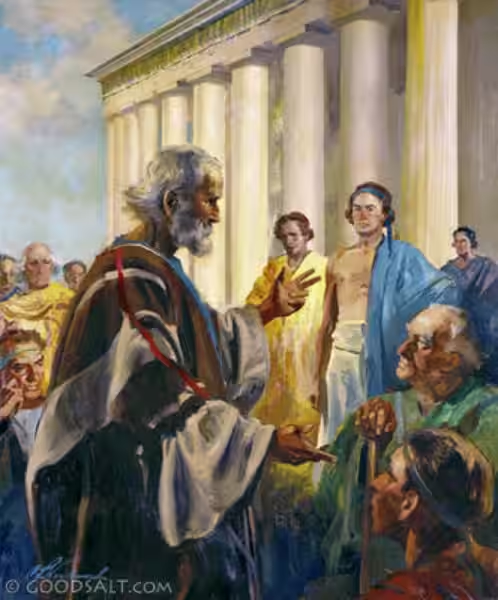
Imagine yourself transported to ancient Athens, a bustling metropolis brimming with philosophers, poets, and people from diverse backgrounds. This vibrant city, a hub of intellectual and cultural exchange, also held a unique place in the early spread of Christianity, particularly through the ministry of the apostle Paul. His presence in Athens reveals a fascinating interplay between established religions and the nascent Christian faith.
Paul’s journey to Athens, like many journeys throughout history, was driven by a deep-seated desire to share the message of Jesus Christ. He wasn’t simply aiming to convert, but to engage in meaningful dialogue. This involved understanding the existing religious landscape, a critical component of any successful missionary endeavor. Understanding the cultural context was crucial. The Athenians’ devotion to countless gods and goddesses, such as Zeus, Apollo, and Artemis, was deeply ingrained in their daily lives and social fabric.
The Athenian Religious Landscape: A Tapestry of Beliefs
Athens wasn’t a monolithic religious entity. It was a tapestry woven with diverse beliefs. From the prominent state religions, focused on the city’s patron deities, to the numerous mystery cults offering promises of salvation and the afterlife, the religious scene was complex and dynamic. People worshipped in temples, participated in festivals, and sought guidance from oracles. This deeply rooted religious landscape influenced every facet of Athenian life. This included their social interactions, political decisions, and even their artistic expressions.
For example, the Panathenaic Games, a major Athenian festival, demonstrated the powerful link between religion and community. These games were dedicated to Athena, the city’s patron goddess, showcasing the deep connection between the Athenians and their deities. Understanding these various religious expressions was key to Paul’s engagement with the people of Athens.
Paul’s approach to sharing his message in Athens was not about confrontation, but about engagement and dialogue. He didn’t dismiss the existing beliefs, but rather sought common ground. He recognized the Athenians’ intellectual curiosity and the importance of their philosophical discussions. This approach meant engaging with their ideas, recognizing shared values, and finding points of connection. This is critical in interfaith encounters, as it allows for a respectful and effective exchange.
He addressed the people at the Areopagus, a prestigious court and a focal point of intellectual discourse. This allowed him to use a common space, not just to preach, but to engage in reasoned discussion. He used existing philosophies, like those of Epicurus and Stoics, as a springboard to introduce the concept of a resurrected Christ.
The Areopagus Speech: A Testament to Persuasion
Paul’s speech at the Areopagus is a compelling example of his approach. He didn’t try to impose his beliefs; instead, he spoke of an unknown God that the Athenians were already seeking. He used their intellectual curiosity about the divine and their desire for something transcendent to introduce the concept of a single, all-powerful God. His speech was a testament to the power of careful argumentation and respectful engagement. This highlights the importance of understanding the audience’s background and perspective when attempting to share beliefs.
Paul’s speech at the Areopagus is a powerful demonstration of his ability to bridge cultural divides in his attempts to share his message. The speech stands as a reminder that effective communication often involves adapting one’s approach to the needs and beliefs of the audience. He wasn’t trying to tear down existing structures, but to build bridges of understanding.
Key techniques employed include:
Paul’s visit to Athens, though not immediately resulting in a large-scale conversion, left an undeniable mark. His interaction with the Athenians illustrated the importance of cultural sensitivity and the power of respectful engagement in religious dialogue. It demonstrated that sharing faith across cultures doesn’t require discarding existing beliefs, but rather building on shared values and common aspirations.
His actions and the way he chose to engage with the Athenians set a precedent for future missionaries. It’s a testament to the enduring power of dialogue, respect, and understanding in religious encounters. This approach, one where knowledge and sensitivity are central, remains relevant today. The historical impact of Paul’s actions in Athens continues to inspire and influence how we interact with others of different beliefs.
Frequently Asked Questions about Paul in Athens
What was Paul’s mission in Athens?
Paul’s primary mission in Athens was to preach the Gospel of Jesus Christ and establish a Christian community. He sought to share the message of salvation through faith in Jesus, engaging with the intellectual and spiritual climate of the city.
Why did Paul go to Athens?
Paul traveled to Athens as part of his broader missionary journey throughout the Roman world. He likely visited as part of his planned route, aiming to spread the Christian message to various groups and individuals.
What was the religious landscape of Athens at that time?
Athens was a center of Greek philosophy and polytheistic religion. Numerous temples and shrines dedicated to various gods and goddesses were prominent. Philosophical schools, such as the Epicureans and Stoics, exerted significant influence on the intellectual life of the city.
Paul engaged with Athenians in the Areopagus, a prominent public space, using reasoned arguments and discussions to present his beliefs alongside local practices. His method involved engaging with their existing understanding of the divine and showing how Jesus fit within that framework.
What was Paul’s message in Athens, specifically regarding religion?
Paul’s message in Athens focused on the one true God, presenting Jesus as the fulfillment of prophecies and the resurrection. He contrasted the worship of many gods with the worship of the one true God who had revealed Himself in Jesus.
How did the Athenians respond to Paul’s message?
Reactions to Paul’s message in Athens varied. Some were intrigued and inquired further, while others ridiculed and rejected his claims. A small number of people became followers.