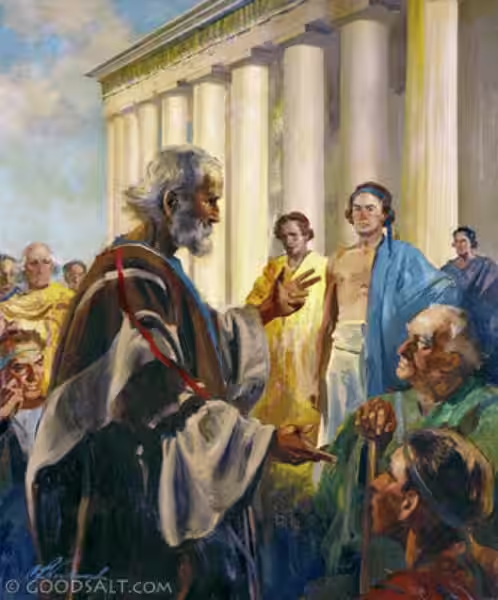
Acts 17, a pivotal chapter in the Book of Acts, details the apostle Paul’s missionary journey to the city of Athens. This encounter with a fascinating, diverse, and often skeptical audience offers valuable insights into the early Christian movement and its reception in a non-Jewish environment. It highlights the challenges of communicating the gospel in unfamiliar contexts and underscores the importance of adapting communication strategies to connect with different cultures.
The chapter beautifully demonstrates the universal appeal of the Gospel. Paul, encountering the Athenians’ unique religious landscape, did not simply impose his beliefs. He engaged with their philosophical inquiries, building bridges of understanding. This approach, although challenging, ultimately proved effective in planting seeds of faith. This is a timeless example of effective evangelism, showing the importance of being sensitive to the beliefs of those we encounter and building upon existing knowledge to communicate the message of Christ.
Athens, renowned for its philosophical discourse and polytheistic religion, presented a unique challenge to Paul. The Athenians, immersed in a culture of intellectualism and diverse beliefs, were not immediately receptive to the message of a single God. This contrasting environment illustrates the necessity of cultural sensitivity when sharing the Christian faith.
Paul’s encounter with the Athenians involved several key elements. He observed their devotion to idols in the marketplace and their philosophical pursuits in the Areopagus. Recognizing these elements, he carefully selected his words, using their own language and concepts to convey the message of Christ. This cultural sensitivity proved vital in establishing a foundation for faith amidst a different religious landscape. Acknowledging the Athenians’ intellectualism was crucial; for example, Paul was careful to note and address prominent Athenian philosophies to establish common ground.
This pivotal speech, delivered on Mars Hill, is a model for effective evangelism. Paul didn’t simply preach; he engaged in a dialogue, using the language of his audience. He addressed their questions, acknowledged their beliefs, and carefully connected the Christian message to their pre-existing concepts. In this sense, the speech was not just a sermon but a conversation designed to evoke critical thinking and reflection.
Crucially, Paul’s speech in Acts 17 demonstrates respect for existing beliefs. He didn’t dismiss the Athenian’s ideas, but rather sought to introduce a new perspective. This approach is critical in fostering understanding and acceptance in any cultural setting. Key points in the speech that highlight this are:
Acknowledging their devotion to the unknown God
Linking his message to their philosophical inquiries
Presenting the resurrection of Jesus as a logical conclusion
This approach fostered a genuine interaction, rather than a one-sided presentation of belief.
The Response and Subsequent Impact
The response to Paul’s address, while not immediately receptive, was significant. Some mocked his message, while others listened and pondered. This mixed reaction is a reflection of the human response to profound truths and the complexity of faith. It reflects the fact that evangelism isn’t always a simple process; it requires patience and understanding.
The most pertinent impact of this episode, recounted in Acts 17, is the establishment of a seed for future faith. Despite the immediate rejection from some, others were touched by Paul’s words. This laying of the groundwork is essential. The prospect of future conversions was demonstrably present in the exchange. Some were “invited” to consider the message, demonstrating a step-by-step approach to evangelism that is still relevant today.
Acts 17 serves as a crucial lesson in the art of evangelism. It teaches us that sharing faith requires a deep understanding of the cultural context, a willingness to engage in dialogue, and a respectful approach to different perspectives. By studying this passage, we can learn how to effectively communicate the Gospel in modern society, fostering connections and building bridges across cultures.
The story of Paul in Athens, documented in Acts 17, is not just a historical account; it’s a blueprint for effective, sensitive, and impactful faith sharing. It underscores the importance of empathy, understanding, and patience in spreading the word of God in a diverse world. This chapter is a testament to the enduring power of the Gospel when approached with wisdom and discernment.
Frequently Asked Questions
What is a summary of Acts 17?
Acts 17 recounts the Apostle Paul’s arrival in Athens, where he encountered the city’s diverse religious beliefs. He reasoned with the philosophers and debated in the Areopagus, arguing for a monotheistic God and emphasizing Jesus’ resurrection. The Athenians, though intrigued, were generally unconvinced, but some individuals believed.
What religions are mentioned in Acts 17?
Acts 17 primarily focuses on the encounter between Paul and the Greek philosophers and their polytheistic beliefs. While there isn’t an exhaustive list, the text shows a variety of Greek and Roman religious practices and philosophies, including Epicureanism and Stoicism. The core message, however, is the presentation of Christianity as the one true faith.