If you have ever reached the end of Ruth and wondered why the book never identifies its writer, you are asking a reasonable question. The book of Ruth is anonymous: unlike some biblical books, it does not begin with an author’s name or provide a clear statement about who composed it.
Jewish tradition attributes Ruth to the prophet Samuel, but that view comes from later rabbinic tradition rather than a claim inside the book itself. Modern scholars usually refer to the author simply as the anonymous writer of Ruth. The book’s setting is the period of the judges, while its final form may have been written much later.
Short answer: No one can identify the author of Ruth with certainty. Samuel is the traditional attribution, but the biblical text itself remains anonymous.
What the book of Ruth says about its own authorship
Ruth begins by placing its events “in the days when the judges ruled,” as described by the reference Ruth 1:1. That opening gives readers a historical setting, but it does not name the person who wrote the story. The narrator speaks about the characters from an outside perspective and never steps forward as an identified witness.
The book also contains no authorial signature, preface, dedication, or explanation of how the story was preserved. The writer presents Naomi, Ruth, Boaz, and the people of Bethlehem through a carefully shaped narrative, but the narrator’s identity remains hidden.
The final verses trace Ruth’s family line through Boaz to David, Israel’s future king, as recorded in Ruth 4:18-22. That genealogy may offer clues about the book’s purpose and date, but it does not settle the question of authorship. A genealogy can be added or preserved by an editor, passed down with a story, or included by the original writer.
Why Samuel is traditionally named as the author
The traditional answer comes primarily from rabbinic Jewish interpretation. The Babylonian Talmud, in Bava Batra 14b-15a, associates Samuel with the writing of Ruth, Judges, and Samuel. This attribution became an influential explanation of who composed the book.
Samuel would appear to be a plausible figure within the biblical storyline. He lived during the transition from the period of the judges to the monarchy, and Ruth ends with a genealogy leading to David. Because Samuel is closely connected with the rise of David, later readers may have seen him as a natural candidate for recording David’s family history.
Still, the traditional attribution does not function like direct evidence from the book. Ruth never says that Samuel wrote it, and the text does not identify Samuel as its source. Traditional attributions can preserve valuable interpretive memory, but they are not always the same as demonstrable authorship.
There is another complication. If Samuel wrote the complete form of Ruth, readers must explain how the genealogy reaches David and how the story came to be preserved in its present form. That is not impossible, but it means the traditional view depends on assumptions that the book itself does not spell out.
What modern scholars say about the anonymous author
Modern biblical scholarship usually distinguishes between the story’s setting, the events it describes, and the date of its composition. These are related questions, but they are not identical. A story set in the time of the judges could have been written during that period, centuries afterward, or shaped from older material by a later writer.
Many scholars date the composition or final form of Ruth somewhere in the monarchic or postexilic periods, though proposals vary. The evidence is debated because the book preserves an old rural setting while also using language, social concerns, and a genealogy that may point to later readers.
The safest scholarly conclusion is therefore modest: an unknown Israelite or Jewish author composed or shaped Ruth, drawing on traditions about Bethlehem, Moab, family obligation, land, and David’s ancestry. The text gives enough information to study its literary design and historical interests, but not enough to identify the writer by name.
How to assess the authorship question step by step
Check the book for a named author. Ruth does not identify its writer anywhere in the narrative.
Separate biblical evidence from later tradition. Samuel’s name comes from rabbinic tradition, not from an explicit statement in Ruth.
Examine the narrative perspective. The writer knows the characters, customs, and outcome of the story but does not claim to be one of them.
Consider the genealogy. The line from Perez to David connects Ruth to Israel’s royal history, but it does not prove who compiled the book.
Compare language and themes. Vocabulary, social customs, and concerns about community identity can help suggest a date, but they rarely identify a specific author.
State the conclusion carefully. Samuel is the traditional answer; anonymous authorship is the answer best supported by the text itself.
This approach avoids two common mistakes. One is treating tradition as if it were an explicit biblical statement. The other is assuming that an anonymous book has no meaningful historical or theological value simply because its author is unknown.
When were the events in Ruth supposed to happen?
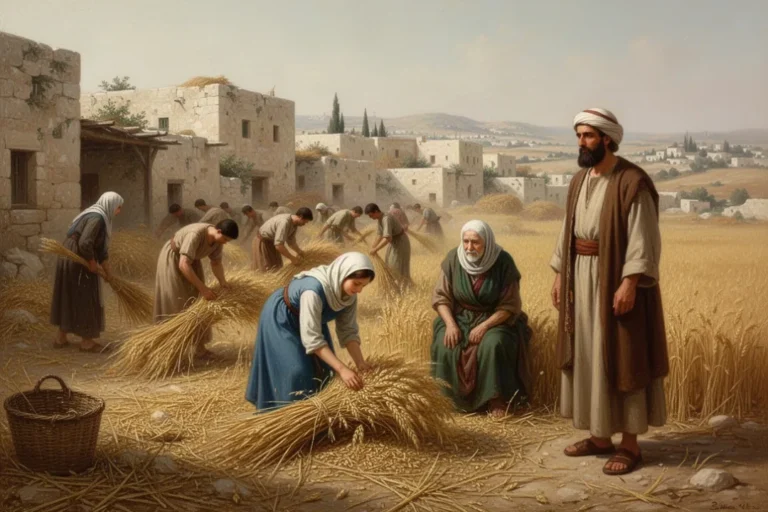
The story is set during the time of the judges, a period portrayed elsewhere in the Hebrew Bible as politically unstable and spiritually troubled. Ruth begins with a famine in Bethlehem, the deaths of Elimelech and his two sons, and Naomi’s return from Moab with Ruth.
The setting matters because the story takes place before the monarchy and before David becomes king. Boaz is presented as a respected landowner in Bethlehem, and the conclusion links his family to David. The narrative therefore looks backward to an earlier generation while telling readers why David’s ancestry includes a Moabite woman.
That setting should not automatically be treated as the date when the book was written. Historical narratives often describe earlier periods from a later perspective. The writer may have used older family traditions, local memories, legal customs, or oral storytelling while giving the account its present literary form.
The phrase “in the days when the judges ruled” also helps distinguish Ruth from the darker cycles found in Judges. Ruth is set in the same broad era, but it focuses on loyalty, work, kinship, and restoration within one family and community.
What the genealogy reveals about the book’s purpose
The genealogy at the end of Ruth is one of the most important clues for interpreting the book. It connects Boaz to Obed, Obed to Jesse, and Jesse to David, following the line described in Ruth 4:18-22. The list places a personal story of loss and recovery inside the larger history of Israel’s royal family.
That ending may explain why the book was preserved. Ruth is not only about a widow finding security or about a foreign woman joining an Israelite family. It also explains the ancestry of David and presents that ancestry as emerging from faithful relationships and responsible action.
The genealogy does not name the person who wrote the preceding chapters. It may have belonged to the story from the beginning, or it may reflect the work of a later compiler. Some interpreters also observe that the genealogy appears to move quickly from the family of Boaz to David, suggesting that the book’s final shape serves a broader historical purpose.
Either way, the genealogy shows that the author or final editor wanted readers to connect Ruth’s household with the future of Israel. The book’s final perspective is therefore wider than its opening crisis in Moab.
What the language of Ruth suggests about its date
Language can provide clues, although it cannot identify a writer with certainty. Ruth includes dialogue, narrative descriptions, legal terms, blessings, and references to social practices. Some readers see features that could fit an early period, while others identify vocabulary or concerns that may reflect a later stage of Hebrew writing.
The book also explains certain customs for its audience. For example, Ruth 4 describes a procedure involving a sandal and a public transaction connected with land and family redemption. The narrator gives enough information for readers to understand the practice, which may suggest that the custom was less familiar to the book’s later audience than it was to the characters.
That kind of explanation does not prove a late date. A writer may explain a local practice for readers from another region, preserve an old custom carefully, or clarify an unusual legal situation. Dating evidence is suggestive rather than conclusive, especially in a short book whose language may have been edited over time.
Scholars therefore discuss several possibilities, including a composition during the monarchy, a later postexilic setting, and a work that preserves earlier traditions while receiving later editorial shaping. None of these proposals establishes a named author.
How Ruth’s treatment of Moab shapes the authorship discussion
Ruth is a Moabite woman who becomes part of Naomi’s family and later marries Boaz. Her identity is emphasized from the beginning, and the narrative does not hide the fact that she comes from outside Israel. Yet Ruth is consistently portrayed as loyal, courageous, diligent, and worthy of honor.
This positive portrayal becomes especially significant when read alongside other biblical passages that address Moabite identity and relations with Israel. Deuteronomy 23:3-6 contains restrictions concerning Moabites, while Nehemiah 13:1-3 describes a later effort to separate the community from foreign groups associated with Moab and Ammon.
Because of this tension, some scholars view Ruth as a story that speaks into debates about foreigners, marriage, belonging, and communal identity. On this reading, the book may have been written or circulated during a period when the status of foreign wives and their descendants was being discussed.
Other interpreters see the story primarily as an older family narrative about loyalty and redemption, without assigning it a direct political purpose. Both approaches recognize that Ruth’s treatment of Moab is central. Neither approach can identify the author, but each helps explain why an anonymous writer might have preserved this particular story.
Keep the claims separate: Ruth’s sympathetic portrayal of a Moabite woman may reveal the writer’s social and theological concerns, but it does not tell us the writer’s name.
Why the author’s anonymity does not weaken Ruth
Ancient biblical books do not all handle authorship in the same way. Some are linked to named prophets, kings, or leaders; others are transmitted without a personal signature. In Ruth, the narrator’s authority comes through the story’s structure, characterization, customs, and connection to Israel’s history rather than through an announced identity.
The absence of an author also keeps attention on the events and relationships. Readers are invited to observe how Naomi responds to grief, how Ruth acts toward Naomi, how Boaz uses his social position, and how the community participates in restoration. The book’s message does not depend on knowing whether the writer was a court historian, a local storyteller, a priest, or another educated Israelite.
Anonymous authorship is also different from uncertainty about the text’s meaning. You can responsibly discuss its themes, historical setting, literary craft, and theological claims without pretending to know the writer’s biography. Unknown authorship limits what can be claimed; it does not prevent careful interpretation.
What the book’s structure reveals about its writer
Although the author remains unnamed, the book displays deliberate literary skill. Its four chapters move from famine and death to return, provision, public negotiation, marriage, and a family line leading to David. The writer controls information carefully and allows ordinary actions to carry broad significance.
Ruth 1 centers on departure, bereavement, and return. Ruth 2 shifts to the fields, where Ruth meets Boaz and receives protection. Ruth 3 brings the question of family redemption into a nighttime encounter at the threshing floor. Ruth 4 moves into the public space of the town gate, where legal and family matters are settled before witnesses.
This progression suggests a writer who understood how to connect private loyalty with public responsibility. The author does not present redemption as a single emotional moment. Instead, restoration involves food, labor, land, kinship, legal consent, marriage, children, and the recognition of the wider community.
The narrative also uses contrasts. Bethlehem begins with famine but ends with abundance and a child. Naomi begins empty and returns with Ruth, whose presence becomes part of Naomi’s restoration. Ruth begins as a widowed outsider and becomes the great-grandmother of David according to the genealogy’s line.
What can be said about the writer’s identity
Beyond calling the author anonymous, scholars can make only cautious observations. The writer knew Israelite customs, understood the significance of Bethlehem and David’s ancestry, and could present dialogue and legal procedure with precision. The book’s polished form suggests a capable storyteller or compiler.
The author may have been from Judah, given the focus on Bethlehem and local customs, but that remains an inference rather than a fact. The writer may have had access to family traditions or community records, though the text does not describe its sources. It is also possible that the story passed through several stages before reaching its final written form.
Claims that the author was a woman, a court official, a priest, or a member of David’s family go beyond what the text can establish. Readers may find such theories interesting, but they should be labeled as speculation. The responsible answer is not more specific than the evidence allows.
How different answers to “Who wrote Ruth?” compare
Samuel wrote Ruth: This is the traditional Jewish attribution associated with the Talmud and fits Samuel’s connection to David, but Ruth itself does not confirm it.
A known later biblical figure wrote Ruth: This possibility has been proposed in various forms, but no named candidate has sufficient textual evidence.
An anonymous writer composed the book: This is the most cautious conclusion because the narrative does not identify its author.
A later editor shaped older traditions: This may explain the combination of an early setting, traditional customs, and a genealogy connected to David, but the exact stages cannot be reconstructed with certainty.
These possibilities are not all mutually exclusive. A traditional story could have been preserved by one person, edited by another, and eventually associated with a respected figure such as Samuel. Since the text does not describe that process, readers should distinguish between what is possible and what can be demonstrated.
What the original audience may have needed to know
The writer assumes that readers will understand the emotional importance of family loyalty, land, widowhood, and protection for vulnerable people. At the same time, the explanations of customs suggest that some practices required clarification. The audience may have known the broad history of Israel while needing help connecting an older family story to David’s lineage.
The book’s use of place names is also meaningful. Bethlehem, the “house of bread,” is associated with famine at the beginning and renewed life at the end. Moab is both a foreign land and the place from which Ruth comes. These locations help the writer explore belonging without turning the story into a simple account of insiders and outsiders.
Ruth’s audience may also have been interested in the legitimacy of David’s ancestry. By showing that Ruth was welcomed into the family and became an ancestor of David, the author presents the royal line as connected to a foreign woman who demonstrated extraordinary loyalty to Israel’s people and God.
How to answer the question in one clear sentence
If someone asks who wrote the book of Ruth, you can answer: “The author is unknown; Jewish tradition says Samuel wrote it, but the book itself does not identify its writer.” That wording gives the traditional answer without presenting it as proven fact.
You can add that the story is set during the period of the judges and ends by connecting Ruth and Boaz to David. The writer’s identity remains uncertain, while the book’s central concerns—loyalty, kindness, family responsibility, inclusion, and restoration—are clearly developed in the narrative.
The most accurate reading respects both tradition and evidence. Samuel remains an important historical attribution in Jewish interpretation, but anonymous authorship is the conclusion supported directly by the biblical text.
Frequently asked questions
Does the Bible say that Samuel wrote Ruth?
No. The book of Ruth does not name Samuel or any other author. The association with Samuel comes from later rabbinic tradition, especially the discussion in Bava Batra. Samuel’s connection to David makes the attribution understandable, but it remains a traditional view rather than a statement made by Ruth itself.
Was Ruth written during the time of the judges?
The story is set during the period of the judges, but that does not prove when the book was composed. A later writer could describe earlier events, preserve older traditions, or shape them for a new audience. Scholars therefore distinguish between the narrative’s setting and the date of the book’s final form.
Why does the book of Ruth end with David’s genealogy?
The genealogy connects Ruth’s family to David and places a private story of loss, loyalty, and restoration within Israel’s larger history. It may also help explain why the book was preserved. The genealogy highlights Ruth’s importance in David’s ancestry, but it does not identify the person who wrote the book.
Is Ruth a historical account or a work of literature?
Readers answer that differently depending on their religious and scholarly approach. The book presents itself as a narrative about people, places, customs, and ancestry, while also showing careful literary design. Its authorship and date are uncertain, so claims about its exact historical development should remain cautious rather than overly specific.




Leave a Reply