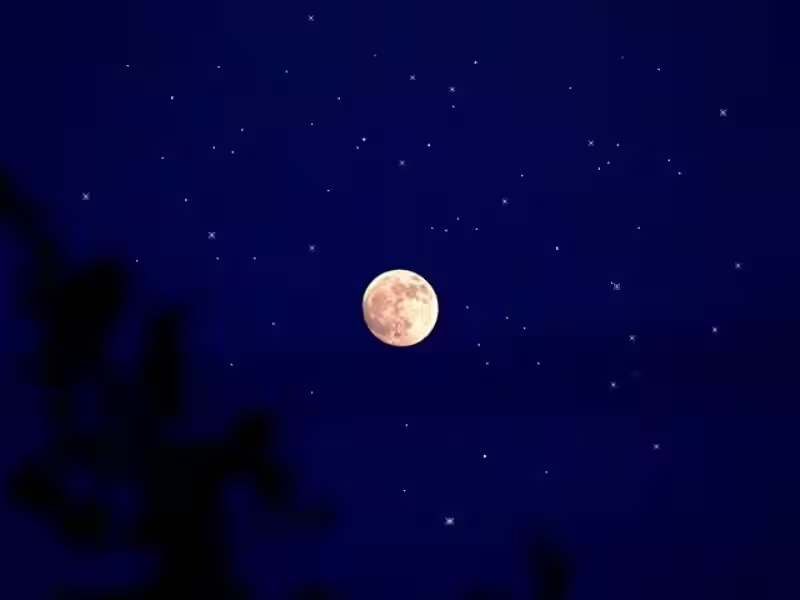
The moon, a celestial body that has captivated humanity for millennia, holds a significant place in various religions and spiritual traditions worldwide. Its cyclical nature, waxing and waning phases, and visible presence in the night sky have led to numerous interpretations and associations. Religious perspectives often intertwine mythology and astronomy, creating a rich tapestry of symbolism that reflects cultures’ understanding of the cosmos and their place within it, often deeply intertwined with the moon under the sun.
Its prominence in religious contexts underscores its powerful impact on human cultures. From ancient civilizations to contemporary spiritual practices, the moon’s symbolism continues to resonate. For instance, the lunar cycle has often been linked to agricultural cycles, feminine energy, and the cyclical nature of life itself. Think about how many cultures have connected the waxing and waning moon to harvests, menstrual cycles, or even the ebb and flow of emotions. This shared experience, across diverse cultures, highlights the moon’s profound influence on human consciousness and spiritual understanding, often positioned under the sun as a complement to the sun’s power.
The moon’s significance varies greatly across religious traditions. In some, it’s seen as a divine entity or a symbolic representation of the divine feminine. In others, it serves as a calendar system, a symbol of time, or a guiding light for spiritual journeys. For example, in many indigenous cultures, the moon is venerated as a powerful spirit or a guardian of the night. This reverence often extends to specific lunar phases, with rituals and ceremonies associated with them. Respect for the natural world is often reflected in these beliefs.
Consider the role of the moon in the Eastern tradition. In Hinduism, the moon is often associated with the deity Chandra, who embodies wisdom, tranquility, and purity. Buddhist traditions often depict the moon as a reflection of enlightenment, emphasizing its ability to illuminate the path towards spiritual understanding. These examples show how diverse cultures, with their own unique worldviews, find meaning and connection in the moon under the sun. This illustrates the dynamic relationship between human spirituality and the celestial bodies, where the moon, under the sun, plays a significant role.
The Moon as a Symbol of Cycles and Change
The moon’s cyclical phases have long resonated with the concepts of change, growth, and decay. Its waxing and waning embodies the concept of constant transformation, reflecting the cyclical nature of life itself. This is especially clear in many agricultural societies, where the lunar cycle was closely linked to the planting and harvesting seasons. The moon under the sun is a visible reminder of these recurring cycles.
Furthermore, the moon’s association with feminine energy is rooted in its cyclical nature. This connection often symbolizes fertility, abundance, and nurturing. In many cultures the moon’s phases are connected to aspects of our lives, like the menstrual cycle. Consider the symbolism of the moon and the sun in ancient Greek myths, where the moon represented the cyclical nature of life, or the concept of the moon and the sun in the spiritual teachings of indigenous cultures, reflecting the cyclical nature of the seasons and the rhythms of life on Earth. Understanding these connections reveals a profound respect for the natural world and the cyclical processes that govern existence.
The Moon Under the Sun: A Source of Spiritual Guidance
In various religious traditions, the moon is frequently viewed as a source of spiritual guidance. Throughout history, the moon’s light has been used to navigate and to find direction, representing the strength of our inner light. Meditation practices and spiritual rituals often incorporate the moon’s phases, harnessing its energy for introspection and growth. The moon under the sun, in this context, helps us to navigate not just the physical world but also the internal one.
The moon’s presence in the night sky offers a unique opportunity for reflection and contemplation The experience of the moon under the sun is a profound way of being in the natural world, encouraging spiritual exploration. Examples are plentiful; from the moon-worship rituals of ancient Egypt to the modern practice of lunar-based meditation, the moon’s presence has been integral to various spiritual endeavors. Furthermore, the moon’s influence on tides reminds us of the powerful forces in nature, and its presence in our lives, under the sun, reminds us of the cyclical nature of existence.
The moon under the sun, in its various forms, holds a significant place in many religious traditions. It symbolizes, in diverse ways, cycles of change, feminine energy, and spiritual guidance. Its presence in the night sky, coupled with its cyclical phases, has inspired myths, rituals, and practices for millennia, demonstrating the profound connection between humanity and the cosmos. The moon under the sun, in essence, is a powerful reminder of the intricate interplay between the visible and the unseen, between the rhythms of nature and the depths of the human spirit.
Ultimately, understanding the moon’s role within different religions provides profound insights into human consciousness and the way we interact with the world around us. It fosters a deeper appreciation for the sacredness of the natural world and provides a powerful tool for personal reflection and spiritual exploration, showing us how the moon under the sun reflects our deepest beliefs and yearnings. From the ancient agricultural societies to modern spiritual practices, the moon continues to illuminate our paths under the sun.
Frequently Asked Questions
What is the Moon under the Sun in relation to religion?
The concept of “Moon under the Sun” isn’t a standard religious term or doctrine. It likely refers to a specific interpretation or perspective related to the moon’s position in relation to the sun. This interpretation may vary depending on the specific religious context or philosophical framework.
How does the moon’s position relate to religious symbolism?
In various cultures and religions, the moon and sun are often symbolic. The moon may represent cycles, change, intuition, or feminine energy. The sun often symbolizes light, power, creation, or masculine energy. Their relative positions could signify a balance or interplay between these aspects.
Are there any religious texts that mention the moon being “under” the sun?
Major religious texts don’t typically use the phrase “Moon under the Sun” in a direct, theological context. The concept may be a modern interpretation or a metaphor developed within a specific community or worldview.