“Eloi, Eloi, lama sabachthani?” is Jesus’ anguished cry from the cross, meaning, “My God, my God, why have you forsaken me?”
The words appear in Mark 15:34 and, with a slightly different transliteration, in Matthew 27:46. They are among the most difficult sayings of Jesus because they express profound suffering while coming from someone Christians believe is the Son of God.
The cry should not be treated as a simple statement that Jesus stopped trusting God. It is also not merely an emotional outburst without biblical background. Jesus is invoking Psalm 22, a prayer that begins with desolation and moves toward confidence, public vindication, and praise.
The phrase is commonly translated as “My God, my God, why have you forsaken me?” The wording comes from the opening line of Psalm 22, which Jesus applies to his own suffering at the crucifixion.
Eloi means “my God.” The repeated form gives the cry urgency and emotional weight. Lama means “why,” while sabachthani carries the sense of being abandoned, left, or forsaken.
English Bibles spell the phrase in different ways because they are representing an ancient spoken language with English letters. You may see Eloi, Eli, lama, lema, sabachthani, or sabachthani with minor spelling variations.
These differences do not create different sayings. They reflect the challenges of transliterating words from Aramaic and Hebrew into Greek and then into English. The Gospel writers preserved the sound of Jesus’ cry before giving its meaning for readers.
Central point: Jesus’ words express genuine human anguish, but they also deliberately direct listeners to Psalm 22, whose full movement is from abandonment to trust and praise.
Where the saying appears in the Gospels
Mark records the cry in Mark 15:34, during the darkness that covers the land while Jesus is being crucified. Matthew includes it in Matthew 27:46, within his account of Jesus’ final suffering.
Mark uses the form “Eloi, Eloi”, while Matthew presents a form closer to “Eli, Eli.” Both accounts connect the words with the first line of Psalm 22. The difference in spelling is one reason readers may encounter the phrase in more than one form.
The wording is especially striking because the Gospels usually report Jesus speaking in Greek, the language in which they were written. By preserving these Semitic words, the Gospel accounts allow readers to hear something of the original sound of his cry.
After Jesus speaks, some bystanders think he may be calling for Elijah. That misunderstanding is related to the similarity between the sound of “Eli” and the name “Elijah,” as well as popular expectations that Elijah might appear in connection with a righteous sufferer or the end of the age.
The bystanders’ response also emphasizes how isolated Jesus is. His words are not received with understanding or compassion. Instead, they become an occasion for confusion while he remains exposed to pain, mockery, and public shame.
Why Jesus refers to Psalm 22
Psalm 22 is a prayer spoken by a person who feels abandoned by God and surrounded by enemies. The speaker describes humiliation, physical danger, ridicule, and the apparent silence of God. Those themes closely resemble the circumstances of Jesus’ crucifixion.
Jesus’ first words from the psalm function like a biblical reference. In an age when many people learned Scripture by hearing it repeatedly, quoting the opening line could call the rest of the psalm to mind. The cry therefore has both an immediate emotional meaning and a wider scriptural meaning.
The psalm does not move in a straight line from despair to an easy answer. It allows the sufferer to speak honestly about fear and abandonment. Yet it also remembers God’s past faithfulness, asks for deliverance, and ends with a vision of worship extending beyond one individual or one generation.
That pattern helps explain why Jesus could cry out to God while still addressing God as “my God.” The words contain pain, but they also contain relationship. Jesus is not speaking into an empty universe; he is lamenting before the God whom he continues to address.
Psalm 22 gives suffering people language for honest lament without requiring them to pretend that pain is small.
The connection with Psalm 22 does not remove the horror of the crucifixion. Instead, it shows how the Gospel writers understand the cross: as real suffering that belongs within the larger story of Israel’s Scriptures and God’s purposes.
Does the phrase mean God abandoned Jesus?
Christians answer this question in different ways, depending on how they describe the relationship between Jesus’ divine and human natures and how they understand the cross. Most Christian interpretations agree that Jesus experienced the full reality of human forsakenness, but they do not usually mean that the Father ceased to love the Son or that the Trinity was destroyed.
One common interpretation is that Jesus is identifying with humanity’s deepest experience of alienation from God. The crucifixion involves sin, judgment, death, and rejection. Jesus enters the place where people feel separated from God and bears suffering in a uniquely complete way.
Another interpretation emphasizes the literary and scriptural setting. Jesus is voicing Psalm 22’s lament and inviting people to recognize that the psalm’s suffering servant is also moving toward vindication. The cry is therefore not a denial of faith but the language of a faithful sufferer who brings his distress directly to God.
A further explanation focuses on Jesus’ real humanity. Christian teaching does not portray his body as immune to pain or his human emotions as artificial. Hunger, grief, fear, physical suffering, and the experience of abandonment are treated as genuine parts of his earthly life.
These interpretations can overlap. The saying can reveal the severity of Jesus’ suffering, echo Israel’s prayer tradition, and point toward the saving meaning Christians associate with the cross. It should not be reduced to only one dimension.
Pastoral care: If you feel abandoned by God, this saying does not condemn you for expressing that pain. It shows that lament can be brought honestly into prayer.
How the cry relates to Jesus’ other words on the cross
The Gospels record several sayings from the cross, and they do not all emphasize the same aspect of the event. Jesus speaks words of forgiveness, entrusts himself to God, addresses those near him, and expresses physical distress. The cry from Psalm 22 belongs among these different expressions of suffering and purpose.
In Luke, Jesus’ final words emphasize entrusting his spirit to the Father. In John, his final statement emphasizes the completion of his mission. These accounts do not need to be treated as competitors. Each Gospel selects and arranges material to present the crucifixion with its own theological emphasis.
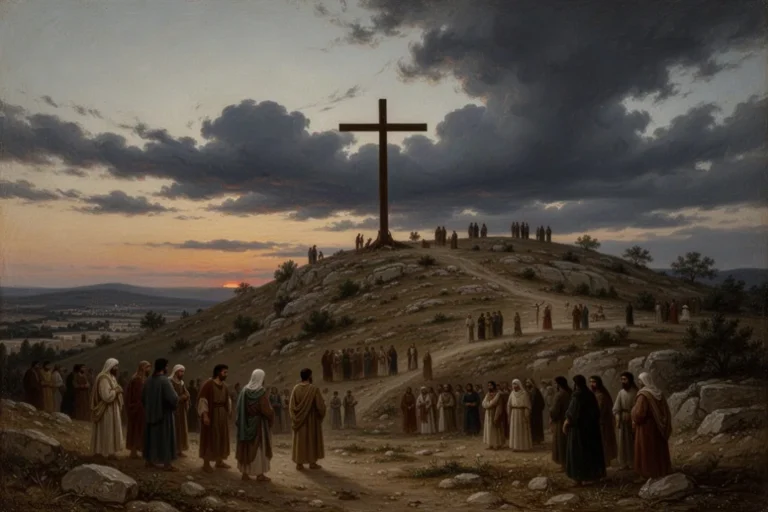
Matthew and Mark place the cry of abandonment at the center of their descriptions of Jesus’ death. Their accounts highlight the darkness, the mockery, the tearing of the temple curtain, and the recognition of Jesus by a Roman centurion. The saying contributes to a scene marked by hiddenness, suffering, and a surprising revelation of identity.
Reading the sayings together prevents a one-sided conclusion. Jesus is not only distressed, and he is not only calm. He is a suffering person who continues to address God, remains faithful to his mission, and enters death in trust even when the immediate experience is one of desolation.
When Jesus cries out, some people nearby think he is calling Elijah. This may result from hearing the Semitic name for “my God” and associating it with Elijah. The Gospel scene then shows someone offering sour wine while others wait to see whether Elijah will come.
Elijah was a major prophetic figure in Jewish Scripture. Later Jewish expectations connected him with restoration and the preparation for God’s intervention. Because of those associations, the bystanders’ comment is more than a random misunderstanding; it reflects the religious assumptions surrounding Jesus’ death.
The misunderstanding also creates dramatic irony. The people hear a recognizable religious sound but fail to understand Jesus’ actual prayer. The reader, however, is directed toward Psalm 22 and can see that the cry is rooted in Scripture rather than in a request for Elijah.
That detail should not be used to mock the bystanders or to suggest that every person present was equally hostile. It shows how difficult it was for observers to interpret Jesus’ words while the crucifixion unfolded amid darkness, physical suffering, and public humiliation.
How different translations handle the phrase
Most English translations translate the phrase into English in the main text and may include the original-sounding words in a footnote or note. Others retain the transliteration in the text and then provide the meaning. Both approaches help readers see the connection between the spoken cry and the translation.
The variation between “Eli” and “Eloi” is especially noticeable when comparing Matthew and Mark. Matthew’s form is closer to the Hebrew wording of Psalm 22, while Mark’s form reflects an Aramaic expression. The Gospel writers were not necessarily trying to provide a modern language lesson; they were preserving the saying in the form known to their communities.
Some translations use “forsaken,” while others use “abandoned” or wording with a similar meaning. “Forsaken” has a traditional religious sound in English, whereas “abandoned” may communicate the emotional force more directly to modern readers. Neither word should be read apart from Psalm 22.
When comparing translations, pay attention to three details:
The original-language form: Does the translation retain or explain the Aramaic or Hebrew wording?
The reference: Does a note direct you to Psalm 22?
The surrounding scene: How does the translation present the darkness, the bystanders, and Jesus’ death?
Common mistakes when interpreting “Eloi, Eloi, lama sabachthani”
The phrase is often discussed in short quotations, which can make its meaning seem simpler than it is. Several common mistakes arise when readers separate the words from their Gospel setting or from Psalm 22.
Assuming the cry proves Jesus had no faith: A lament is directed toward God, not away from God. Jesus continues to call God “my God.”
Ignoring Psalm 22: The phrase is not an isolated sentence. Its biblical background shapes how the Gospel writers expect it to be heard.
Treating “forsaken” as proof that the Father stopped loving Jesus: The word describes the experience of abandonment, but it does not by itself settle every theological question about the Trinity.
Assuming every spelling is a separate saying: Eloi, Eli, lama, lema, and related forms reflect transliteration and language differences.
Reading the line as a complaint without hope: Psalm 22 begins with distress but continues toward remembrance, deliverance, and praise.
Using the phrase to dismiss emotional pain: Jesus’ example gives dignity to truthful lament. It does not tell suffering people to hide their feelings.
Assuming the bystanders understood Jesus correctly: The Gospel narrative specifically presents their Elijah comment as a misunderstanding.
How to study the saying in its biblical context
A careful reading starts with the immediate verses in Matthew 27 and Mark 15. Notice what happens before and after the cry. Consider the darkness, the public taunts, the offer of sour wine, the bystanders’ response, and the way each Gospel describes Jesus’ death.
Next, read Psalm 22 as a complete prayer rather than stopping at its opening line. Pay attention to its changes in tone. The speaker remembers God’s faithfulness, asks for rescue, describes danger, and eventually speaks of God’s reign and the spread of worship.
Then compare the Gospel accounts without forcing them to sound identical. Matthew and Mark share much material, while Luke and John present additional sayings and distinctive emphases. Differences in selection and arrangement can reveal what each Gospel wants its readers to notice.
Finally, consider the phrase as prayer language. You do not have to choose between historical seriousness and personal application. The saying matters because it belongs to the crucifixion narrative, and it also gives words to people who experience silence, grief, injustice, or spiritual desolation.
Read the surrounding Gospel passage rather than the sentence alone.
Read Psalm 22 in full and observe its movement from lament toward praise.
Compare several translations to see how they handle the transliteration and the word “forsaken.”
Separate observation from interpretation: first identify what the text says, then consider theological conclusions.
Allow lament to remain honest: do not rush past the suffering in order to reach an answer.
What the phrase can mean for prayer and suffering
For many Christians, the most immediate significance of Jesus’ cry is that God is not distant from human pain. The cross does not present suffering as imaginary or easily explained. Jesus experiences rejection, violence, darkness, and apparent divine silence.
The words also show that prayer can include difficult questions. Asking “why” is not automatically rebellion. In Scripture, lament often combines complaint with memory, petition, and continued dependence. The person who prays may not understand what God is doing, but still turns toward God.
That makes the phrase meaningful for people facing bereavement, illness, abuse, war, discrimination, depression, or another crisis. It should never be used to offer a quick explanation for someone else’s suffering. A better response is often to listen, acknowledge the pain, and allow the person to pray honestly.
Jesus’ cry can also prevent shallow ideas about faith. Faith is not always a feeling of certainty or peace. Sometimes faith consists in addressing God from within confusion and darkness, using words inherited from Scripture when your own words are difficult to find.
The phrase does not promise that every painful experience will receive an immediate explanation. Its significance is more grounded than that: the Christian story places profound abandonment within Jesus’ own suffering and connects that suffering with the hope of resurrection and renewed praise.
How Christians understand hope in Psalm 22
Psalm 22’s hope does not erase the opening lament. The speaker does not pretend that enemies are harmless or that pain is insignificant. Hope develops through remembering God’s past acts, asking for help, and trusting that the present crisis will not have the final word.
Christians read this pattern through the death and resurrection of Jesus. The crucifixion is understood as the deepest point of humiliation, while the resurrection is understood as God’s vindication of Jesus. In that reading, Jesus’ cry stands at the border between apparent defeat and the victory revealed afterward.
Different traditions explain the saving meaning of the cross in different ways. They may emphasize sacrifice, victory over evil and death, reconciliation, moral transformation, or several of these themes together. The words from Psalm 22 do not provide a complete theory of atonement by themselves.
They do provide a faithful picture of the suffering Messiah: one who is mocked, surrounded, and seemingly abandoned, yet whose story leads to the public declaration of God’s faithfulness. That is why the phrase carries both sorrow and expectation.
“Eloi, Eloi, lama sabachthani” is therefore not a detached expression of despair. It is the prayer of Jesus in extreme suffering, a deliberate echo of Psalm 22, and a doorway into the Christian understanding of the cross as both genuine abandonment and the beginning of God’s decisive saving work.
Frequently asked questions
Is “Eloi, Eloi, lama sabachthani” Aramaic or Hebrew?
The form in Mark is generally associated with Aramaic, while Matthew’s form is closer to Hebrew and the wording of Psalm 22. Because the Gospel writers recorded the phrase in Greek letters, English spellings vary. These language differences do not change its central meaning: Jesus addresses God while expressing the agony of abandonment.
Did Jesus lose faith when he said these words?
No. The cry is a lament, not a rejection of God. Jesus still addresses God as “my God,” and the wording recalls Psalm 22, a prayer that begins in distress but continues toward trust and praise. The statement reveals the depth of Jesus’ suffering without proving that he stopped believing or that God stopped loving him.
Why do some Bibles say “forsaken” and others say “abandoned”?
Both words translate the idea of being left or deserted. “Forsaken” is traditional biblical English, while “abandoned” may sound more direct to modern readers. The surrounding context matters more than the choice between those two words. Psalm 22 shows that the statement belongs to a prayer of anguish that remains directed toward God.
What should someone do with this verse during personal suffering?
Use it as permission to pray honestly rather than as a formula that promises an immediate explanation. You can name your pain, ask why, remember what you know of God’s character, and seek support from trusted people. If suffering includes danger, abuse, or severe mental-health symptoms, spiritual reflection should accompany practical help from qualified professionals.





Leave a Reply