Christianity creation story: Genesis and its meaning
Christianity creation story: Genesis and its meaning
The Christian creation story is found mainly in Genesis chapters 1 and 2. It teaches that God created the universe, ordered the earth, made living creatures, and formed human beings in his image. Genesis also presents creation as good, purposeful, and dependent on God.
Genesis contains two closely related accounts. Genesis 1 describes creation across six days followed by the seventh-day rest, while Genesis 2 focuses more closely on the human pair, the garden, work, relationship, and responsibility. Christians read these chapters in different ways, but both accounts point to a world that is not accidental or meaningless.
Genesis 1 opens with the earth described as unformed and unfilled, while darkness covers the deep. God begins creating through a series of commands. Light appears, the sky is established, dry land emerges, vegetation grows, and the sun, moon, and stars are placed in the heavens. The account then describes sea creatures, birds, land animals, and humanity.
The repeated pattern gives the passage a clear structure: God speaks, something comes into being, God evaluates it, and the creation scene moves forward. The phrase “God saw that it was good” is especially significant. It presents the material world as valuable rather than inherently evil or spiritually inferior.
The six-day pattern can be outlined this way:
Day one: light is separated from darkness.
Day two: the expanse of the sky separates the waters.
Day three: dry land appears, and plants grow.
Day four: the sun, moon, and stars mark times and seasons.
Day five: sea creatures and birds are created.
Day six: land animals and human beings are created.
Day seven: God rests and blesses the day.
The sequence is not merely a list of objects. It moves from disorder toward an inhabited world. The first three days establish spaces—light and darkness, sky and sea, land and vegetation. The next three days fill those spaces with lights, animals, and people. This arrangement gives the account a strong sense of order and completeness.
Humanity receives a distinct place in the narrative. Genesis 1 says that men and women are made in the image of God and are given responsibility for the earth and its living creatures. This does not mean humans look physically like God. It refers to their unique relationship with God and their calling to represent his rule through wise care of creation.
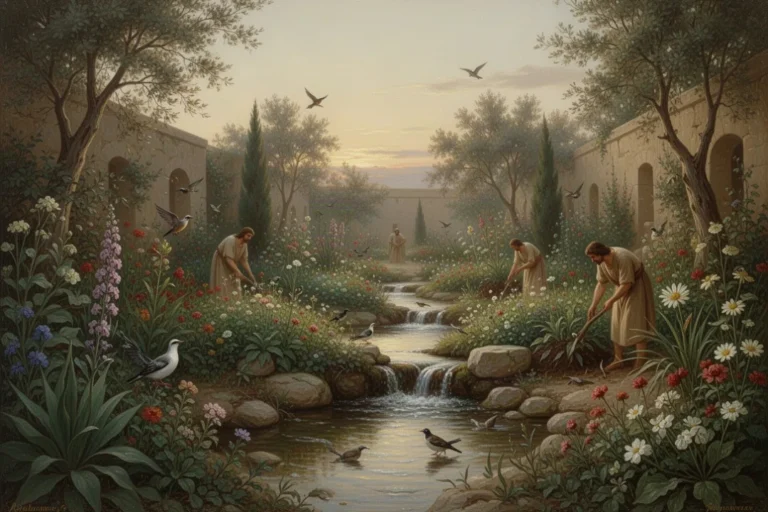
Genesis 2 retells the beginning from a more personal angle. The land is described as dry, and a human being is formed from dust before receiving life from God. God places the man in the garden of Eden, gives him work, and establishes a command concerning the tree of the knowledge of good and evil.
The second chapter also describes the creation of the woman. The account emphasizes that the human being should not remain alone and that the woman is a corresponding partner. The man and woman are portrayed as naked without shame, suggesting innocence, trust, and unbroken relationship before sin enters the story.
Central idea: Genesis presents creation as a purposeful act of God in which the world, human life, work, relationships, and rest all have meaning.
Why Genesis includes two creation accounts
Readers sometimes ask why Genesis 1 and Genesis 2 do not sound exactly alike. Genesis 1 gives a broad, carefully ordered account of the cosmos. Genesis 2 narrows the focus to the garden and the first humans. Their different emphases do not automatically mean that one chapter must be rejected.
Genesis 1 emphasizes God’s authority over all creation. God creates by speaking, assigns roles to the heavenly lights, and brings the world into order without needing help from another deity. This would have sharply distinguished Israel’s faith from surrounding ancient religions that treated nature as divine or described creation as the result of conflict among gods.
Genesis 2 emphasizes God’s closeness to human beings. The imagery is more intimate: God forms the human from dust, plants a garden, brings animals to the human, and provides a partner. The chapter explores what it means for people to live in relationship with God, one another, the land, and their work.
The chapters also use different literary rhythms. Genesis 1 repeatedly follows a measured sequence of days and evaluations. Genesis 2 reads more like a focused narrative about the first human community. Biblical writers often place accounts side by side to develop different aspects of a subject rather than repeat every detail in identical language.
Christians therefore hold several views about how the chapters relate. Some believe they describe the same events from two perspectives. Others regard Genesis 1 as a highly structured theological account and Genesis 2 as a complementary narrative that concentrates on humanity. Some readers see the chapters as literary traditions brought together in the final form of Genesis.
These interpretations differ, but they commonly agree on several claims:
God is the source of creation and is not part of the created order.
The world has structure, purpose, and value.
Human beings possess distinctive dignity and responsibility.
Work and rest belong within God’s good design.
Human freedom includes real moral accountability.
Understanding the chapters by their themes can prevent a narrow reading that treats Genesis only as a technical description of physical processes. The text speaks about who created, why creation matters, and how people should live, as well as questions about sequence and timing.
What Christians believe the creation story teaches
God created everything
The Christian creation story begins with God rather than with matter, chance, or competing divine powers. The universe is presented as dependent on God, while God does not depend on the universe for existence. This belief is often called creation ex nihilo, meaning creation from nothing, although the opening description in Genesis also uses imagery of an unformed and unfilled earth.
The central theological point is that creation owes its existence to God’s will and power. The stars, oceans, animals, and human beings are not gods. They are created things. This distinction shaped Christian teaching about worship: creation may reveal God’s greatness, but it is not itself the proper object of worship.
The material world is good
Genesis repeatedly calls creation good. That affirmation matters because some ancient and later philosophies have treated physical matter as a problem or prison for the spirit. Biblical Christianity instead teaches that bodies, food, sexuality, land, animals, and ordinary work belong to the created order God calls good.
This does not mean everything in the present world is as it should be. Christian teaching distinguishes between the goodness of creation and the damage caused by sin, violence, injustice, death, and human misuse. The goodness of the original creation provides the basis for hope that God intends to restore rather than discard the created world.
Human beings have dignity and responsibility
Being made in God’s image gives every human being a distinctive worth that does not depend on wealth, intelligence, health, social position, productivity, or age. Genesis presents this dignity as belonging to humanity as male and female. Christian ethics often draws on this teaching when discussing the protection of vulnerable people and the equal value of every person.
Human authority over the earth is not permission for careless exploitation. The words commonly translated as “rule” or “have dominion” occur alongside the responsibility to cultivate and guard the garden. Christian interpretations differ over environmental questions, but responsible stewardship is a major implication of the text.
Work and rest are part of creation
Genesis 2 places the human being in the garden “to work it and take care of it,” according to the meaning of the passage. Work therefore appears before the fall and is not presented as a punishment in itself. The pain and frustration associated with work enter later, but productive care of the world belongs to the original calling of humanity.
The seventh day adds another dimension. God rests, blesses the day, and sets it apart. This does not suggest that God becomes exhausted. It portrays completion and a deliberate stopping of work. Christian practice has connected this pattern to Sabbath, worship, recovery, and resistance to the idea that human value depends entirely on constant production.
Human freedom includes limits
The garden is generous, but it is not without boundaries. The command concerning one tree establishes that human beings are not autonomous owners of reality. They are free creatures who live under God’s authority. The limit gives moral meaning to obedience and makes trust a genuine choice.
Genesis presents freedom as more than doing whatever one wants. True human flourishing involves receiving life as a gift, recognizing God’s wisdom, and accepting that created beings do not define good and evil entirely for themselves. This theme continues throughout the Bible and remains central to Christian moral teaching.
How the fall changes the creation story
Genesis 3 follows the creation accounts with the story of temptation and disobedience. The woman and the man eat from the prohibited tree after questioning God’s command. The immediate results include shame, fear, hiding, blame, and a breakdown in trust between human beings and God.
The fall does not mean that the material world suddenly becomes worthless. Instead, the relationship between people and the created order becomes distorted. Childbearing, work, the ground, marriage, and mortality are described in the context of pain and struggle. Christians commonly call this condition the fall and connect it with the spread of sin into human life.
The story also explains why the world can be both good and deeply broken. Creation retains signs of beauty, order, and generosity, yet it is marked by suffering, injustice, disease, violence, and death. Human beings retain dignity as God’s image-bearers, but their desires and institutions can be bent toward selfishness and harm.
Different Christian traditions explain the doctrine of original sin in somewhat different ways. Some emphasize inherited guilt, others stress an inherited condition of corruption and alienation, and others focus on the universal human tendency to sin. All major Christian approaches treat the fall as a decisive explanation of humanity’s damaged relationship with God and neighbor.
Later Christian teaching connects the creation story with Jesus Christ. The New Testament describes Christ as central to God’s work in creation and redemption, and it presents salvation as the beginning of a renewed creation. The biblical story therefore moves from creation to fall, redemption, and restoration rather than ending with Eden.
Reading Genesis 3 carefully: The passage explains the entrance of sin and broken relationships, but it does not teach that creation itself is evil. Christian hope points toward healing and renewal of creation.
How Christians interpret the age of creation
Christian beliefs about God as Creator do not produce only one view of the earth’s age or the way creation unfolded. Some Christians read the six days of Genesis 1 as six ordinary days and believe the earth is relatively young. Others understand the days as longer periods, a literary framework, or a sequence that is not intended to provide a modern scientific chronology.
Many Christians accept an ancient earth and believe God used evolutionary processes within his creative work. Some of these Christians view Genesis as theological literature rather than a scientific account. Others accept aspects of evolutionary science while insisting that God remains the ultimate source and sustainer of life.
There are also Christians who reject evolutionary explanations and defend a young-earth interpretation. Their reasons can include a particular reading of the genealogies, the role of death before the fall, and the meaning of the Genesis days. These views should not be confused with the shared Christian confession that God created and sustains the world.
The apparent conflict between Genesis and science often results from asking the text to answer a question it may not have been designed to answer. Modern science investigates physical mechanisms, observable patterns, and natural history. Genesis addresses God’s identity, the world’s dependence on him, humanity’s role, and the moral shape of existence.
That distinction does not settle every debate. Some Christians believe specific scientific claims conflict with biblical teaching, while others see no necessary conflict. The disagreement is genuine, but it is not accurate to say that all Christians interpret Genesis in one way or that one scientific position represents Christianity as a whole.
If you are comparing interpretations, consider these questions:
What does the passage repeatedly emphasize?
Is the proposed reading consistent with the language and structure of Genesis?
Does it distinguish theological claims from scientific claims?
How does it account for both Genesis 1 and Genesis 2?
Does it recognize the range of historic and contemporary Christian interpretations?
Christians can disagree about chronology while affirming the core message that the universe is not self-explanatory, human life has profound value, and creation belongs to God. A careful reading avoids using Genesis as a weapon in arguments and instead takes seriously what the text actually emphasizes.
Why the creation story still matters to Christian life
The creation story shapes Christian worship by directing attention away from created things and toward their Creator. It also gives believers language for gratitude. Food, relationships, beauty, knowledge, land, animals, and physical bodies can be received as gifts rather than treated as meaningless matter.
Genesis also influences Christian views of justice. If every person bears God’s image, no group can be treated as disposable. The creation account does not give a complete social policy, but it supplies a foundation for defending human dignity and challenging systems that exploit people.
Environmental responsibility follows from the same framework. The earth is neither a possession to consume without limits nor a deity to worship. It is a created home entrusted to human care. Christians may disagree about particular environmental policies, but the biblical themes of stewardship, restraint, gratitude, and accountability provide strong reasons to protect land, water, animals, and future generations.
The rhythm of work and rest also remains practical. People are not machines whose value depends on constant output. A pattern that includes worship, rest, family, community, and responsible work reflects the creation account more closely than a life organized entirely around productivity.
Finally, the Christian creation story gives a framework for hope. It says that existence has a source, human life has meaning, evil is not part of God’s original design, and the damage of sin does not have the last word. For Christians, the promise of renewal reaches its fullest expression in the hope of a restored creation under God’s reign.
Genesis therefore functions as more than a story about the beginning of the universe. It is a foundation for Christian beliefs about God, humanity, morality, work, rest, the natural world, sin, and redemption. Its central message is that the world is created with purpose and that human beings are accountable for how they live within it.
Frequently asked questions
Are Genesis 1 and Genesis 2 contradictory?
Not necessarily. The chapters use different forms and emphasize different details. Genesis 1 presents a broad, ordered account of the cosmos, while Genesis 2 focuses on the garden and the first human relationships. Many Christians read them as complementary perspectives, although Christians differ about their literary composition and precise relationship.
Do all Christians believe creation happened in six 24-hour days?
No. Some Christians hold a young-earth interpretation with six ordinary days. Others understand the days as literary structure, longer periods, or a framework compatible with an ancient earth and evolutionary development. These groups can still share the central belief that God is the Creator and sustainer of all things.
What does “image of God” mean for human beings?
It describes humanity’s distinctive relationship and responsibility before God, not a physical resemblance. Human beings are called to reflect God’s character, exercise wise care over creation, and live in accountable relationships. The teaching also supports the equal value and dignity of every person, regardless of ability, status, age, or background.
Does the creation story teach that work is a punishment?
No. Genesis places the human being in the garden to cultivate and care for it before the fall. Work is part of the original calling, while painful toil, frustration, and conflict are associated with humanity’s disobedience. The story presents both meaningful labor and the need for limits, rest, and dependence on God.




Leave a Reply