The Bible’s lost son appears in Jesus’ parable commonly called the parable of the prodigal son, found in Luke 15:11–32. A younger son rejects his family, wastes his inheritance, loses everything, and eventually returns home; instead of punishing him, his father welcomes him with compassion and celebration.
The story is not only about one wayward child. Jesus also includes the older brother, whose resentment reveals another kind of distance from the father. The parable shows that both sons need the father’s grace, although only one leaves home physically.
Jesus tells the parable in Luke 15, alongside the stories of the lost sheep and the lost coin. These three parables respond to religious leaders who criticized Jesus for welcoming sinners and eating with them. The setting matters because the stories defend God’s willingness to seek, receive, and restore people who have wandered.
The chapter does not use the word “prodigal” as the title of the story. “Prodigal” traditionally refers to someone who spends recklessly, so “prodigal son” is a familiar later name. “Lost son” emphasizes the wider message: the son is separated from his home and relationship, but he is not beyond recovery.
Luke 15:11–32 is sometimes called the parable of the two sons because the older son has a major role. The father’s response to each child helps readers see two different responses to God: open rebellion and self-righteous resentment. Jesus leaves the ending unresolved, inviting the listeners to consider whether the older brother will join the celebration.
Central idea: The lost son is restored not because he can repay what he wasted, but because the father chooses to receive him with mercy and restore him to the family.
What the younger son does before he returns
The younger son asks his father for the share of the estate that would normally come to him later. In the world of the parable, this request is deeply offensive because it treats the father’s possessions as more desirable than the father himself. The son wants the benefits of belonging without the responsibilities of remaining in the household.
The father grants the request and divides his property between the two sons. Jesus does not describe the father as forcing the younger son to stay. This gives the story a painful realism: love allows a person to make a destructive choice, even when the consequences can be foreseen.
The younger son then travels to a distant country and spends his wealth in reckless living. Luke describes him as having wasted his property, but the parable does not provide a detailed list of his actions. The important point is that he uses his freedom without wisdom and eventually has nothing left to protect him from hardship.
A severe famine follows, and the son becomes dependent on others. He takes a job feeding pigs, an especially degrading situation for a Jewish listener because pigs were considered unclean under Jewish law. The detail communicates more than financial trouble: the son has reached a place of social, economic, and spiritual humiliation.
He becomes so hungry that he longs for the food given to the pigs. Luke says that no one gives him anything. This contrasts sharply with the father’s household, where even servants have enough bread. The son’s crisis helps him recognize the depth of his separation and remember the abundance of home.
Why the lost son decides to go home
The turning point comes when the son “comes to himself,” meaning that he recognizes the truth about his situation. He remembers that his father’s hired workers have food to spare while he is starving. His repentance begins with an honest assessment: he has sinned against heaven and against his father, and he cannot claim that his suffering is someone else’s fault.
The speech he prepares includes an admission of wrongdoing and a request to be treated as one of the hired workers. He no longer assumes that he deserves the privileges of a son. His plan shows both genuine humility and limited understanding: he is ready to return, but he expects that his place in the family has been permanently lost.
The parable does not portray repentance as merely feeling guilty. The younger son turns around and goes home. His words matter, but so does his movement toward the person he has offended. In the same way, biblical repentance involves a changed direction, not only regret over painful consequences.
His motives are mixed. Hunger helps drive him home, and the story does not require readers to decide that his motives are perfect before the father receives him. A person may begin turning back because of consequences, fear, need, or a growing awareness of sin. God’s mercy can meet people at the beginning of an imperfect return.
How the father responds to the returning son
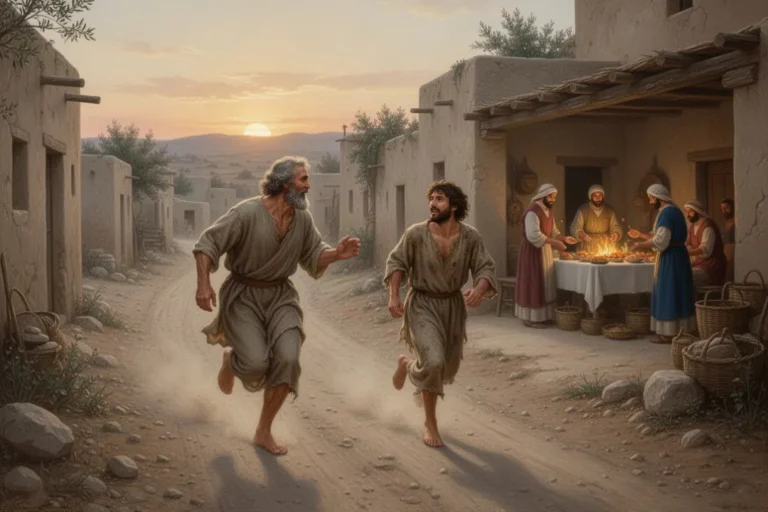
While the son is still far away, the father sees him, feels compassion, and runs to meet him. Jesus gives the father an unusually active response. He does not wait coldly for a formal explanation or demand that the son prove his worth before coming near. He closes the distance himself.
The father embraces and kisses his son before the son can complete the speech he has prepared. The son confesses his sin and acknowledges that he is no longer worthy to be called a son. The father does not debate that confession, but he also does not accept the son’s plan to live as a servant.
Instead, the father orders servants to bring the best robe, a ring, and sandals. These items represent public restoration to the household. The son who expected a reduced position is treated as a restored family member. The father then commands a feast because the one who was dead is alive again and the one who was lost has been found.
These descriptions are parable imagery, so each detail should be read in context rather than turned into a rigid formula. Together, they communicate a clear truth: forgiveness is not reluctant tolerance. The father does more than allow the son to remain nearby; he welcomes him back into belonging and joy.
Luke 15 presents the father’s joy as the appropriate response when someone who was lost is found again.
The father does not deny the son’s past. The inheritance has been spent, and the harm cannot simply be erased from history. Restoration means that the relationship is reopened despite the loss. Forgiveness does not claim that destructive choices were harmless; it refuses to let those choices have the final word.
What the older brother reveals about being lost
The older brother is working in the field when he hears music and dancing. After learning that his brother has returned and that the father has prepared a feast, he becomes angry and refuses to enter. His response exposes a different kind of alienation: he is physically near the father’s house but emotionally distant from the father’s joy.
He reminds the father that he has served for many years and obeyed his commands. He also complains that the father has never given him a young goat for a celebration with his friends. His language suggests that he views the relationship primarily as a contract: faithful service should earn greater rewards, while the younger son’s failure should disqualify him from celebration.
The older brother calls the returning child “this son of yours” rather than “my brother.” The father gently answers by calling him “your brother,” redirecting him toward family rather than comparison. The issue is not whether the younger son’s behavior was right. It was not. The issue is whether mercy toward him should be considered a threat to the older brother.
The father explains that the celebration is fitting because the younger brother was dead and is alive, and because he was lost and has been found. The parable ends before the older brother responds. That unfinished ending likely confronts Jesus’ critics directly: will they enter the joy of welcoming sinners, or remain outside because grace has been extended to people they judge unworthy?
The older brother warns against religious resentment. A person can appear obedient while secretly believing that God owes them special treatment. Faithfulness can become a source of pride when it is used to compare oneself with people who have failed more visibly.
What the lost son teaches about God’s forgiveness
The father in the parable represents the gracious heart of God. Jesus does not present forgiveness as a reward earned by moral improvement. The son returns with nothing to offer except confession and a willingness to come home. The father’s compassion comes first in the reunion.
That does not make repentance unnecessary. The son must recognize his sin, leave the distant country, and return. The story holds together two truths that are sometimes separated: people must turn from sin, and God welcomes repentant people with mercy.
The father’s forgiveness is also personal. He does not merely cancel a debt in an abstract sense; he restores a broken relationship. The son is not accepted because his actions were acceptable. He is accepted because the father’s love is greater than the son’s failure.
Christians connect this parable with the wider biblical teaching that God seeks reconciliation with sinners. The parable itself does not mention the cross or explain every part of Christian salvation. It does show the character of divine mercy: God is not eager to keep repentant people at a permanent distance.
The father’s welcome can be comforting to people who believe their past makes them impossible to love. Abuse, addiction, dishonesty, sexual sin, rejection of faith, and years of estrangement may have serious consequences, but the story does not place a limit on God’s willingness to receive a truly returning person.
Forgiveness also does not require ignoring safety or removing every consequence. A person may be welcomed spiritually while still needing to rebuild trust, repay what can be repaid, accept legal consequences, or respect boundaries. Grace restores dignity, but wise restoration may take time.
How the lost son differs from a story about getting whatever you want
The parable does not teach that God approves every desire or that reckless behavior is harmless. The younger son’s choices lead to poverty, hunger, and broken relationships. The father’s mercy comes after the son acknowledges his wrongdoing and returns, not as approval of the life he had been living.
Nor does the story promise that every earthly loss will be reversed in the same way. The son receives a robe and a celebration, but the parable is focused on restored relationship rather than the recovery of financial wealth. Readers should not use it to guarantee that every consequence will disappear immediately.
The story also does not say that reconciliation always means returning to an unsafe environment. In situations involving violence, coercion, exploitation, or serious abuse, wise boundaries and professional support may be necessary. A forgiving heart can coexist with protection, accountability, and separation.
Finally, the parable is not mainly a lesson about managing money. The wasted inheritance helps show the seriousness of the son’s separation, but the central conflict concerns relationship, repentance, and welcome. Reducing the story to financial irresponsibility misses the emotional and spiritual meaning of the father’s response.
Practical ways to apply the parable of the lost son
The story invites more than admiration. It asks you to consider where you are in relation to the father, the distant country, and the other members of the family. Application will differ depending on whether you identify with the younger son, the older son, the waiting father, or someone affected by another person’s choices.
If you identify with the younger son: name the truth about your choices without minimizing them, and take a concrete step toward repentance and repair.
If you identify with the older brother: examine whether obedience has become a reason to despise people who receive mercy.
If someone has returned to faith: offer encouragement without demanding that they prove themselves through humiliation.
If you have been harmed: remember that forgiveness does not require immediate trust or renewed access to your life.
If you are waiting for someone to return: combine compassion with wise boundaries, prayer, and realistic expectations.
A useful prayer based on Luke 15 might include confession, gratitude for mercy, and a request for freedom from resentment. You can name the “distant country” in your own life: a pattern, relationship, ambition, or belief that has drawn you away from God and from people who care for you.
You can also read the parable slowly with three questions: What does each person want? What does each person fear? What does each person believe they deserve? These questions often reveal that the younger son seeks independence, the older son seeks recognition, and the father seeks restored relationship.
Common mistakes when interpreting the Bible’s lost son
Readers often focus on the younger son because his behavior is dramatic. That is understandable, but the story loses some of its force when the older brother is ignored. Jesus includes him to challenge people who are confident that they are morally superior to obvious sinners.
Calling the story only “the prodigal son”: this can make the younger son seem like the entire message. Remember the older brother and the father’s appeal to him.
Assuming repentance means perfect motives: the son returns while hungry and desperate. His motives develop within the return rather than becoming flawless beforehand.
Confusing forgiveness with restored trust: forgiveness can be offered immediately, while trust may need to be rebuilt through consistent actions.
Using grace to excuse harm: mercy does not remove the need for accountability, restitution, treatment, or protection.
Believing obedience earns God’s love: the older brother’s complaint shows how service can become a demand for payment instead of a response to love.
Promising that every family reunion will happen: the parable reveals God’s heart; it does not guarantee that another person will choose repentance.
For difficult family situations: You can hope for repentance and reconciliation while still keeping appropriate boundaries. Forgiveness is a spiritual response; rebuilding a relationship requires truth, safety, and dependable change.
The father’s response gives churches a pattern for receiving people who return after years away. A congregation should make room for honest confession, patient growth, and genuine belonging rather than requiring a returning person to perform shame before being accepted.
At the same time, a church must protect people from manipulation and repeated harm. Welcoming a repentant person does not mean placing them immediately in leadership, overlooking abuse, or pressuring victims to reconcile. Compassion and accountability belong together.
Church communities can also learn from the older brother. Longtime members may feel overlooked when attention is given to newcomers or returning people. Leaders can honor faithful service without allowing resentment to define the community’s response to grace.
The parable presents celebration as a shared responsibility. The father does not keep the restoration private; he calls the household to recognize that the lost person has been found. A healthy community makes repentance possible by offering truth, support, practical help, and a clear path toward trustworthy participation.
What “lost” means in the parable
To be lost in Luke 15 does not mean that a person has no value. The sheep, coin, and son remain precious even while separated from their proper place. “Lost” describes a condition of disconnection that calls for recovery, not a permanent identity.
The younger son is lost through deliberate departure. The older brother is lost through pride and refusal to share the father’s mercy. Their different paths show that separation from God can look like obvious rebellion or respectable self-righteousness.
The father’s actions reveal that the lost are not forgotten. He watches, runs, embraces, explains, and invites. Jesus’ emphasis falls on the joy of restoration: heaven rejoices when sinners repent, and God’s people are called to reflect that joy rather than resent it.
The final question remains directed toward every reader: will you accept the father’s mercy for yourself, and will you allow that same mercy to reach people you believe have failed too badly? The lost son’s return is important, but the parable’s lasting invitation is to enter the father’s joy and recognize the returning person as family.
Frequently asked questions
Is the lost son the same as the prodigal son?
Yes. “The lost son” and “the prodigal son” are common names for Jesus’ parable in Luke 15:11–32. “Prodigal” highlights the younger son’s reckless spending, while “lost son” emphasizes his separation and restoration. Some readers call it the parable of the two sons because the older brother’s resentment is also central to Jesus’ message.
What does the father represent in the parable?
The father represents God’s compassionate willingness to forgive and restore repentant people. He does not approve the younger son’s rebellion, but he receives him before the son can earn his way back. His response shows that divine forgiveness restores relationship and dignity, while real-life reconciliation may still require accountability, boundaries, and rebuilt trust.
Does the lost son’s story mean Christians must forgive everything immediately?
The parable encourages a merciful attitude, but it does not require you to ignore danger, deny harm, or restore trust instantly. Forgiveness and reconciliation are related but distinct. You can release personal vengeance while still seeking justice, keeping distance from an unsafe person, requiring changed behavior, and receiving help from wise counselors or church leaders.
Why is the older brother included in the story?
The older brother represents people who appear faithful but resent mercy shown to obvious sinners. His anger reveals that someone can remain close to religious activity while being distant from the father’s heart. Jesus includes him to challenge self-righteousness and to ask whether those who consider themselves obedient will join God’s celebration when a sinner returns.










Leave a Reply