Paul’s journey to Athens, a pivotal moment in early Christianity, offers profound insights into the spread of faith and the encounters of different cultures. Understanding where he preached isn’t just a historical exercise; it’s a window into the early Christian movement and its adaptability to new environments. The city, known for its intellectual and philosophical pursuits, presented a unique challenge and opportunity for the apostle. Learning about this journey allows us to appreciate the resilience of faith and its capacity to transcend boundaries.
Athens, in its splendor and complexity, was a melting pot of ideas. Philosophers like Plato and Aristotle had shaped the city’s intellectual landscape. Imagining Paul, a man deeply rooted in Jewish tradition, navigating this world of Greek thought is fascinating. His message, based on the resurrection of Jesus Christ, undoubtedly stood in contrast to the prevailing philosophies of the time. This cultural collision is precisely what makes Paul’s time in Athens so significant, a clash of ideas that is still relevant in today’s diverse world. For example, the concept of the “unknown God” that Paul encountered in the city can be seen as a representation of the open-mindedness and intellectual curiosity that existed in ancient Athens.
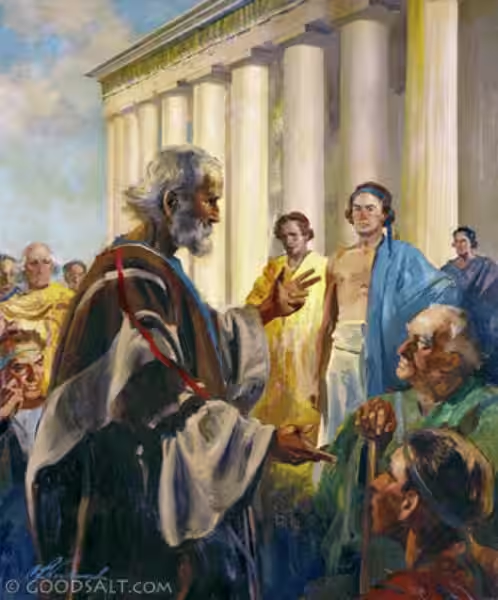
Paul’s primary preaching location in Athens was the Areopagus. This elevated platform wasn’t your typical marketplace; it was a crucial civic center, a place where important debates and discussions took place. This was a very public setting, and Paul found himself among those engaged in intellectual discourse. He wasn’t just preaching to a crowd, but engaging in a dialogue with people from every imaginable background—philosophers, poets, skeptics, and everyday citizens. Imagine the sheer diversity of opinions and perspectives that surrounded him.
Another key location was the marketplace, a bustling hub of activity. This allowed Paul to interact in a more informal manner, engaging with individuals more directly. He likely used the marketplace as a starting point for conversations, connecting with people on a more personal level. He wasn’t just delivering a sermon; he was seeking out opportunities to share his faith in a relatable way. Think of it as a very early form of street evangelism. He was aiming to connect with the Athenians on a human level, sharing his message in a way that resonated with their culture and experiences.
The Areopagus: A Crucible of Ideas and Faith
The Areopagus, or Mars Hill, was undoubtedly the most significant site of Paul’s preaching. Standing on this hill, overlooking the city, he addressed the Athenians. This setting was both symbolic and strategically important, mirroring the importance of the Athenian high court. Paul used this prestigious location to present his message in a formal manner, engaging with the city’s educated elite. This was a forum where he could present a complex theological argument, drawing on Jewish scripture and Greek philosophy to illustrate the Christian message. The Athenians were known for their intellectual pursuits, and Paul attempted to speak to them in their own terms.
In this context, we understand that this wasn’t a simple conversion experience. Paul’s address involved a delicate balance: respecting their intellectual traditions while introducing a unique faith. He was inviting a conversation, not imposing a doctrine. This approach was crucial to the long-term success of the burgeoning Christian movement. He presented his message not just as a religious belief, but as a philosophical one, attempting to address some of the Greek concepts of divinity and human nature through the lens of Christianity. For instance, some Athenians who believed in the existence of many gods may have found the concept of one God intriguing.
Paul’s time in Athens, though not resulting in a large number of immediate conversions, was incredibly influential in the long run. His interactions with the Athenian intellectuals and citizens, his ability to engage with their thoughts and questions, laid a foundation for the spread of Christianity throughout the region. The seeds of faith, sown in the vibrant marketplace and on the hallowed Areopagus, would grow in the years to follow. His preaching, no matter its immediate success, was a vital step in connecting the Christian message to a broader cultural landscape. This encounter with Hellenistic culture was crucial for the future development of Christianity.
The impact of Paul’s preaching in Athens is still felt today. It demonstrates the enduring power of faith, its ability to adapt to new environments, and the importance of bridging cultural divides. It’s a reminder that communication and understanding are essential, even when facing intellectual differences. For example, Paul’s willingness to adapt his message and engage with the Athenians in their own language and conceptual frameworks serves as a model for intercultural dialogue in all times.
Frequently Asked Questions
Where did Paul preach in Athens?
Paul preached in Athens at the Areopagus, a hilltop meeting place.