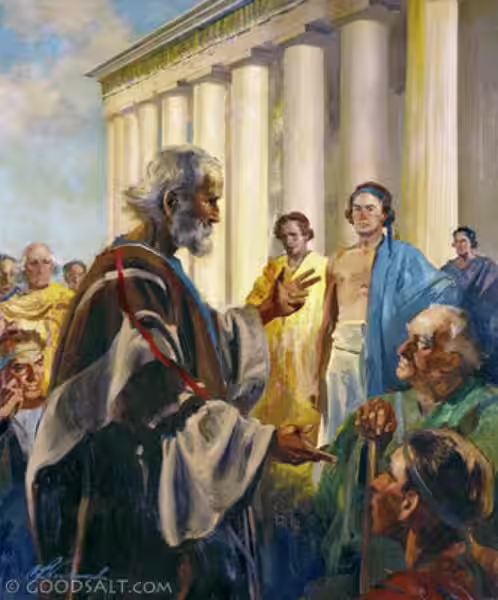
Paul’s journey to Athens, as recounted in the Book of Acts, offers a fascinating glimpse into the complexities of religious encounter in a foreign land. His preaching in the Areopagus, a prominent Athenian court, marks a pivotal moment in the early spread of Christianity. It wasn’t simply a matter of sharing a message, but a complex conversation, a dialogue between cultures and beliefs. The context of that time – the vibrant intellectual scene of ancient Athens – adds a unique layer of interest to Paul’s approach.
Ancient Athenian society was steeped in philosophy and debate. Philosophical schools like the Stoics and Epicureans thrived, and the city was known for its public forums and marketplaces where ideas were exchanged. Paul’s preaching in Athens had to contend with this rich intellectual landscape. He wasn’t simply proclaiming a new god, but seeking common ground, which is a valuable lesson for us today. This is important because it demonstrates how effective religious communication involves understanding the audience and adapting to their existing beliefs and values.
The Areopagus, a hilltop court in Athens, served as a significant venue for public discourse. It wasn’t just a place of legal decisions; it was a center for philosophical debate. Paul’s choice to preach there highlights a conscious effort to engage with the intellectual elite of the time. By preaching at the Areopagus, Paul recognized the importance of adapting one’s message. The Athenians were known for their intellectual curiosity; therefore, Paul had to make his message intellectually appealing.
Paul’s speech on the Areopagus wasn’t a simple, one-sided presentation. He recognized and acknowledged the Athenians’ existing beliefs. He wasn’t trying to undermine their beliefs but rather introduce a new perspective by weaving his ideas into their existing framework. This is a crucial point. Understanding the audience’s belief systems and building upon them creates a more effective and persuasive dialogue that resonates with the audience.
Key Elements of Paul’s Athenian Sermon
Paul’s speech demonstrated important principles of effective religious communication. First, he observed and respected the Athenians’ existing beliefs. Paul wasn’t trying to erase what they valued, but rather show how his message completed the picture. He spoke of a creator god, the unknown God, which was part of the Athenian’s belief system. This approach made his message more relatable and less threatening.
Second, Paul used reason and logic. He didn’t just recite dogma; he presented a case for his beliefs based on evidence and reasoning, crucial in creating an argument. He used a common ground; the Athenian belief in an unknown god to transition into the concept of the Christian God. A good example of this is his reference to the “unknown God” present in the Athenian culture. This was crucial to connecting with the audience and creating a bridge between their ideals and his. Furthermore, he employed analogical reasoning, a method of explaining complex concepts through relatable examples. Using local mythology and philosophy to explain Christian concepts made the message more easily digestible and understandable.
The Impact and Legacy of Paul’s Preaching
Paul’s sermon in Athens, though its immediate impact is debated, is profoundly significant in the history of religion. It illustrates how we can build bridges across cultural divides. His willingness to engage with the existing intellectual and religious landscape, and to adapt his message to the local context, has been a model for missionaries and religious leaders for centuries. Paul’s adaptations and contextualization of his message are crucial. He didn’t try to force his beliefs on the Athenians but instead presented ideas that were relevant to their context.
The lasting legacy of Paul’s Athenian encounter lies in the enduring power of dialogue and mutual understanding. His approach challenges modern religious discourse. It reminds us that genuine connection requires empathy, respect, and a willingness to engage with others’ perspectives. Ultimately, Paul’s preaching in Athens shows that effective religious communication hinges on respect for and engagement with the beliefs of others. Successful evangelism truly depends on understanding and appealing to the audience’s current reality.
Frequently Asked Questions
What was the purpose of Paul’s preaching in Athens?
Paul’s preaching in Athens aimed to share the message of Christianity with the people of that city, a center of Greek intellectualism. He sought to connect with them on a philosophical level, using their own ideas to bridge the gap between their existing beliefs and the Gospel.
What was the Athenian culture like at that time?
Athens was a center of Greek philosophy and culture. It was known for its intellectual curiosity and vibrant marketplace of ideas. People were accustomed to discussing various philosophies and religions.
What were the key points of Paul’s message in Athens?
Paul’s message centered on the resurrected Jesus Christ, arguing that he was the fulfillment of their own prophesies and the one true God. He emphasized a personal relationship with God through faith in Christ.
How did the Athenians respond to Paul’s message?
The Athenians’ response varied. Some were interested and receptive, while others were skeptical or outright opposed, particularly those dedicated to traditional Greek gods. Some philosophers, like the Epicureans and Stoics, challenged Paul’s theology.
How did Paul’s approach differ from his previous methods of preaching?
In Athens, Paul adapted his approach to the audience’s intellectual background, drawing on their philosophical frameworks to present the Christian message. This differed from his more straightforward approach in other locations, where his focus was more on the Jewish communities.
What is the significance of Paul’s preaching in Athens in the context of Christianity?
Paul’s preaching in Athens illustrates the adaptability and universality of the Christian message. It shows how the early followers of Jesus sought to share their faith with diverse cultures and intellectual traditions.