Why Did God Create Man? Exploring the Question Through Religion
Why Did God Create Man? Exploring the Question Through Religion
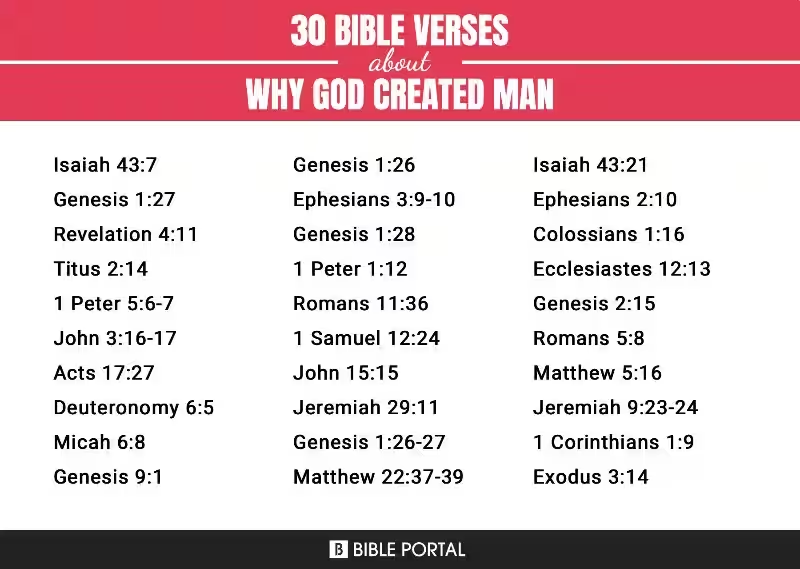
For millennia, humans have pondered the profound question of existence – and a core part of that pondering has revolved around the origin of humanity. Why did God create man? This question, deeply rooted in religious beliefs, has fueled countless philosophical debates and theological discussions. The answers, while often complex and varied, offer insights into the nature of divinity, the purpose of life, and the human condition.
Different religions offer distinct perspectives on this fundamental question. Monotheistic religions, like Christianity, Judaism, and Islam, often posit that God created humans for a specific purpose within a grand cosmic design. This purpose varies, but frequently involves relationship with the divine, moral responsibility, and achieving a higher state of being. For example, in Christianity, the concept of humanity being created "in God's image" suggests a unique position and responsibility for ethical living. This is often understood as a reflection of God's own character and an inherent dignity given to humanity.
The Natural World’s Perspective on God’s Creation of Man
While religious texts provide narrative explanations, exploring the natural world offers another lens through which to consider this question. Evolutionary biology, for instance, paints a picture of gradual development over vast periods, offering no divine intervention. However, this perspective doesn't necessarily negate the possibility of a divine hand shaping the process. The beauty and complexity of the natural world can be seen as evidence of a grand design, even if one doesn't subscribe to a creator God. Consider the intricate mechanisms of the human body or the delicate balance of ecosystems; these systems suggest a powerful, intelligent force at play, regardless of whether that force is considered divine.
This natural perspective also prompts reflection on what constitutes purpose. Is purpose something inherent in the design of the universe, or is it something we create for ourselves? Perhaps the beauty of existence lies in the journey itself, rather than a predetermined endpoint. This pondering leads to a different way of considering our place in existence, one that moves from a pre-ordained divine purpose to a potentially more open-ended self-defined one.
Religious Interpretations of God’s Design
Many religions propose a divine plan. For example, in certain interpretations of Christianity, God created humans to be in relationship with him, to learn and grow, and ultimately, to experience eternal life. Some religious texts describe humanity as being placed in a specific role within the universe, a role that involves stewardship of the world and interacting with other beings. This idea often involves a responsibility for ethical conduct and the well-being of others. These religious viewpoints present a framework for understanding our place in the universe and the meaning of our existence.
Another perspective suggests that God created humans out of a desire for companionship and love. This idea resonates with the concept of God as a relational being, expressing a deep desire for connection with creation. Within this context, human relationships, compassion, and empathy become crucial aspects of understanding our purpose, reflecting God's love in the world. For instance, helping those in need, expressing kindness, and promoting justice are ways we can actively participate in the divine plan, according to this viewpoint.
Different Perspectives and Challenges
The answer to "Why did God create man?" is not a simple or universally agreed-upon one. Different religious traditions offer diverse interpretations, sometimes leading to conflicts or disagreements. These conflicts often stem from differing understandings of God's nature and human potential. Moreover, some argue that assigning a specific divine purpose to humanity can limit our understanding of our potential and our capacity to create our own meaning and purpose.
Further, the idea of a creator raises questions about free will and responsibility. If God created humans, are we ultimately responsible for our actions, or are we simply following a predetermined path? This philosophical debate continues to engage thinkers and believers alike. In essence, the question of creation and purpose remains a deeply personal and philosophical one, shaping our understanding of life, morality, and our relationship with the universe.
Frequently Asked Questions
Why did God create man?
Different religions offer varying perspectives on this question. Many believe humanity was created for a specific purpose, such as serving God, fulfilling a divine plan, or co-creating with God. Others view humanity's creation as part of a larger cosmic process or as a natural evolution.
What is religion?
Religion is a system of beliefs, practices, and values centered around a particular faith or deity. It often involves rituals, ceremonies, and moral codes that provide adherents with a framework for understanding the world, their place in it, and their relationship with the divine. Different religions may have varying interpretations of the divine, the nature of reality, and the path to spiritual fulfillment.