Romans 5:12 teaches that sin entered human history through one man, Adam, and that death followed sin as a condition affecting all humanity. Paul uses this idea to begin a larger comparison between Adam and Jesus Christ. Adam represents the disastrous reach of disobedience; Christ represents the greater reach of grace, righteousness, and life.
The verse is short, but it raises several questions. What does Paul mean by “one man”? How are sin and death related? Does the passage say that people are guilty because of Adam’s personal act, or that Adam’s fall created a condition into which everyone is born? The answers become clearer when Romans 5:12 is read with the surrounding verses rather than in isolation.
Romans 5:12 begins with the image of something entering the world through one person. Paul identifies that thing as sin, and he connects sin with death. He then says that death spread to all people, relating this universal outcome to the fact that all have sinned.
Because Bible translations differ, it is better to focus on the verse’s structure than on one English wording. Paul presents a sequence: one man, sin entering, death following, and death reaching everyone. The sequence does not suggest that Adam’s sin was a minor private failure. It describes a turning point with consequences extending throughout the human race.
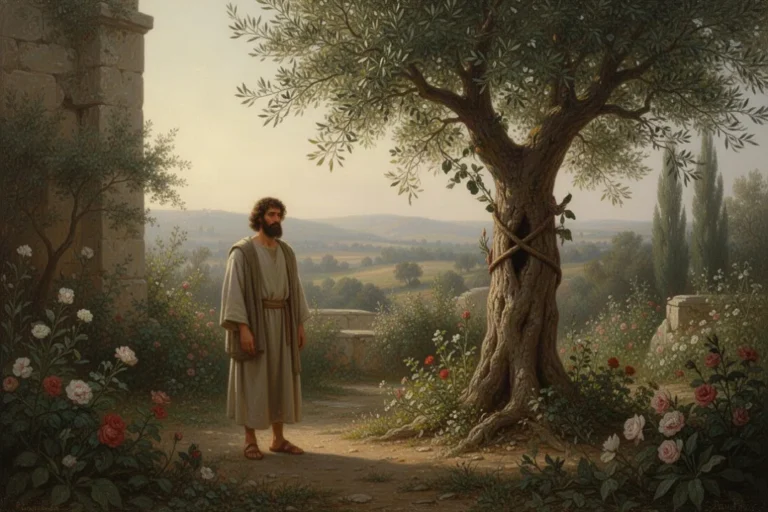
The reference to Adam comes from Genesis 2–3. God gives Adam a command concerning the tree of the knowledge of good and evil, and Adam disobeys. Genesis describes the resulting alienation, shame, hardship, and death. Romans 5 interprets that event as the beginning of humanity’s fallen condition.
Paul is not trying to retell every detail of Genesis. His purpose is theological and pastoral: he wants Roman Christians to understand why Christ’s saving work is large enough to answer humanity’s deepest problem. If sin and death have a universal reach through Adam, then grace and life through Christ must be understood as even more powerful.
Central idea: Romans 5:12 is the opening move in Paul’s Adam-and-Christ comparison. The verse explains the reach of sin and death so the following passage can show the greater reach of God’s grace.
How Adam functions in Paul’s argument
Adam is more than a character from the opening chapters of Genesis in Romans 5. Paul treats him as a representative figure whose action has consequences for those who come after him. Adam’s disobedience affects the human family because humanity belongs to the line that descends from him.
Paul develops this representative pattern in Romans 5:15–19. He repeatedly contrasts the trespass of one man with the obedience of one man. The first man is Adam; the second is Jesus. Adam’s act is associated with condemnation and death, while Christ’s act is associated with justification and life.
This does not mean that Adam and Jesus are equal in moral character or power. Paul emphasizes the difference between them. Adam’s trespass brings ruin, but Christ’s grace is not merely a reversal of equal size. God’s gift is described as overflowing and abundant, exceeding the damage caused by sin.
The comparison also explains why Paul can speak about salvation as something that comes through one representative person. Humanity’s trouble is not treated as a collection of unrelated mistakes. It has a shared source and a shared pattern. In the same way, God’s answer is not merely a set of individual improvements; it is centered on a new representative head, Jesus Christ.
Romans 5:12 therefore should not be read as an isolated statement about how the first sin happened. It introduces Paul’s explanation of two realms or conditions: one shaped by Adam’s disobedience and death, and one shaped by Christ’s obedience and life.
What “sin entered the world” means
When Paul says sin entered through Adam, he is describing more than the first occasion on which a human being made a wrong choice. Sin becomes a ruling power in the human story. It distorts relationships with God, affects the inner life, produces guilt and shame, and leads people into further disobedience.
Paul often uses the word sin in Romans both for individual acts and for a power that exercises influence over humanity. In Romans 5, the language of sin reigning through death prepares for the language of sin reigning in people’s lives later in the letter. Romans 6 then describes believers as no longer needing to live under sin’s dominion.
This helps explain why Romans 5:12 includes both a historical claim and a present human reality. Adam’s transgression belongs to the beginning of the story, but the effects of sin continue in every generation. People do not merely inherit a bad example; they participate in the same pattern of rebellion through their own choices.
Other passages in Romans make human responsibility unmistakable. Romans 1–3 describes people suppressing truth, practicing injustice, and falling short of God’s righteousness. Romans 3:23 presents universal sinfulness as the reason all people need God’s grace. Romans 5:12 fits this wider argument by connecting the inherited condition from Adam with the actual sins committed by each person.
Why death is central to Romans 5:12
Death in this verse is both a physical reality and a theological sign. Human beings die physically, but Paul sees death as evidence that sin has disrupted the created order. Death is not presented as humanity’s natural route to flourishing; it is an enemy associated with the reign of sin.
Paul later calls death “the last enemy” in 1 Corinthians 15:26, a reference that points to the future defeat of death through Christ’s resurrection. In Romans 5, death is already reigning, but Paul insists that those who receive God’s grace will reign in life through Jesus Christ. The contrast is between death’s present dominion and life’s promised victory.
The verse does not require the idea that every individual dies because of one particular personal sin. Infants, people with severe cognitive disabilities, and those who have not committed the same outward acts as others still experience death. Paul’s point is broader: the whole human race exists under the consequences of Adam’s fall and the reality of universal sin.
At the same time, Romans 5:12 does not reduce death to a biological event with no spiritual meaning. Paul connects death to separation from God and to condemnation in the surrounding discussion. The good news is therefore not only that believers receive comfort after death. Through Christ, God addresses the deeper reign of sin that makes death fearful and final.
What “all sinned” can mean in Romans 5:12
The final part of the verse has received careful attention because it can be translated and interpreted in more than one way. The central question is whether Paul is saying that all people sinned in Adam, or that death spread to all because all people eventually commit sin themselves.
Both ideas appear in Christian interpretations, and the verse should be considered alongside Romans 5:13–14. Paul explains that sin was present before the law given through Moses, even though people did not violate a command in exactly the same form as Adam did. He then says that death reigned even over those whose sin was not like Adam’s transgression.
That discussion shows that Paul has more in mind than a simple list of individual lawbreaking. Adam’s transgression is distinctive because he received a direct command. Yet death still reigned over later generations. Paul is explaining a shared human condition connected with Adam and expressed through everyone’s own sin.
Some Christian traditions emphasize inherited guilt: Adam’s disobedience is counted as humanity’s disobedience because Adam represented the human race. Other traditions emphasize inherited corruption, mortality, and a bent toward sin, while distinguishing those effects from personal guilt for Adam’s specific act. Still others describe humanity as born into a damaged condition in which people inevitably become sinners themselves.
These approaches differ in their theological details, but they agree on the main movement of the passage. Humanity is not morally or spiritually neutral. Sin and death have a universal reach, and people need a salvation that they cannot create through moral effort alone.
How Romans 5:12 relates to original sin
The doctrine commonly called original sin draws heavily on Romans 5:12–21, along with passages such as Genesis 3, Psalm 51, and 1 Corinthians 15. In broad terms, original sin means that Adam’s fall affects every human being’s condition before God.
The phrase can refer to several related ideas, so it should not be treated as though every Christian group defines it in exactly the same way. Depending on the tradition, original sin may include inherited guilt, the loss of original righteousness, mortality, corruption of human desires, separation from God, or a tendency toward sinful action.
Paul’s language in Romans 5 supports at least three connected claims:
Adam’s sin had consequences beyond Adam himself. His disobedience changed the condition of the human race.
Death became universal. It is a sign that humanity lives under the effects of sin.
People also sin personally. The universal human condition is confirmed by the actual disobedience of individuals.
Romans 5:12 should not be used to suggest that human beings are as sinful as they could possibly be at every moment. The doctrine does not require the claim that every person is equally cruel or that no one can perform acts of kindness. It means that sin has affected every person’s relationship with God and that no one can claim complete righteousness apart from God’s grace.
Nor does the verse mean that people are forced to commit every particular sin. A fallen condition influences human desires and choices, but Scripture still treats people as responsible moral agents. Paul holds together human bondage to sin and human accountability without reducing either one.
How Romans 5:12 prepares for the gospel
The verse can sound overwhelmingly negative if it is separated from the rest of the chapter. Paul’s goal, however, is not to leave readers focused on Adam. He uses Adam to make the sufficiency of Christ clearer. The problem is universal, but God’s remedy is greater.
Romans 5:15 says that the trespass and the gift are not alike. Through one man’s trespass, many die; through the grace of one man, Jesus Christ, God’s gift overflows to many. Paul then connects the gift with justification, righteousness, and reigning in life. These are not vague hopes. They describe God’s decisive action for those who receive his grace.
Romans 5:18–19 brings the contrast into sharper focus. Adam’s trespass is associated with condemnation, while Christ’s righteous act is associated with justification and life. Adam’s disobedience makes many sinners; Christ’s obedience makes many righteous. The language emphasizes that salvation rests on Christ’s faithful work, not on human self-repair.
This is why Romans 5:12 should be read with a strong sense of direction. The passage moves from Adam to Christ, from trespass to grace, and from death to life. A reading that explains human sin but neglects Paul’s focus on Christ misses the purpose of the comparison.
Read the whole unit: Romans 5:12 introduces the problem, but Romans 5:15–21 explains the answer. The passage is not mainly about assigning blame to Adam; it is about showing why Christ’s saving work is sufficient for a humanity marked by sin and death.
How different Christian traditions read the passage
Christian traditions generally agree that Romans 5:12 teaches a universal human problem connected with Adam, but they explain the connection in different ways. These differences involve questions about guilt, corruption, mortality, baptism, free will, and the nature of divine grace.
Many Protestant traditions, especially those shaped by Augustinian and Reformation theology, stress representation and imputed guilt. Adam acted as the representative head of humanity, so his condemnation is connected with those he represented. Christ then provides a corresponding representative righteousness received by faith.
Catholic theology teaches that original sin is inherited from Adam and affects the human condition, while distinguishing original sin from a person’s deliberate personal sins. It emphasizes the loss of original holiness and the wounded condition of human nature, with grace restoring and healing what sin has damaged.
Eastern Orthodox theology often places greater emphasis on inherited mortality and corruption than on the idea that people bear personal blame for Adam’s particular act. Humanity inherits a world subject to death and a condition inclined toward sin, while each person remains responsible for personal choices.
These summaries are broad and cannot represent every theologian or denomination. They show, however, why readers may hear different explanations of Romans 5:12 while still affirming the same basic biblical themes: Adam’s fall has universal consequences, people truly sin, death is tied to sin, and Christ brings a greater gift.
Common mistakes when interpreting Romans 5:12
Several reading habits can make the verse harder to understand. Avoiding these mistakes helps keep the interpretation connected to Paul’s argument and to the rest of Scripture.
Stopping at verse 12. Romans 5:12 introduces a comparison that continues through verse 21. Read the whole section before drawing conclusions.
Ignoring the contrast with Christ. Paul’s purpose is not merely to explain Adam’s failure but to show the greater power of Christ’s grace.
Treating “all sinned” as a simple slogan. The phrase must be read with verses 13–14 and with Paul’s wider teaching about both inherited sin and personal wrongdoing.
Assuming every tradition defines original sin identically. Christians agree on the universal effects of the fall but differ on how guilt, corruption, and mortality relate.
Blaming Adam as an excuse for personal sin. Romans 5 explains humanity’s condition, but Romans 1–3 also holds individuals accountable for their own rebellion.
Reducing death to biology alone. Paul connects death with sin’s reign and points toward resurrection life as God’s answer.
Making the verse teach more than it says. Romans 5:12 does not answer every question about infants, people who have never heard the gospel, or the mechanics of inherited sin.
Separating the verse from Genesis. Paul’s reasoning depends on the Adam narrative, so Genesis 2–3 provides essential background.
Practical steps for studying Romans 5:12
A careful study does not require technical training, but it does require attention to context. These steps can help you form a balanced interpretation rather than building a doctrine on one phrase.
Read Romans 5:1–21 as one argument. Notice how Paul moves from peace with God to suffering, hope, Adam, Christ, law, and grace.
Mark the repeated contrasts. Look for terms such as one, many, trespass, gift, condemnation, justification, death, and life.
Read Genesis 2–3. Pay attention to the command, the disobedience, the consequences, and the entry of death into the human story.
Compare Romans 5:12 with Romans 5:15–19. The later verses clarify what Paul means by the effects of Adam’s action and the greater work of Christ.
Read Romans 6–8 next. These chapters explain how believers are released from sin’s dominion and set their hope on life through the Spirit and resurrection.
Separate shared condition from personal acts. Ask what humanity receives through Adam and what each person chooses through his or her own actions.
Keep the gospel central. Any explanation of the fall should lead back to Paul’s main claim: God’s grace in Christ is greater than the reign of sin.
What Romans 5:12 means for Christian faith
Romans 5:12 gives a realistic account of why human beings need redemption. It does not portray sin as a superficial lack of education or as a problem solved by better circumstances. Humanity is caught in a condition marked by disobedience, alienation, and death.
That diagnosis also explains why Christian salvation is described as grace. If sin were only a collection of isolated mistakes, people might imagine that enough discipline could remove the problem. Paul instead presents a condition so deep that the answer must come from God’s action through Christ.
The verse can also shape humility. No one stands outside the human problem and looks down on everyone else. Adam’s story is not merely about “those people” who fail; it is about the shared condition of humanity. The proper response is honest confession, dependence on grace, and trust in the one Paul presents as the new source of righteousness and life.
Finally, Romans 5:12 gives Christian hope a clear foundation. Death is real, sin is serious, and human effort is insufficient, but Adam does not have the last word. Paul’s central claim is that Jesus Christ has acted decisively to provide what Adam’s disobedience could not: justification for the guilty, reconciliation with God, and life that overcomes death.
Frequently asked questions
Does Romans 5:12 say that Adam’s sin is the only reason people die?
Paul connects death with Adam’s sin and with the universal reality of human sin. The verse presents Adam’s fall as the entrance of sin and death into the human story, but the surrounding passage also emphasizes that people themselves sin. It is therefore not a statement that individuals are personally innocent while suffering only for Adam’s action.
Is original sin explicitly named in Romans 5:12?
The phrase “original sin” does not appear in the verse itself. It is a later theological term used to describe the condition Romans 5:12–21 and related passages teach: Adam’s fall affects every human being, death is universal, and people need grace. Christian traditions explain the inherited effects differently, especially regarding guilt, corruption, and mortality.
How does Romans 5:12 connect to Jesus?
Romans 5:12 introduces Adam so Paul can compare him with Jesus in the rest of the passage. Adam’s disobedience is associated with sin, condemnation, and death, while Christ’s obedience is associated with grace, justification, righteousness, and life. The main point is not only how sin entered but that Christ’s saving work is greater than the damage caused by Adam.
Does Romans 5:12 mean people have no free will?
No. Paul describes humanity as affected and dominated by sin, but Romans also treats people as responsible for their choices. The verse explains why human beings need God’s grace; it does not say that people are machines unable to make meaningful decisions. Christian traditions differ over how sin affects freedom, yet they generally affirm both human responsibility and the necessity of divine grace.





Leave a Reply