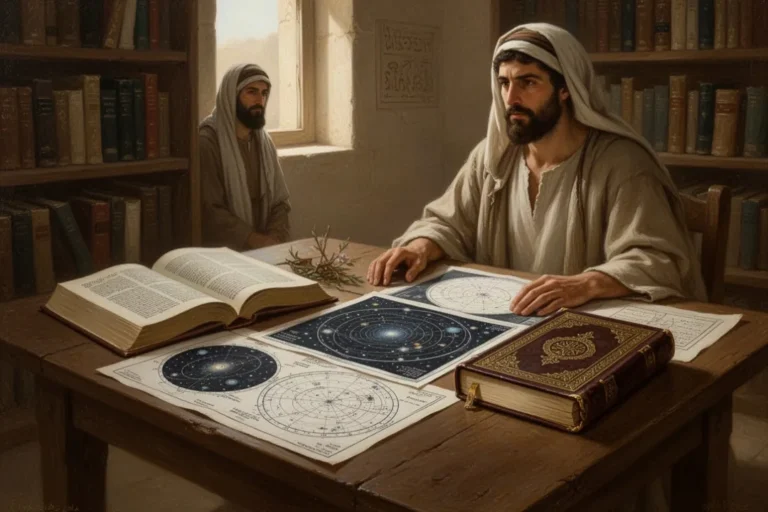
Religion and science are not automatically opposites. Science investigates the natural world through observation, testing, measurement, and evidence. Religion usually addresses questions about meaning, purpose, moral responsibility, spiritual experience, and ultimate reality. Conflict can arise when either one is asked to answer questions outside its proper methods, or when a religious interpretation and a scientific explanation make competing claims about the same physical event.
The most useful approach is to distinguish what can be tested from what is interpreted through faith, philosophy, or theology. A scientific explanation of how a star forms does not by itself settle whether the universe has purpose. Likewise, a religious belief about creation does not replace the measurements and models used to study stars. Understanding that difference makes room for both careful inquiry and serious religious reflection.
Science is a method for building reliable knowledge about the physical universe. Scientists form questions, collect evidence, develop explanations, test predictions, compare results, and revise conclusions when better evidence appears. Scientific knowledge is therefore evidence-based and open to correction, rather than a final collection of unquestionable statements.
Religion is broader and varies greatly among traditions. It may include beliefs about God or gods, sacred texts, worship, moral duties, community practices, personal transformation, and life after death. Religious claims can concern history or the natural world, but many religious questions focus on values and ultimate meaning, which cannot be settled by a laboratory test alone.
Science asks: What happens, how does it happen, and what evidence supports that explanation?
Religion often asks: What should we value, how should we live, and what might existence mean?
Philosophy asks: What follows logically from our evidence, beliefs, and assumptions?
Ethics asks: Which actions are right or wrong, and why?
These categories overlap, but they are not identical. Medicine can describe how a treatment affects the body, while ethics helps determine whether the treatment is fair, voluntary, and appropriate. Cosmology can describe the early development of the universe, while religion and philosophy may ask why there is a universe at all. Treating these as separate but related questions prevents many unnecessary disputes.
Four ways religion and science can relate
Scholars and educators commonly describe the relationship between religion and science in several broad ways. These descriptions are not rigid boxes, and a person may hold different views depending on the subject. Still, they provide a practical framework for understanding why people reach different conclusions.
Independence: Religion and science address different kinds of questions. Science studies physical processes, while religion concerns spiritual meaning, worship, and moral life. The two may coexist because they are not competing explanations of the same thing.
Dialogue: Scientific discoveries can raise philosophical or theological questions, and religious traditions can contribute ideas about human dignity, responsibility, and the proper use of knowledge. Neither field becomes a substitute for the other.
Integration: Some thinkers try to develop a larger worldview in which scientific knowledge and religious beliefs fit together. This may involve philosophical arguments about causation, consciousness, order, or the origin of the universe.
Conflict: A direct disagreement occurs when a religious interpretation makes a testable claim that conflicts with strong scientific evidence, or when someone treats a scientific theory as proving a broad philosophical conclusion that the evidence does not establish.
The conflict model receives much public attention, but it is only one possible relationship. Many religious people accept mainstream science, including evolution and modern medicine, while interpreting their faith in ways that do not require a literal reading of every sacred creation account. Other believers reject particular scientific conclusions, usually because they understand those conclusions as contradicting central religious commitments.
Useful distinction: A scientific theory is not a casual guess. In science, a theory is a well-supported explanatory framework that connects evidence, makes predictions, and remains open to revision.
How to evaluate a claim involving religion and science
When a claim combines religious language with scientific language, begin by identifying exactly what is being asserted. Vague statements such as “science proves religion” or “science disproves God” usually move too quickly from evidence to a much broader conclusion. Ask whether the claim concerns a measurable event, a philosophical interpretation, a personal experience, or a moral judgment.
State the claim precisely. Replace a broad slogan with a specific question. For example, ask whether a particular event occurred, whether a biological process has a natural explanation, or whether a scientific discovery affects a theological belief.
Identify the evidence. Separate observations from interpretations. Ask whether the evidence comes from controlled experiments, historical records, personal testimony, mathematical reasoning, or a sacred tradition.
Check the method. Determine whether the method is appropriate for the question. A microscope can reveal cellular structures, but it cannot directly measure moral value or divine purpose.
Separate facts from worldview conclusions. Evidence may support a conclusion without proving every broader belief attached to it. A fact about brain activity, for example, does not by itself settle every question about consciousness or the soul.
Consider alternative explanations. Look for explanations that account for the same evidence with fewer assumptions. This is useful in science, history, and theology.
Check the scope of the conclusion. A finding about one organism, community, or historical document should not automatically be expanded into a claim about all life, all religions, or all human experience.
Distinguish disagreement from misunderstanding. People may disagree about the evidence, the interpretation, or the underlying values. These are different kinds of disagreement and require different responses.
This process also helps you recognize scientism, the view that scientific methods are the only legitimate way to know anything. Science is exceptionally powerful for studying the natural world, but the claim that science is the only source of knowledge is itself a philosophical claim, not a laboratory result. Logic, history, ethics, and everyday reasoning all use forms of justification that are not identical to experimental science.
Why evolution creates religious disagreement
Evolution is one of the clearest examples of the relationship between religious belief and science. Modern evolutionary biology explains how populations change over generations and how natural selection, mutation, inheritance, genetic drift, and other processes contribute to the diversity of life. Evidence comes from genetics, fossils, anatomy, ecology, observed changes in populations, and the geographic distribution of organisms.
Religious responses to evolution differ. Some traditions or communities interpret creation narratives as literal scientific accounts and reject evolutionary explanations. Others read those narratives as theological or poetic accounts that communicate beliefs about dependence on God, human responsibility, or the goodness and order of creation rather than a technical sequence of biological events.
Some religious believers accept evolution while maintaining that God is the ultimate source of creation. Others hold that evolution describes a real process but does not answer questions about why life exists, why the universe has intelligible laws, or how human beings should treat one another. These are compatibility positions, although they do not all agree about the details.
The central issue is often not the evidence for evolutionary change itself, but the interpretation of what evolution means. Scientific evidence can address common ancestry and biological mechanisms. It cannot, by itself, determine whether human life has spiritual significance or whether a creator exists. Those conclusions require philosophical or theological reasoning in addition to biology.
How cosmology affects beliefs about creation
Cosmology studies the universe on its largest scales: its structure, history, expansion, matter, energy, and possible future. Scientific models are built from observations such as the movement of galaxies, the properties of radiation, and the distribution of matter. These models describe an early hot, dense state and the subsequent development of the universe, although major questions remain about the earliest moments and the nature of dark matter and dark energy.
Some people see cosmic order or the apparent suitability of the universe for life as evidence of a creator. Others explain these features through physical theories, selection effects, or future discoveries. Still others argue that scientific descriptions and theological beliefs address different levels of explanation. None of these positions should be presented as a simple scientific proof unless the relevant claim can actually be tested.
A beginning in the scientific history of the observable universe is also not automatically identical to a theological doctrine of creation. Creation in theology may refer to the universe’s dependence on God at every moment, not merely to an event at its earliest measurable stage. Conversely, a cosmological model does not need a religious interpretation in order to function as science.
What science can and cannot say about God
Science can investigate claims about the physical effects of an alleged event. If someone says a substance cures a disease, scientists can test the substance. If someone says a prayer practice changes measurable health outcomes, researchers can design studies to compare outcomes while accounting for expectation, behavior, selection effects, and other variables.
Science is less equipped to evaluate a claim defined as transcendent and not dependent on measurable physical effects. A deity understood as beyond nature cannot be placed in a laboratory in the same way as a chemical compound. That does not prove or disprove the deity; it means the question is not framed as an ordinary empirical hypothesis.
Arguments for and against God often use philosophical reasoning, including arguments from causation, morality, consciousness, order, religious experience, or the problem of suffering. These arguments can be examined for logical strength and hidden assumptions, but they are not scientific experiments in the narrow sense. People may reasonably regard them as persuasive, unpersuasive, or inconclusive.
Claims about miracles require special care. A reported miracle may be meaningful to a religious community, but a personal account is not the same as independently verified evidence. Scientific investigation can examine medical records, timing, alternative causes, and whether the event is repeatable. If an event is unique and cannot be reproduced, its theological significance may remain separate from what science can establish about it.
How religion and science shape medical ethics
Medicine relies heavily on science to understand disease, assess treatments, and estimate risks. Yet science alone does not decide every medical question. It can show what an intervention is likely to do, but it cannot determine whether a person should accept it, how scarce treatment should be distributed, or which tradeoffs respect human dignity.
Religious traditions have influenced ideas about compassion, care for vulnerable people, the sanctity or value of life, responsibility to family, and duties to the wider community. Secular ethics contributes other frameworks, such as autonomy, justice, harm reduction, and informed consent. In practice, medical decisions often involve several of these principles at once.
Vaccination and treatment: Scientific evidence addresses safety and effectiveness; ethical reasoning addresses consent, public risk, and access.
End-of-life care: Medicine can describe prognosis and available interventions; moral and religious beliefs may shape judgments about suffering, treatment, and dignity.
Reproductive medicine: Clinical evidence explains risks and outcomes, while religious and philosophical views may differ about embryos, parenthood, and responsibility.
Genetic technologies: Science can identify what a technique can change; ethics asks which uses are responsible and who should benefit.
Religious convictions should not replace evidence when a treatment’s safety is at stake. At the same time, scientific capability does not automatically establish moral permission. A society needs open discussion among scientists, patients, religious leaders, ethicists, and the public before making decisions that affect human welfare.
Why religious experiences are difficult to study scientifically
People may report prayer, worship, meditation, conversion, visions, or a sense of divine presence as deeply real experiences. Researchers can study the psychological, neurological, social, and behavioral dimensions of those experiences. They can examine patterns of attention, emotion, memory, stress, group participation, and changes in reported well-being.
Those measurements do not settle whether the experience had a divine source. A neurological account may describe what happens in a person’s brain during prayer without showing that the experience is false or true. Every ordinary perception also involves brain activity, so the presence of brain activity does not by itself explain away the perceived object.
Personal experience can be meaningful evidence for the person who has it, but it is usually weaker as public evidence because it may not be independently verifiable. Reports can be affected by memory, expectation, social pressure, cultural language, or changes in mood. Respectful evaluation allows both possibilities: an experience may have genuine psychological importance, and its ultimate interpretation may remain uncertain.
How sacred texts should be read alongside scientific evidence
Sacred texts were written and transmitted in historical settings with particular languages, literary forms, audiences, and purposes. A passage may function as poetry, wisdom literature, law, narrative, prophecy, ritual instruction, or theological reflection. Reading every passage as if it were a modern scientific report can create problems that the text’s original genre does not require.
Responsible interpretation considers genre, context, translation, historical setting, and the wider tradition. It also asks whether a passage is making a claim about physical mechanism or using imagery to communicate a religious conviction. Different communities may answer those questions differently, and disagreement within a religion is common.
When a scientific finding appears to conflict with a sacred text, several possibilities should be considered:
The scientific interpretation may be incomplete or mistaken.
The religious interpretation may rely on a modern assumption rather than the text’s intended genre.
The text may be addressing a theological question rather than a physical mechanism.
The scientific and religious claims may concern different aspects of the same subject.
A genuine conflict may exist, requiring a person or community to reconsider an interpretation or a scientific claim.
This approach does not require treating all interpretations as equally convincing. It requires enough care to identify what is actually being claimed before declaring a contradiction.
What scientists and religious thinkers can learn from each other
Science offers religion a disciplined example of intellectual humility. Scientific practice requires people to test favored ideas, publish methods, acknowledge uncertainty, and change conclusions when evidence demands it. Religious communities can apply similar habits when interpreting texts, evaluating testimony, or discussing claims about the natural world.
Religion and moral philosophy can challenge science to consider the human consequences of research. Scientific advances in artificial intelligence, reproductive medicine, genetics, environmental change, and weapons technology create questions about responsibility that data alone cannot answer. Religious traditions may contribute long-developed reflections on restraint, obligation, compassion, and the treatment of vulnerable people.
Neither side should claim authority it has not earned. Scientists are not automatically experts in theology because they study the universe, and religious leaders are not automatically experts in biology because they lead a community. Productive conversation depends on subject-matter expertise, accurate representation, and willingness to acknowledge uncertainty.
Practical guideline: Let scientific evidence guide claims about measurable natural processes, and use philosophy, ethics, and theology to examine meaning, values, and responsibility without presenting those reflections as laboratory results.
How to discuss religious and scientific disagreement respectfully
Discussions about religion and science often become personal because they touch identity, family, morality, and the meaning of life. A productive conversation begins by asking what the other person actually believes rather than assigning a position based on a label. “Religious” and “scientific” each describe many different approaches, not two uniform groups.
Use specific language. Instead of asking whether someone believes in “science,” ask which evidence or conclusion they accept. Instead of asking whether someone is “religious,” ask how they interpret a particular teaching and whether they view it as literal, symbolic, historical, or theological.
Several habits can keep the exchange focused:
Define important terms such as theory, evidence, faith, proof, miracle, and interpretation.
State the strongest version of the other person’s position before criticizing it.
Do not treat one religious tradition as representative of every tradition.
Do not treat one scientist’s philosophical opinion as the conclusion of science itself.
Admit what remains uncertain and distinguish uncertainty from ignorance.
Ask whether the disagreement concerns evidence, logic, values, or personal experience.
Respect does not require pretending that every claim is equally supported. It means evaluating claims by appropriate standards while recognizing that a disagreement about evidence may not be the same as a disagreement about ultimate meaning.
Questions that remain beyond a scientific answer
Science can continue to expand what humans know about matter, life, minds, and the universe. It may explain processes that once seemed mysterious, but explanation does not eliminate every philosophical question. People still ask why truth should matter, what makes a life good, whether moral obligations are objective, and how consciousness relates to the physical world.
Some questions may eventually receive scientific contributions without becoming purely scientific questions. Research can inform debates about human behavior, suffering, cooperation, and mental health, but evidence still needs interpretation within an ethical framework. A complete understanding of human life may require empirical knowledge, logical reasoning, moral reflection, historical understanding, and personal or communal meaning.
Religion and science are therefore best understood neither as automatic enemies nor as identical paths to knowledge. Science provides rigorous tools for investigating nature. Religion can provide practices, narratives, communities, and interpretations that address meaning and obligation. Where their claims overlap, careful evidence and honest interpretation are necessary; where their questions differ, forcing one field to replace the other only creates confusion.
Frequently asked questions
Are religion and science fundamentally incompatible?
No. They become incompatible only when particular religious and scientific claims directly contradict each other. Many religious people accept established scientific findings while understanding faith as addressing purpose, morality, worship, or ultimate reality. Some believers and nonbelievers do see a deeper conflict between naturalistic science and theism, but that is a philosophical disagreement rather than a conclusion shared by all scientists or all religious traditions.
Does science prove or disprove God?
Science does not generally prove or disprove a deity understood as transcendent and not directly measurable. It can test specific claims about physical events, health effects, or alleged miracles. Arguments about God commonly involve philosophy, theology, personal experience, and interpretations of the universe. Scientific discoveries may influence those arguments, but they do not settle every question about divine existence.
Can a person believe in evolution and follow a religion?
Yes. Many religious believers accept evolution as the scientific explanation for biological change and interpret creation teachings in theological, symbolic, or literary terms. Others believe God works through evolutionary processes, while some traditions reject evolution or particular versions of it. The answer depends on how a person understands sacred texts, divine action, human uniqueness, and the relationship between scientific evidence and religious interpretation.
Why can’t science answer every question about meaning and morality?
Science can provide evidence about consequences, human behavior, health, and the conditions under which people flourish. It cannot alone determine what people ought to value or whether an action is morally right. Those judgments require ethical reasoning and often draw on philosophy, religion, law, culture, or shared principles such as justice and human dignity. Scientific facts inform moral decisions but do not replace them.





Leave a Reply