The man shall not live by bread alone bible verse (Matthew 4:4) and Living on God’s Word
Matthew 4:4 · King James Version
Quick Answer: In the man shall not live by bread alone bible verse (Matthew 4:4), Jesus answers temptation by pointing to God’s Word as the real source of life. Food matters, but it cannot sustain you spiritually. When you trust and obey every word from God, you live with lasting strength that bread alone cannot provide.
Matthew 4:4 (King James Version)
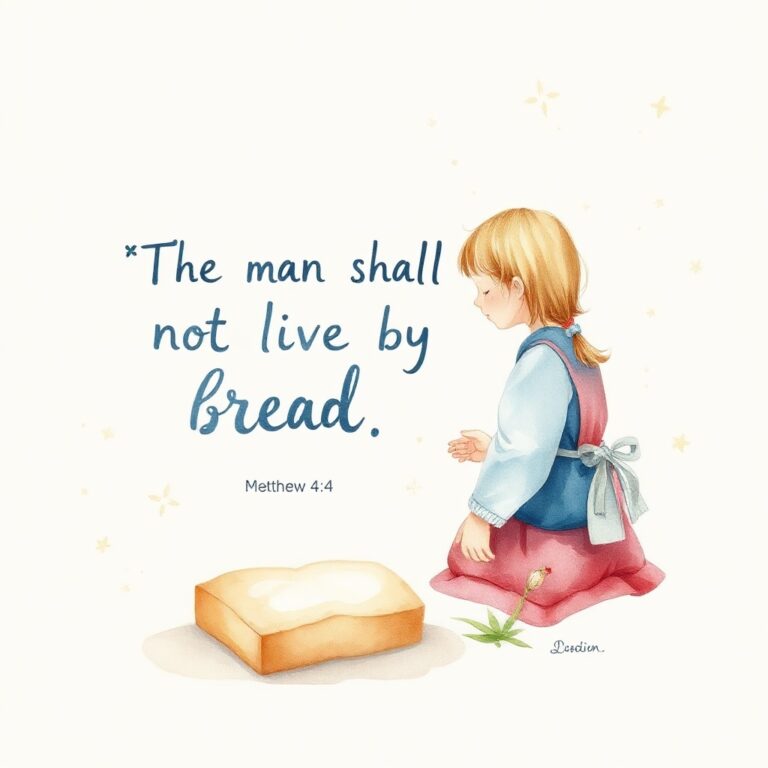
“But he answered and said, It is written, Man shall not live by bread alone, but by every word that proceedeth out of the mouth of God.”
When hunger met temptation: Jesus in the wilderness
Matthew 4:1-11 records the season when Jesus was led into the wilderness to be tested. The setting is stark: fasting, isolation, and spiritual pressure at the moment when His physical needs were real. Satan tempted Him to treat God as a means to an end—turning stones into bread—implying that meeting immediate appetite would prove trust.
Jesus’ response is not a rejection of physical needs, but a correction of the foundation. He quotes Deuteronomy 8:3, reminding that God’s purpose for His people goes beyond survival. In the wilderness, Israel learned that God used dependence as training—teaching them to live as those whose lives are sustained by divine speech, not mere provisions.
So in Matthew 4:4, the “battle” is not only about food. It’s about authority: whose word will rule? Jesus demonstrates that obedience to God’s Word is the path of true life, even when circumstances feel unbearable.
Word, bread, and the source of life (general Greek/Hebrew notes)
In Matthew 4:4, the phrase “every word” points to God’s speech and expressed will—what God has said, promised, commanded, and declared. The Greek term for “word” commonly carries the sense of a message or declaration, not merely casual talk. “Proceedeth” suggests an active source: God’s word comes forth as life-giving instruction.
The supporting Old Testament citation, Deuteronomy 8:3, emphasizes that Israel’s sustenance came through God’s providence, including disciplines of dependence. While the Hebrew behind “word” can cover speech, command, or instruction, the theological emphasis remains consistent: God’s utterance is sufficient to sustain His people.
The key takeaway is not that bread is evil, but that God’s Word is ultimate.
1) Bread answers hunger; God’s Word answers life
Jesus was hungry, and hunger is not sinful. Yet Satan tried to reduce “life” to consumption. The temptation sought a shortcut: use power to satisfy need rather than trust God’s timing and purpose. Matthew 4:4 corrects that reduction. Jesus says, “Man shall not live by bread alone….” Bread meets a temporary requirement, but it cannot provide spiritual vitality, direction, or endurance.
In Scripture, “life” is more than staying alive; it is walking with God, receiving His guidance, and being formed by His truth. That is why Jesus does not argue about calories—He argues about authority and dependence. He appeals to “every word that proceedeth out of the mouth of God,” showing that God’s spoken reality sustains what bread cannot.
This matters because people often treat God’s Word like a supplement—something to add when it’s convenient. But Jesus presents God’s Word as the foundation. If your survival depends on bread, you will fear shortages. If your survival depends on God’s Word, you can face scarcity with steady trust.
2) Jesus fights temptation with Scripture, not improvisation
Notice how Jesus responds: “It is written…” He does not speak from emotion or personal philosophy. He draws from Scripture as a living weapon. The pattern is instructive for believers today. When you’re pressed—by anxiety, appetite, anger, or pressure—what comes out of you reveals what truly governs you.
The “word” Jesus quotes is connected to God’s purpose in the wilderness: God teaches dependence. Israel learned that the Lord can provide even when the usual supply routes fail. In the same way, Jesus demonstrates dependence in His own testing.
Practical spiritual implication: if you want to live by God’s Word, you must know God’s Word before the crisis arrives. Meditating on Scripture ahead of time shapes your instincts so that, when temptation comes, you’re able to respond with truth. You’re less likely to chase immediate comfort and more likely to obey God even when it costs.
In this verse, Jesus sets an example: the path through testing is not self-reliance, but Scripture-saturated trust.
3) “Every word” means God’s guidance is comprehensive
Jesus doesn’t say, “Man shall live by some words” or “by the parts that feel good.” He says “every word” that proceeds from the mouth of God. That phrase highlights God’s comprehensive care: His Word speaks to doctrine, morality, hope, perseverance, and daily decisions.
This also guards against selective reading. Many people prefer verses that soothe while avoiding verses that correct. But Jesus’ statement invites a fuller posture: receive God’s Word as a whole—what He commands, what He promises, what He warns, and what He teaches.
Even when bread is scarce, God’s speech continues. Even when your circumstances contradict your plans, God’s Word remains stable. Living by God’s Word therefore includes believing His character, obeying His commands, and trusting His providence.
So the man shall not live by bread alone bible verse is not just a poetic line; it is an ongoing principle. Your life is sustained as you submit to God’s voice—through Scripture, prayer, and obedience.
Daily ways to live on God’s Word
To apply Matthew 4:4, treat God’s Word as more than inspiration—treat it as daily bread for the soul. First, choose a realistic reading rhythm: start with a short passage and stay long enough to understand what it says about God and how it expects you to respond. Second, practice “temptation pause” by asking, “What does God’s Word say here?”—then obey the next clear step.
Third, memorize key phrases that match your struggle. When pressure rises, Scripture you already hid in your heart becomes the fastest anchor. Fourth, replace “comfort-by-default” with “obedience-by-faith.” If you’re tempted to control outcomes through sinful shortcuts, respond with prayer and Scripture rather than improvisation.
Finally, review your week: where did God’s Word guide you, and where did you ignore it? Growth often looks like small, repeated choices that train your dependence on the Lord.
Related Bible Passages
Deuteronomy 8:3
God humbled and fed Israel so they would learn that dependence on His Word sustains life.
Psalm 119:105
God’s Word is a lamp that guides your steps, showing how life works in the real world.
Meditation on the law produces strength and courage to obey, not just to survive.
John 6:27
Jesus contrasts perishing food with food that endures to everlasting life, rooted in God’s work.
2 Timothy 3:16-17
Scripture equips believers for every good work, reinforcing that God’s Word is sufficient for life and obedience.
Frequently Asked Questions
What does “bread alone” mean in Matthew 4:4?
“Bread alone” refers to living on physical provisions without living by God’s Word. It doesn’t deny food is necessary; it denies that food can supply spiritual life, direction, or endurance. Jesus teaches that God’s speech from His mouth is the deeper source of true living.
Is the man shall not live by bread alone bible verse only about hunger?
No. Hunger is the immediate setting, but the real issue is temptation and authority. Satan was pushing Jesus to meet need in a way that bypassed God. The verse addresses every kind of pressure where you might trade obedience for immediate relief.
How can I apply “every word” when I feel overwhelmed?
Start small. Read one passage, identify one promise to believe or one command to obey, and pray for the strength to take that next step. “Every word” doesn’t mean you must solve your entire life at once; it means God’s guidance is not partial—so choose the next clear act of faith.
Why did Jesus quote Deuteronomy instead of responding differently?
Jesus modeled the practice of answering temptation with Scripture. Deuteronomy 8:3 reminded Him of God’s training purpose in the wilderness and His faithfulness in provision. Quoting “It is written” also shows that God’s Word is trustworthy even when circumstances feel extreme.
A Short Prayer
Lord Jesus, teach us to live by Your Word, not by what we can merely consume or control. When temptation pressures us, help us remember Your promises and obey Your commands. Give us hunger for Scripture and courage to trust Your timing, even in wilderness seasons. Strengthen our faith so we endure, guided by every word that proceeds from Your mouth. Amen.
Key Takeaway: Jesus’ words in Matthew 4:4 call you to trust God’s Word as your true source of spiritual life, not merely physical provision.