Contemplation prayer: meaning, methods, and practical guidance
Contemplation prayer: meaning, methods, and practical guidance
Contemplation prayer is a quiet way of being attentive to God rather than trying to fill prayer with many words.
For many Christians, contemplation prayer means resting in God’s presence with a receptive heart. You may use a sacred word, a short passage of Scripture, or simple awareness of God’s love, but the purpose is not to produce a special feeling. The purpose is <strongloving attention, honest openness, and a willingness to remain present.
Thoughts will come and go. You may feel peaceful one day and distracted the next. Neither experience proves that prayer is succeeding or failing. Contemplative prayer is less about controlling your mind than about gently returning to God whenever you notice that your attention has wandered.
What contemplation prayer means in Christian practice
The word contemplation can suggest deep reflection, but Christian contemplation is more than thinking carefully about a religious subject. It is a form of prayer in which you attend to God with love, trust, and receptivity. You are not attempting to analyze God or force a spiritual experience.
Some Christian writers describe contemplation as a loving gaze toward God. That gaze can be expressed through silence, adoration, a repeated prayer, awareness of Christ, or a quiet response to Scripture. The form may vary, while the central movement remains the same: turning toward God with fewer words and less self-directed effort.
Contemplation does not require unusual spiritual gifts. It can take place in a church, a quiet room, a park, or during a brief pause at work. A person may practice it for several minutes or for a longer period, depending on health, responsibilities, and experience.
Key idea: Silence is not the goal by itself. In contemplation prayer, silence creates room for attentive relationship with God.
How contemplation differs from meditation and ordinary prayer
Christian traditions use the words meditation and contemplation in somewhat different ways, so the terms do not always have one universal definition. A helpful distinction is that meditation usually involves active reflection, while contemplation emphasizes quiet presence and receptive attention.
Vocal prayer uses spoken or silently formed words, such as the Lord’s Prayer, a psalm, or a prayer written by someone else.
Meditative prayer may examine a passage of Scripture, imagine a Gospel scene, consider a theological truth, or reflect on how God is calling you to respond.
Contemplative prayer rests with God in simplicity, allowing words and ideas to become secondary while attention remains turned toward God.
Intercessory prayer brings the needs of other people before God, sometimes with detailed requests and sometimes with a simple, repeated prayer.
These forms can support one another. You might read a Gospel passage, reflect on its meaning, and then spend several minutes sitting quietly before God. The reflective portion is meditation; the quiet resting that follows may be contemplation.
Contemplative prayer also differs from techniques designed only to produce relaxation or mental emptiness. Slow breathing and physical stillness can help settle you, but Christian contemplation does not treat emptiness as the final aim. Its focus is <strongrelationship with God, even when that relationship is experienced without strong emotion.
Why people practice contemplation prayer
People come to contemplative prayer for different reasons. Some want a more intimate relationship with God after finding that constant speaking leaves little room for listening. Others need a steady way to pray during grief, uncertainty, spiritual dryness, or major life changes.
Contemplation can help you notice the difference between God’s presence and the stream of thoughts that usually dominates your attention. It can also expose your impatience, anxiety, or need to control results. That exposure may feel uncomfortable, but it can become an invitation to greater honesty.
Regular quiet prayer may gradually shape the way you respond outside prayer. You may become more aware of resentment before acting on it, more willing to listen to another person, or more able to recognize fear without allowing fear to make every decision. These changes are not automatic, and they should not be used to measure your spiritual worth.
Contemplative prayer is not a method for obtaining answers on demand. It does not guarantee emotional calm, visions, certainty, or a solution to a difficult situation. Its value is found in faithful presence, not in dramatic results.
A simple practice can make contemplation less intimidating. Choose a realistic period, begin without demanding a particular outcome, and return gently whenever your attention moves away.
Choose a suitable time and place. Select a location where you can sit safely and remain undisturbed for a short period. Turn off unnecessary notifications and decide how long you will pray before beginning.
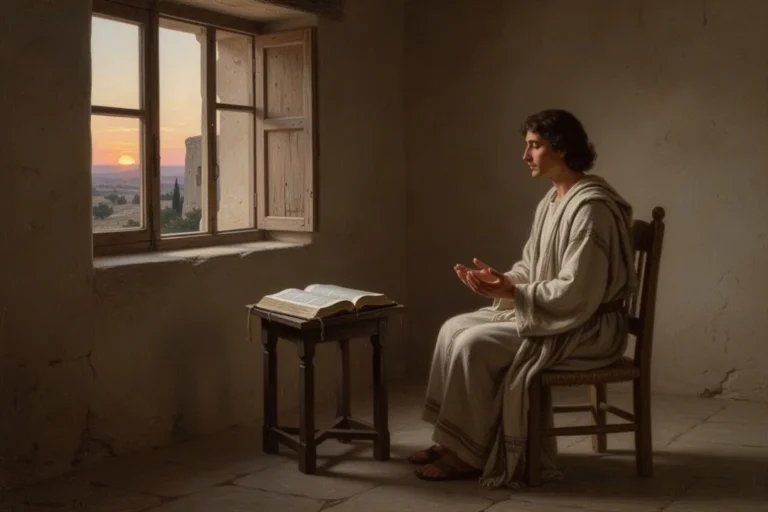
Adopt a steady posture. Sit in a chair with your feet supported, or use another posture that helps you remain awake and comfortable. You do not need a special position, and discomfort is not a sign of deeper prayer.
Begin with a simple act of faith. Acknowledge that you are coming into God’s presence. You might silently offer yourself to God or ask for the grace to be attentive.
Use a brief sacred word if helpful. Choose a word such as “Jesus,” “mercy,” “peace,” or “Abba” if it fits your tradition and relationship with God. The word is not a magical formula; it is a gentle way to renew your intention.
Let thoughts come and go. When you notice planning, memories, sounds, physical sensations, or worries, do not argue with them. Acknowledge the distraction and return gently to God or to your sacred word.
Stay receptive without forcing silence. You are not required to stop every thought. Simply release the need to follow each thought and remain available to God.
End with care. When the prayer period ends, offer a brief word of thanks or make a simple closing prayer. Stand slowly and carry the attentiveness of the practice into your next activity.
Start with five to ten minutes if you are new to this form of prayer. A short practice that you can repeat consistently is usually more helpful than an ambitious session that leaves you discouraged. You can gradually lengthen the time if the practice remains peaceful and responsible within your life.
What to do when your mind keeps wandering
Mind wandering is normal. The mind naturally remembers conversations, anticipates tasks, notices sounds, and reacts to bodily sensations. The moment you realize that you have drifted can itself become a moment of prayer, because you have become aware of where your attention has gone.
Do not evaluate every distraction. You do not need to label it as good or bad, spiritual or unspiritual. Return with the same gentleness you would offer a child who had become distracted during a conversation.
If you are thinking about a task, acknowledge it and return to God.
If a strong emotion appears, allow yourself to recognize it without making an immediate decision.
If a physical sensation is uncomfortable, adjust your posture when needed rather than treating discomfort as a spiritual test.
If you keep falling asleep, pray at a different time or sit in a more alert posture.
If a serious concern needs action, write a brief reminder after prayer and return to the practice.
The repeated return matters more than the number of uninterrupted minutes. Each return expresses trust over control. You are not trying to win a contest against distraction; you are practicing a faithful turning toward God.
Using Scripture in contemplation prayer
Scripture can provide a strong doorway into contemplative prayer. Choose a short passage that draws you toward God rather than one that requires extensive study during the prayer period. A brief Gospel scene, a psalm, or a passage about God’s mercy may be suitable.
Read the passage slowly once or twice. Notice a word, image, or phrase that speaks to you, then allow the text to become quiet within you. You do not have to explain every detail or discover a new interpretation. Let the passage lead you into presence rather than analysis.
For example, you might read the account of Jesus welcoming children in Mark 10:13–16 and sit quietly with the sense of being received. You might read Psalm 23 and rest with the image of God’s care, or consider John 15:1–11 and allow its theme of remaining connected to Christ to guide your prayer. These references can be prayed with without reproducing the passage word for word.
A practice sometimes called lectio divina moves through reading, reflection, prayer, and quiet resting. The stages are not a rigid formula. You may spend several minutes with the text, respond to God in your own words, and then remain silently attentive.
Practical tip: Keep a short Scripture passage nearby, but resist turning prayer into a study session. If questions about history or interpretation arise, note them for later and return to the prayer.
Several Christian approaches to contemplation prayer
There is no single technique that all Christians must use. Different communities have developed practices that share a quiet, attentive orientation while using different language and theological emphasis.
Centering Prayer
Centering Prayer commonly uses a sacred word as a symbol of your intention to consent to God’s presence and action. When thoughts arise, you return lightly to that word. The practice does not depend on repeating the word constantly; using it only when you notice that you have become absorbed in a thought may be more appropriate.
People who practice this method often set aside a regular period and finish with a more active prayer or Scripture reading. Guidance from an experienced teacher can be useful, especially when questions arise about expectations, difficult emotions, or the role of the sacred word.
You may also pray contemplatively without a formal method. Sit quietly, become aware of God’s presence, and offer your attention without trying to create a particular inner state. When you notice distraction, turn back to God through a short phrase or a simple act of trust.
This approach can be especially accessible if structured techniques feel unnatural. Its simplicity should not be confused with passivity. You are choosing to remain present, release unnecessary mental activity, and receive the time as prayer.
Prayer of the heart
Some Eastern Christian traditions use the Jesus Prayer or another brief invocation repeated with attention and humility. The exact wording and guidance vary by tradition. The practice is not a mechanical way to produce a spiritual state, and it should be approached with respect for the tradition in which it developed.
A short prayer can also be adapted more generally as a way to gather your attention. If you use repeated words, let them express a real relationship with God rather than treating the repetition as a technique that guarantees a result.
Contemplative prayer with sacred images or music
Some people become attentive to God through an icon, a cross, a candle, sacred art, or quiet instrumental music. These supports can help focus the senses, but they are not necessary. If an image or sound becomes distracting, remove it and return to simpler prayer.
How to tell the difference between contemplation and daydreaming
Contemplation involves an intentional turning toward God, even when the experience feels ordinary. Daydreaming usually carries your attention into an imagined situation, memory, fantasy, or internal conversation without that intentional orientation.
The boundary may not always feel sharp. During prayer, you may imagine a Gospel scene or remember someone who needs care. That does not automatically make the prayer unhelpful. Ask whether the thought is drawing you toward love, truth, and God, or whether you are simply following a mental story because it is absorbing.
If you discover that you have been daydreaming, there is no need for self-criticism. Recognize what happened and return. The purpose is not to maintain perfect concentration but to practice honest and loving awareness.
What contemplation prayer is not
Clear boundaries can prevent confusion. Contemplative prayer is not a way to manipulate God, predict the future, or obtain secret knowledge. It is not a substitute for medical care, mental health treatment, wise counsel, or practical action.
It is also not the same as suppressing emotions. If grief, anger, fear, or shame emerges, forcing it away may make prayer less honest. You can acknowledge the feeling, ask for help, and seek support when the experience is too heavy to manage alone.
It is not a requirement to empty your mind completely.
It is not a competition to pray for longer than someone else.
It is not proof of spiritual maturity when you feel peaceful.
It is not proof of spiritual failure when you feel distracted or dry.
It is not a replacement for worship, community, service, confession, or responsible decisions.
Christian contemplation should deepen love of God and neighbor. If a practice consistently makes you more isolated, fearful, grandiose, or contemptuous of others, pause and seek guidance from a trusted pastor, spiritual director, or qualified mental health professional.
Handling spiritual dryness and difficult experiences
Many people expect quiet prayer to feel peaceful, but contemplation can bring you into contact with restlessness or spiritual dryness. You may feel nothing, question whether God is present, or become aware of pain that busyness had covered. These experiences do not automatically mean that prayer is useless.
Continue gently without trying to manufacture emotion. You may shorten the period, return to spoken prayer, read a psalm, take a quiet walk, or pray with another person. A healthy prayer life includes variety, and contemplation should not become a test you must pass.
If prayer brings persistent panic, disturbing memories, severe dissociation, or thoughts of harming yourself, stop the practice and seek appropriate help. Contact a mental health professional or emergency support in your area when needed. Spiritual language should never be used to dismiss symptoms that require care.
Building a sustainable contemplation prayer routine
A regular rhythm helps more than occasional intensity. Choose a time connected to an existing habit, such as after waking, before lunch, or before bed. If you are often tired at night, morning prayer may be more realistic; if mornings are chaotic, a short midday pause may work better.
Set a modest starting goal. Try five or ten minutes several times a week.
Use one consistent place. A chair, prayer corner, or quiet outdoor spot can signal that it is time to become attentive.
Keep the method simple. Use one short prayer, one passage, or one sacred word rather than changing techniques every day.
Record only useful observations. Note the date, duration, and a brief reflection if journaling helps. Avoid rating the spiritual quality of every session.
Review the pattern occasionally. Ask whether the practice is making you more patient, honest, compassionate, and available to God and others.
Consistency does not mean never missing a day. Responsibilities, illness, travel, and family needs will interrupt your routine. Resume without turning the interruption into a moral judgment.
Questions to bring to a spiritual guide
A pastor, priest, spiritual director, or mature mentor can help you interpret experiences that are difficult to understand alone. Choose someone who respects your conscience, avoids exaggerated claims, and does not pressure you to follow one method as the only faithful option.
You might ask how to respond to persistent dryness, whether your prayer practice fits your Christian tradition, or how to balance solitude with worship and community. You can also discuss strong emotions, unusual experiences, and practical concerns about sleep, anxiety, or concentration.
Good guidance should support freedom and responsibility. It should help you grow in humility, love, wisdom, and discernment rather than dependence on the guide or fascination with extraordinary experiences.
How contemplation prayer can shape ordinary life
The test of contemplative prayer is not how serene you appear while sitting still. Its deeper fruit may appear in ordinary choices: listening before reacting, admitting when you are wrong, resisting the urge to control another person, or offering care when no one notices.
After prayer, choose one small way to carry attentiveness forward. You might speak more patiently in a difficult conversation, put away your phone while someone is talking, or remember a person who is suffering. These actions do not earn God’s love; they express the love you are learning to receive.
Contemplation remains simple at its center: stop, turn toward God, and remain available. Some days will feel focused, while others will feel scattered. With patience, the practice can become a quiet pattern of presence, surrender, and love woven into the rest of your prayer and daily life.
Frequently asked questions
How long should contemplation prayer last?
Begin with five to ten minutes and increase the time only if the practice remains realistic and helpful. Many people eventually choose a longer period, but duration is not a measure of spiritual success. A short, attentive prayer that fits your responsibilities is better than a demanding schedule that produces guilt or exhaustion.
Do I need to use a sacred word?
No. A sacred word can help you return to prayer when thoughts pull your attention away, but it is optional. You can rest with a passage of Scripture, silently attend to God’s presence, or use a brief prayer meaningful to you. Choose the approach that supports faithful attention without becoming mechanical.
Can I practice contemplation prayer if I cannot sit still?
Yes. You can pray while walking slowly, sitting comfortably, or taking a brief pause during the day. Gentle movement may help you remain alert, especially if stillness causes discomfort or sleepiness. The essential element is not a particular posture but your intentional, loving attention toward God.
Is feeling peaceful proof that my prayer is working?
No. Peace may occur, but it is not a required result or reliable measurement. Distraction, dryness, grief, and restlessness can all appear during sincere prayer. Focus on returning honestly to God and on whether the practice gradually encourages greater love, humility, patience, and wise action.





Leave a Reply