When life stops making sense, you may find yourself asking questions that have no quick answer: Why did this happen? What should you believe now? Can faith survive doubt, anger, or disappointment? The phrase “we who wrestle with God” gives language to that experience. It describes an active, difficult encounter with questions about God, suffering, morality, identity, and purpose—not a passive acceptance of easy answers.
The phrase comes from the biblical story of Jacob wrestling through the night in Genesis 32. It is also the title of Jordan Peterson’s 2024 book, We Who Wrestle with God: Perceptions of the Divine. The biblical image and the modern book meet around a common idea: people often discover what they believe by struggling honestly with what they cannot fully understand.
To wrestle with God does not necessarily mean rejecting belief. It can mean bringing your deepest questions into a relationship with the divine rather than pretending uncertainty is not there. A person may wrestle with the existence of God, the goodness of God, the meaning of suffering, or the demands of religious faith.
The word “wrestle” is useful because it suggests effort, resistance, and personal involvement. You are not simply receiving an idea from a distance. You are testing it against your experience, your conscience, sacred texts, and the choices you must make. The struggle may be intellectual, emotional, moral, or spiritual, and it can move between all four.
Someone who has lost a loved one might ask how a loving God could permit death. Someone who has experienced religious hypocrisy might wonder whether faith itself is false or whether human beings have failed to live by it. Another person may believe in God but feel unable to pray, forgive, trust, or accept a moral responsibility. These are forms of spiritual wrestling.
The phrase also avoids the idea that faith is only a matter of certainty. Many religious traditions distinguish between faith and complete knowledge. Faith can involve commitment in the presence of incomplete evidence, while doubt can expose weak assumptions and force a person to become more honest. Doubt does not automatically make belief shallow, and belief does not automatically make doubt foolish.
Core idea: Wrestling with God means refusing to treat ultimate questions casually. The struggle may unsettle you, but it can also clarify what you actually believe and how you intend to live.
There is also a communal meaning in the word “we.” This struggle is not limited to one unusually troubled individual. Biblical figures, saints, philosophers, families, and whole societies have argued about divine justice and human responsibility. Saying “we” recognizes that questions about God are part of the human condition.
How Jacob’s night struggle shapes the phrase
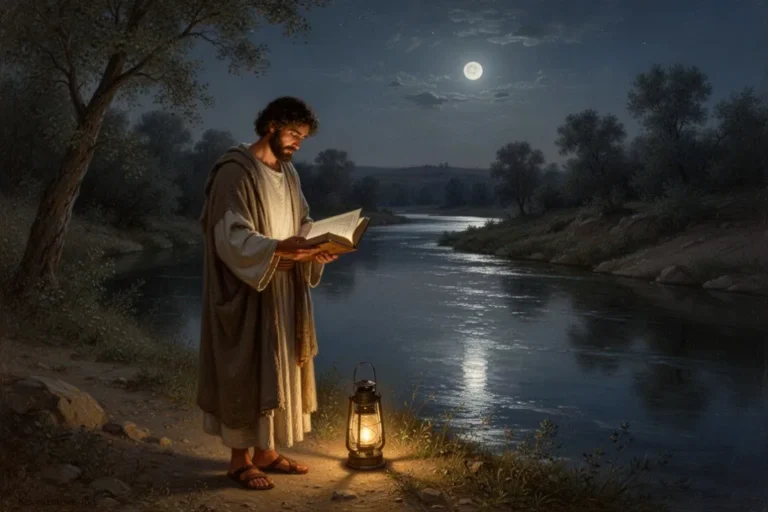
The biblical foundation appears in Genesis 32, where Jacob spends the night wrestling with a mysterious figure. The passage presents the encounter in deliberately complex terms: Jacob wrestles with a man, yet later understands the event as an encounter with God. He is injured, refuses to let go without a blessing, and receives a new name, Israel.
The account is not a simple lesson about winning a physical contest. Its force comes from the way conflict and blessing exist together. Jacob leaves wounded, changed, and marked by the encounter. His limp becomes a reminder that contact with the divine is not always comfortable or immediately reassuring.
Jacob’s earlier life helps explain why the scene matters. He has acted deceptively toward his brother Esau and later faces the consequences of that history. As he prepares to meet Esau, he is caught between fear, guilt, responsibility, and hope. The nighttime struggle can be read as an external expression of an inner crisis: Jacob must confront who he has been and who he may become.
The story suggests several meanings that help explain the modern phrase:
Persistence: Jacob holds on through uncertainty instead of leaving the encounter as soon as it becomes painful.
Transformation: He receives a new name, symbolizing a changed identity and a new stage of life.
Vulnerability: His injury shows that spiritual change may involve real loss, limitation, or humility.
Blessing through struggle: The encounter does not remove every problem, but it gives Jacob a different relationship to his future.
The name Israel is traditionally associated with striving or contending with God, though translations and interpretations vary. In that sense, “we who wrestle with God” describes people who stand in the same broad tradition: they question, resist, plead, listen, and continue seeking a blessing or a direction they cannot manufacture on their own.
Jacob’s story should not be used to romanticize every kind of suffering. Not every painful experience automatically makes a person wiser, and some wounds require practical help, protection, therapy, or medical care. The story is better understood as a picture of meaning-making under pressure, not as a command to remain in harmful situations.
What Jordan Peterson’s book explores
Jordan Peterson’s We Who Wrestle with God: Perceptions of the Divine examines biblical stories as sources of psychological, moral, and existential meaning. Peterson approaches the Bible not only as a religious text but also as a collection of narratives that have shaped Western ideas about good and evil, sacrifice, responsibility, order, and chaos.
The book’s central concern is how people perceive the divine and how those perceptions influence the way they live. Rather than treating biblical stories as detached historical material, Peterson looks at what the stories might reveal about human motives, social life, moral development, and the search for purpose. His approach draws on psychology, mythology, philosophy, and religious interpretation.
Readers should understand the book as an interpretive work rather than a neutral guide to biblical scholarship. Peterson offers a distinctive reading shaped by his long-standing interest in symbolic narratives and the psychological significance of religious tradition. People who want a detailed account of historical context, denominational theology, or the original languages of the Bible may need to read other kinds of books alongside it.
The book’s subject matter includes biblical stories involving creation, rebellion, suffering, sacrifice, and redemption. These stories raise questions such as:
How do human beings move from instinctive behavior toward moral responsibility?
Why do people sacrifice short-term comfort for a future good?
How should individuals respond to suffering that seems undeserved?
What happens when pride, resentment, or wishful thinking distort perception?
How can a person organize life around a purpose larger than immediate pleasure?
Peterson’s method often treats a biblical character or event as operating on several levels at once. A story may describe a relationship between people, symbolize a psychological conflict, and express a claim about the structure of reality. This layered reading is one reason the book appeals to readers who are interested in the connection between psychology and religion.
At the same time, the interpretation can be demanding. Peterson frequently moves between scriptural passages, philosophical ideas, clinical observations, and broad claims about civilization. Readers may find the connections illuminating, while others may want to examine whether a particular interpretation is supported by the text itself or reflects a modern psychological framework.
A careful reader can engage with the book in both ways: as a serious attempt to recover meaning from ancient stories and as an argument that deserves questions. You do not have to accept every interpretation to benefit from asking what a story reveals about your own assumptions, habits, fears, and responsibilities.
Why biblical wrestling still matters in ordinary life
Questions about God rarely stay inside a church, synagogue, study group, or private prayer. They appear when you decide whether to tell the truth at a cost, care for a difficult family member, respond to injustice, or begin again after failure. The phrase matters because it connects spiritual belief with daily conduct.
Consider a person who has been promoted at work but feels tempted to take credit for a colleague’s contribution. The issue is not simply whether that person can quote a moral rule. The deeper question is what kind of person they are becoming and what they are willing to sacrifice for status. A religious story can turn an ordinary workplace choice into a question about character and accountability.
Or consider someone caring for an aging parent. They may be grateful, exhausted, resentful, and ashamed of the resentment. A simplistic answer about faith may make the burden heavier. A more honest spiritual approach allows the person to acknowledge conflicting emotions while still asking what love, duty, and reasonable limits require.
Wrestling can also occur after a major success. A person may achieve financial security or public recognition and then discover that success has not answered the question of what life is for. This kind of crisis is not always a rejection of God. It may be the beginning of a more serious search for purpose beyond achievement.
Religious stories can help because they present human beings as mixed rather than perfectly consistent. Jacob is not introduced as a flawless hero. His story includes deception, fear, family conflict, courage, and transformation. That complexity gives readers room to examine their own lives without pretending that moral growth begins only after every weakness has disappeared.
Wrestling with God may take several practical forms:
Ask the difficult question precisely. Replace “Why is everything wrong?” with a clearer question such as “What do I believe about suffering?” or “What responsibility do I have here?”
Separate experience from interpretation. Feeling abandoned does not prove that you are abandoned, but the feeling still deserves attention and care.
Read slowly. Work through a short biblical passage, noting what it says, what it leaves unresolved, and what assumptions you bring to it.
Discuss the question with trustworthy people. A thoughtful religious leader, counselor, friend, or study group can help you see where fear or resentment may be shaping your conclusions.
Connect belief to action. Ask what your developing convictions require you to do toward another person, not only what they require you to think.
This process does not guarantee a satisfying answer. Its value may lie in helping you become more truthful, patient, responsible, and attentive. The biblical pattern often points toward faithful action before total certainty: Jacob moves toward his brother even though fear remains, and his transformation is shown through what follows the night struggle.
How to read the phrase without oversimplifying it
“Wrestling with God” can be used in ways that are too vague. If every disagreement, frustration, or bad mood is called a spiritual struggle, the phrase loses its depth. A serious struggle usually involves a question that reaches beneath preference and touches identity, meaning, morality, or ultimate reality.
It is also easy to assume that all wrestling must end in a particular kind of certainty. Some people expect a dramatic conversion, a clear sign, or a final answer. Others assume that unresolved questions prove faith has failed. The biblical material is more complicated. It often leaves tension in place while showing a person becoming more honest or more responsible.
The phrase should not be used to pressure someone into accepting an answer they are not ready to accept. Grief, trauma, abuse, depression, and religious doubt can require patient support rather than quick spiritual explanations. If questions about God are accompanied by persistent hopelessness, anxiety, or thoughts of self-harm, professional mental health support is appropriate. Spiritual reflection and clinical care can exist together.
A useful boundary: A spiritual struggle may deepen your understanding, but it should not be used to excuse cruelty, reject needed treatment, or keep you in danger. Seeking help can be an expression of wisdom rather than a failure of faith.
It also helps to distinguish criticism of religion from contempt for religious people. You may object to a doctrine, institution, or interpretation while still recognizing the sincerity and value that faith has brought to others. Likewise, a believer can question a religious community without abandoning every spiritual conviction.
For readers approaching Peterson’s book, this distinction is especially useful. You can appreciate its attention to biblical symbolism while checking its claims against the biblical passages, historical scholarship, and other theological perspectives. Reading critically does not require reading dismissively. It means allowing an interpretation to challenge you while retaining responsibility for your own judgment.
The strongest gift of the phrase is permission to be honest. You do not need to disguise anger as serenity or certainty as faith. You can say that a teaching troubles you, that suffering has changed your belief, or that prayer feels empty. Such honesty is not automatically disrespectful; in many religious traditions, lament and complaint are part of the relationship with God.
The phrase also offers a picture of growth that is less polished than instant clarity. Jacob does not leave the night unchanged in every respect. He is still the same person with a difficult past, but he carries a new name and a new awareness. This suggests that spiritual development is often gradual, expressed through repeated choices rather than one permanent emotional experience.
For someone who is unsure what they believe, a useful starting point is not to force a label. Instead, examine the questions that have the greatest practical importance. What do you consider sacred? What do you owe other people? What kind of suffering can you endure without becoming cruel? What would genuine repentance, courage, or love look like this week?
For someone who already believes, wrestling can guard against shallow certainty. It can expose beliefs adopted only from habit and invite a more mature faith. The aim is not to manufacture doubt, but to let sincere questions remove exaggeration, fear, and borrowed language from your understanding.
For someone who rejects religion, the phrase can still be meaningful as a description of confrontation with ultimate questions. You may wrestle with mortality, justice, consciousness, evil, or the limits of human knowledge without believing in a personal God. The language remains useful because it identifies a struggle with realities that cannot be reduced to convenience or personal preference.
“We who wrestle with God” therefore names both a biblical inheritance and a modern human experience. It points to Jacob’s night encounter, to Peterson’s attempt to interpret divine symbolism, and to the questions that arise whenever a person tries to live responsibly in a world that contains beauty, suffering, freedom, and uncertainty.
Frequently asked questions
Is “we who wrestle with God” a Bible verse?
No. It is not a direct Bible verse. The phrase is based mainly on Jacob’s struggle in Genesis 32, where Jacob wrestles with a mysterious figure and receives the name Israel. Modern writers use the wording to describe the broader experience of questioning, resisting, seeking, and changing through an encounter with God or with ultimate questions.
What is Jordan Peterson’s book We Who Wrestle with God about?
Jordan Peterson’s book examines biblical stories as sources of psychological, moral, and existential meaning. It considers themes such as sacrifice, responsibility, suffering, rebellion, order, and redemption. Peterson reads these narratives through psychology, mythology, philosophy, and religious interpretation, so the book is best approached as a distinctive interpretive work rather than a neutral survey of biblical scholarship.
Does wrestling with God mean that someone has lost their faith?
Not necessarily. A person may question God while still praying, reading scripture, attending worship, or trying to live according to religious values. Doubt can challenge weak assumptions and lead to deeper convictions. It can also lead someone away from belief. The outcome differs from person to person; the phrase describes the struggle rather than guaranteeing its result.
How can I explore spiritual doubts in a healthy way?
Write down the specific question instead of treating all distress as one problem. Read relevant religious texts slowly, speak with someone thoughtful and trustworthy, and allow time for uncertainty. If doubt is connected with trauma, severe anxiety, depression, or thoughts of self-harm, include a qualified mental health professional. Spiritual counsel and clinical support can work together.




Leave a Reply