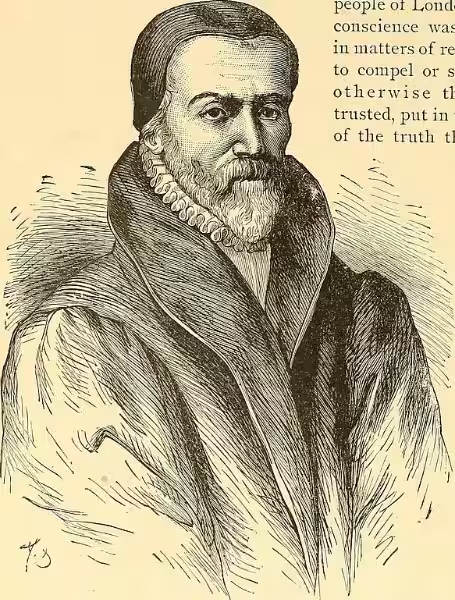
The desire for accessible scripture has driven religious movements throughout history, and the Tyndale Bible stands as a pivotal moment in this ongoing quest. While the Bible had been translated into English before, William Tyndale’s work was groundbreaking for its approach and ultimately, its profound impact on the English language and Protestant Reformation. His translations didn’t simply render Latin into English; they fostered a new understanding and accessibility of the word of God.
Imagine a world where religious texts were only available in ancient languages, understood by a select few. The Tyndale Bible, in contrast, aimed to democratize access to scripture. Tyndale’s translation, driven by a deep-seated belief in the importance of direct engagement with the divine word, was a challenge to the established religious hierarchy that controlled access to the Bible. This desire for a more straightforward, English text fueled his entire translation project and led to his persecution.
Tyndale’s Translation: A Deeper Dive into the Process
Tyndale’s translation was not a simple substitution of words. He meticulously studied the original languages, Hebrew and Greek, using the best resources available at the time. This dedication to accuracy paved the way for future translations. Crucially, Tyndale sought to translate directly from the source text, without relying on existing Latin translations. This approach, while revolutionary, made him a target. He was concerned with the nuances of the original languages, the context, and how these details could shape a modern understanding. This is a powerful example of how a translator’s commitment to the source material can profoundly affect the final product.
His work wasn’t just about transforming words; it was about democratizing access to divine truth. Tyndale’s translation reflected a new understanding of the Bible, one that emphasized individual connection with God, rather than relying solely on the interpretation of religious authorities. He used concepts like “grace,” “faith,” and “repentance” in ways that resonated with the everyday person. This, in essence, was a powerful catalyst for the English Reformation.
The Tyndale Bible and the Protestant Reformation
Tyndale’s translations were integral to the Protestant Reformation. His work became a crucial tool in challenging the authority of the Catholic Church and promoting a more personal relationship with God. Tyndale’s willingness to challenge established interpretations of religious texts was essential in fostering the theological and social shifts of the Reformation. This revolutionary approach directly challenged the Church’s monopoly on religious interpretation. By empowering individuals to read and understand scripture for themselves, Tyndale seeded the seeds of a spiritual awakening.
The impact extended beyond theology. The Tyndale Bible, despite facing severe censorship, fostered a new relationship between the common person and religious texts. Tyndale’s work exemplified the concept of individual interpretation, and it helped pave the way for the development of a uniquely English vernacular. The printing press, a relatively new invention at the time, played a crucial role in disseminating Tyndale’s work. This allowed for mass production of these materials, making them accessible to a wider audience. This contributed to the development of a stronger sense of English national identity.
The Tyndale Bible’s Legacy: A Continued Influence
The Tyndale Bible, though not without its flaws and limitations for modern readers, stands as a monumental achievement in the history of translation. Tyndale’s legacy extends beyond the Reformation. His commitment to accuracy and accessibility continues to inspire translators to this day. His influence on later translations is clear and evident. Think of the King James Version, the New International Version, and many more. These later versions, in turn, have influenced generations of people in their understanding and interpretation of scripture.
Tyndale’s work is a testament to the power of language and the importance of connecting with religious texts on a deeply personal level. His willingness to challenge the status quo and his unwavering commitment to the translation of scripture set a precedent that continues to resonate in the religious world. His commitment to accurately translating the Hebrew and Greek was his final contribution to the English language. Consider how this commitment to the original texts and the power of the spoken word continues to affect us today. Without Tyndale’s vision, our understanding of the Bible might be drastically different.
Frequently Asked Questions
What is the Tyndale Bible?
The Tyndale Bible is a translation of the Bible into English, primarily by William Tyndale, during the early 16th century. It was influential in the development of the King James Version and other English translations.
Why is the Tyndale Bible important?
Tyndale’s translation was significant because it made the Bible accessible to the English-speaking public for the first time. His work challenged the authority of the Catholic Church, who opposed the translation, and encouraged the growth of Protestantism in England.
What are some key characteristics of the Tyndale Bible?
Tyndale’s translation is known for its accuracy and readability, despite being subject to censorship and persecution. He made significant translation choices that influenced later versions, paving the way for more accessible texts in English.
What is religion?
Religion is a complex system of beliefs, values, and practices concerning the spiritual or supernatural realm. It often involves rituals, ceremonies, and a community of believers.
Major religions include Christianity, Islam, Judaism, Hinduism, and Buddhism, among others. Each has its own unique doctrines, scriptures, and traditions.
How does religion influence society?
Religion profoundly impacts societies through moral codes, ethical guidelines, and social structures. It can shape cultural practices, art, and political systems, often playing a role in community building and conflict.
Is religion necessary for a meaningful life?
Whether religion is necessary for a meaningful life is a matter of individual belief. Many find meaning and purpose within their faith, while others derive it from other sources, like philosophy, relationships, or personal values.